

"There is no will to do justice in cases of sexual violence against indigenous women."
Most cases go unreported due to a lack of institutional guarantees, says Lejandrina Pastor Gil, a member of the Wiwa people and advisor on women, family and generation at the National Indigenous Organization of Colombia (ONIC).

Share

By: Pompilio Peña Montoya/ We Remember *
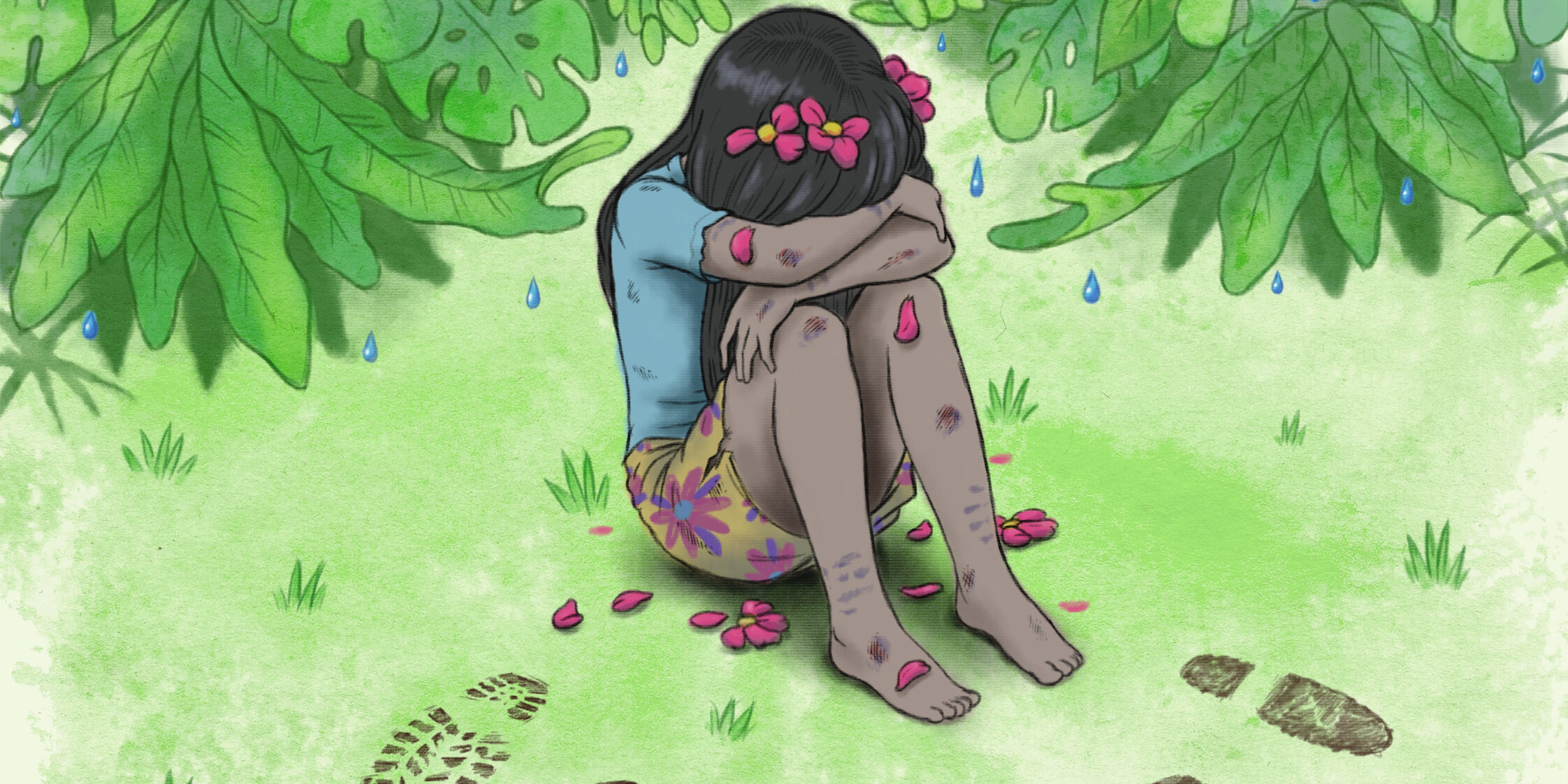
Illustration : Didier Pulgarín
Between January 1 and May 31, 2020, 118 Indigenous women were victims of sexual violence in Colombia, according to data from the National Institute of Legal Medicine. This figure was released after media reports of the rape of an Emberá Chamí girl by seven soldiers from the San Mateo Battalion, attached to the Eighth Brigade of the Army, in the municipality of Pueblo Rico, Risaralda, on June 21. See: 118 cases of sexual violence against women from Indigenous communities under investigation
According to Lejandrina Pastor Gil, a member of the Wiwa people and advisor for women, family and generation at the National Indigenous Organization of Colombia (ONIC), this is just one case of hundreds, most of them silenced due to a lack of institutional guarantees.
Hacemos Memoria spoke with Lejandrina to learn about the landscape of sexual violence against Indigenous peoples in Colombia. In the interview, the leader revealed that when Indigenous communities and organizations seek justice in cases of sexual abuse involving military personnel or priests, they encounter difficulties.
What difficulties do you encounter in dealing with cases of sexual abuse against indigenous women?
I've been working on the ONIC (National Indigenous Organization of Colombia) board for three years. When I started, I found some work on violence against women. Then there was a resolution issued by the organization's authorities stating that, since 2015, they had been calling for this topic to be addressed with great seriousness and depth. However, something worried me: the issue of Indigenous women was misplaced across all state institutions, without unity or order. For example, I remember that we went to the Forensic Medicine Institute to coordinate our work and found that they didn't have the Indigenous variable properly categorized. Then we asked the Prosecutor's Office which of the 115 ancestral peoples had the highest rate of violence against Indigenous women and children, and we found that they didn't have that information; they had cases, but there was no clarity on which people they belonged to. We were even mixed up with the cases from Afro-Colombian communities.
What I want to emphasize is that if we aren't properly categorized within state institutions, then there's no will to achieve justice, and we'll never know the exact figures for sexual violence. This is the main weakness we want to overcome. So much so that, for the Women, Family, and Generation pillar of the National Development Plan, we demanded consultations in the territories to collaboratively design and implement campaigns aimed at reducing violence against women. Look where we are now, and we haven't even started that work, still waiting for a response from the state. It makes you think there's no will. Only this year did the authorities tell us that La Guajira is the department with the highest number of cases of abused women. That's why we're now looking at what strategies to adopt. It's very difficult, but we're going to move forward despite the challenges brought on by the pandemic.
Now, when an act of sexual violence, or any other type of violence, occurs within the community—that is, when the perpetrator is a member of the community—punishment is carried out; our justice system is applied. But if the perpetrator is someone from outside the community, we have to wait three, four, five, or even nine years for the legal proceedings to move forward.
Is there no government commission that deals with cases of violence against indigenous women in order to facilitate these types of cases?
In one of our last meetings with the Ministry of the Interior, other ministries, and the High Commissioner for Human Rights, we set about establishing a commission for Indigenous women, but no one wanted to take responsibility. There was someone in charge of health issues, and another for education, but no one wanted to get involved with women. After three hours of discussion, everyone walked out. This was a way of further violating and disenfranchising us.
Which departments are most affected by this type of violence?
This year, violence against women has skyrocketed. The departments with the highest rates are La Guajira, Chocó, Atlántico, Bolívar, and Guaviare. I believe that's why the issue of the alleged sale of Wayúu women in La Guajira became visible on social media, an issue that we at ONIC (National Indigenous Organization of Colombia) condemn and demanded be investigated. The worst part is that many didn't see this behavior as violent or reprehensible. So we ask ourselves, what do you call that? Furthermore, in Chocó, the Emberá are the Indigenous communities that have suffered the most due to the complexity of the conflict in their territory. And in Guaviare, alarms have been raised regarding the Nukak women, who have suffered the armed conflict for years. There are known cases of minors being raped and exploited by soldiers.
Do you have mechanisms in place to disseminate preventative information on violence against women?
Since we don't have strong support from the state, we rely on our own mechanisms, albeit somewhat precarious ones. When we want to disseminate information about violence against women, we ask colleagues who have media outlets near our territories to broadcast our campaigns. All these issues related to abuse are difficult to communicate, partly due to language barriers.
And why don't they publicize their complaints through the mainstream media?
The media is another matter entirely, one that deserves its own chapter, since some outlets are unwilling to address specific issues concerning Indigenous women. Previously, they claimed Indigenous people were rapists, and for a long time, the country was left with that image. And when we tried to publicize cases involving people from outside the community, they weren't interested.
We have zero tolerance for acts of violence against women and children in our communities, which is why we have strengthened our own justice processes and, where possible, provide spiritual and cultural support to those women whose rights have been violated.
*This article was written as part of an information alliance for the Journalism and Memory Network, between Hacemos Memoria of the University of Antioquia and Agencia Presente
We are present
We are committed to journalism that delves into the territories and conducts thorough investigations, combined with new technologies and narrative formats. We want the protagonists, their stories, and their struggles to be present.
SUPPORT US

FOLLOW US
Related notes

We are present
This and other stories are not usually on the media agenda. Together we can bring them to light.