

13 LGBT+ people murdered in the Colombian Caribbean during quarantine
This week, the list of LGBT+ victims on Colombia's Caribbean coast continued to grow with the death of a 29-year-old Venezuelan trans migrant and a hearing-impaired gay man who was shot dead.

Share

This week, the list of LGBT+ victims on Colombia's Caribbean coast continued to grow with the death of a 29-year-old Venezuelan trans migrant and a hearing-impaired gay man who was shot dead.
By Pompilio Peña Montoya – We Remember *
A light inside a house caught the attention of a neighborhood watchman in Soledad, on Colombia's Caribbean coast, in the department of Atlántico. It was two hours before dawn on Wednesday, July 22, and the streets were deserted. Through the window, the man's gaze swept the walls until his eyes suddenly fell upon the lifeless body of Gabriela, a 29-year-old trans woman and Venezuelan migrant. What happened is still unclear, and conflicting accounts exist. Some believe she took her own life by hanging herself with a sheet. Others are suspicious, wondering if she was coerced into doing it, and are demanding a judicial investigation in an area with documented discrimination and violence against LGBTQ+ people.
Gaby, as her friends called her, was a stylist by profession. Her neighbors describe her as a reserved and kind person. Wilson Castañeda, director of Caribe Afirmativo—an organization that defends the human rights of the Lesbian, Gay, Bisexual, Transgender, and Intersex (LGBTI) community—doesn't believe it was a simple suicide. He has therefore asked judicial authorities to investigate what happened behind the scenes, as there is a possibility that she was coerced into taking her own life or that it was a homicide.
According to Castañeda, what is known about the events leading up to Gabriela's death is that she had argued with a man who visited her at her home. And that, apparently, he had also threatened her.
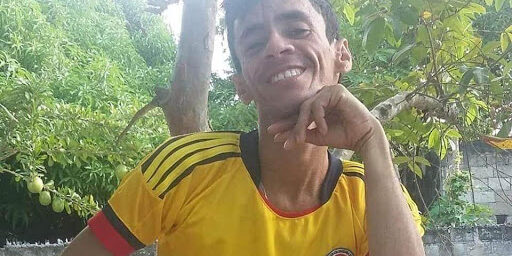
Days before Gabriela's death, in another part of the Caribbean coast, Jhony Menco Galvis, a gay man, was murdered by hitmen. They entered his home, located in the neighboring municipality of Magangué, in the department of Bolívar, and shot him three times, according to police reports. The crime occurred on July 18 at 11:00 p.m. while Jhony was socializing with some neighbors, despite the curfew imposed by authorities to prevent the spread of the coronavirus.
Edwin Castañeda, a friend of the victim, told Hacemos Memoria that Jhony, who was deaf and mute from birth, was very well-loved in the community. He participated in neighborhood activities, provided cleaning services in homes, and was often asked to help out at parties as a kitchen assistant.
“He was just over 40 years old, and we never knew of any threats against him. He was very cheerful and active. He lived very humbly with his mother in the Santa Rita neighborhood, known in Magangué as one of the most dangerous. What his friends told us is that the attack wasn't meant for him, which means the hitmen must have targeted the wrong person,” stated Edwin Castañeda, an LGBTI leader.
As with Gaby's case, at the time of writing, Jhony's murder remains unsolved , with no arrests and no suspects. In fact, according to Wilson Castañeda, impunity for the murders of LGBTI individuals hovers around 80 percent .
Crime on the rise

This year, murders of LGBTI people have increased in the Colombian Caribbean, particularly in the Urabá region of Antioquia and the department of La Guajira. According to data from the Caribe Afirmativo , 19 LGBTI+ people were murdered in this region between January 1 and July 23, 2020. This figure is two higher than the total number of victims reported in 2019, when the organization recorded 17 murders.
“Of the 19 murders recorded in 2020, 13 occurred within the framework of the social isolation decreed by the Government to combat the COVID-19 pandemic. And ten of them were committed in the victims' homes,” Castañeda stated.
The LGBTI rights advocate added that although “historically this type of homicidal violence has mostly affected gay men and trans women, this year, in the Caribbean region, we have seen an increase in violence against lesbian women , something that was previously uncommon.”
According to Castañeda, the municipalities with the highest number of cases are Barranquilla with seven murders and Valledupar with four.
*This article was written as part of an information alliance for the Journalism and Memory Network, between Hacemos Memoria of the University of Antioquia and Agencia Presentes.
We are present
We are committed to journalism that delves into the territories and conducts thorough investigations, combined with new technologies and narrative formats. We want the protagonists, their stories, and their struggles to be present.
SUPPORT US

FOLLOW US
Related notes


We are present
This and other stories are not usually on the media agenda. Together we can bring them to light.