

Paraguayan Navy kidnapped and tortured 35 people, including 3 trans women
35 people were deprived of their freedom and tortured by Navy officials in Ciudad del Este.

Share

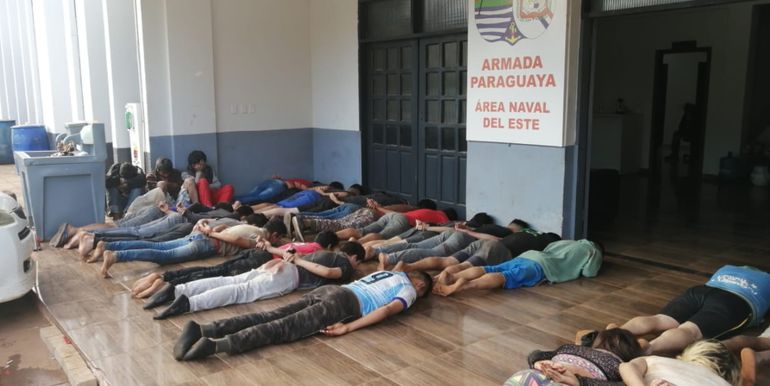
Photos and videos of lacerated backs and bruises on the bodies of young people and older adults circulated on Paraguayan Facebook profiles and WhatsApp groups starting Thursday night. These are the 35 people who were detained by Navy officials in Ciudad del Este, allegedly as suspects in the murder of a non-commissioned officer during an armed confrontation last Wednesday. Among those detained, kidnapped, and tortured were three transgender women.
They were told to look at the ground so their faces wouldn't be identified. Cris, Sadis, and R, the only trans women, were harassed and told they wouldn't survive. “Without any explanation, they were also arrested because they aren't smugglers; they are sex workers who were at home. They were taken away to be mocked and tortured. They said they were going to cut their hair so they would 'be men again.' Their only sin was being transgender,” said Franchesca Galatti, an activist with Panambi in Ciudad del Este.
Volunteers from Somos Gay in Ciudad del Este delivered food and medicine to them on Friday. Thirty-three people were released, and two remain in custody without sufficient evidence. To date, no military personnel have been charged. The Panambi Association condemned the military's actions and reiterated its demand that the State investigate the violence against transgender people and the 62 transfemicides reported during the democratic transition.
Military personnel in the early morning
Near the Paraná River, in the San Miguel neighborhood of Ciudad del Este (CDE), a shootout erupted last Wednesday between a group of suspected smugglers and members of the Paraguayan Navy. The Navy issued a statement to local media that Marcos Gabriel Agüero, a 22-year-old sailor, was wounded in the approximately 15-minute gun battle and died on Thursday. However, the statement made no mention of allegations of torture and arbitrary arrests.
The victims' accounts agree that on Wednesday night, the 15th, around midnight, while several neighbors were asleep, soldiers entered the houses, broke down the doors, and arbitrarily abducted 35 people from their homes, taking them to the Paraguayan Navy base. The closed-circuit television footage clearly shows the moment the soldiers dragged, beat, and threw the detainees into the van.
“It was terrifying. It was midnight and we were about to go to sleep. We heard noises, went outside to look, and saw them (the soldiers) walk by. We locked ourselves in our rooms and each of us went to bed. That's when they came in and kicked down the door. There were about 12 or 15 soldiers. They dragged us out of the house by our hair, all three of us. They put us in a van, like dogs or garbage bags, and took us to the naval base. That's where our ordeal began,” Sadis López Armoa told Presentes.
A 12-hour torture
The transfer was covert. They hid the girls' bodies with merchandise, and the soldiers sat on top of them. "They fired into the air and held their weapons upside down and burned us because they knew there were people underneath," Sadis continued . Some victims alleged that all 35 people were tortured and left with marks of violence and torture. One of them had hot water and alcohol poured on their head, another was beaten by four soldiers in a bathroom.
Between midnight and 2 p.m., the victims' families didn't know where they had been taken. “All that time they kept us face down on the floor; we could barely breathe. They tortured us, beating us with clubs, sticks, and thick ropes like the ones used to tie boats together. They told us they were going to force us to be men, that we shouldn't be like this. Everyone heard it,” Sadis recounted.
The photos and videos of the three women were the last to surface, but they show injuries not only on their backs but also on their abdomens and legs. According to them, they managed to get the soldiers to stop kicking R when they told them she had been in an accident a few days earlier and had an open wound. “It’s sad how they made them suffer. They told me they put a small piece of wood between her toes and then stepped on it. Those methods were used during the dictatorship,” Franchesca emphasized.
Blanca Segovia, the Ombudsman's delegate in Alto Paraná, accompanied the minors from Thursday at noon. She tried to go to the naval base earlier, but the military prohibited entry to anyone, including private citizens and lawyers, starting at 9:00 a.m. It wasn't until after noon that they went to the Public Prosecutor's office, where she was finally able to make contact with them. They had been held incommunicado all morning.
“The paraffin test”
According to Segovia, at 5:00 a.m., the military administered a nitrate and nitrite test to the victims, also known as the "paraffin test," which is used to identify gunpowder residue, to see if any of them had fired a weapon. "There are three major complaints: the torture inside the compound, the paraffin test administered by the military without the presence of the Public Prosecutor's Office, and the intimidation they suffered during the transfer from the naval base to the Public Prosecutor's Office," the lawyer maintains.
“Just as they were about to cut our hair, the prosecutor’s office arrived. Only then could we breathe properly. We were worried because it was already night again. If they didn’t come, we felt that those same people who had tortured us could do anything to us again ,” Sadis recounted. Lawyer and social activist Yolanda Paredes accompanied R’s statement and believes that the people who were detained do not fit the profile of the person the military was looking for.
“If there is any kind of confrontation, the military can enter the water up to 50 meters inland because they have river police authority, but that's only on water. That day they entered 200 meters. They forbade the police from getting involved, they stormed into people's homes, broke down doors, and kidnapped people from their beds—children, the elderly, and transgender people. Everyone agrees on the aggression of those who acted,” Paredes explained, adding that the prosecutor's office supposedly seized two weapons: a rifle and a shotgun, but the bullet that killed the soldier was of a large caliber.
No military personnel were charged
Starting at 2:00 p.m. on Thursday, Navy personnel took the detainees to the Prosecutor's Office to give statements and subjected them to medical examinations. Prosecutor Hermenegilda Cubilla of Unit 1, the ordinary prison in Ciudad del Este, opened a case file to investigate the torture. In an interview with Presentes, she said she only became aware of the case at 5:30 p.m. "At that time, we were informed that a case had been filed with us. We called the forensic doctor, Dr. Hugo Céspedes, and he personally examined 22 adults and 6 minors," she stated. The following day, Prosecutor Alberto González arrived from Asunción.
The Ombudsman's representative accompanied the detainees to the Prosecutor's Office and confirmed that they were five minors between the ages of 14 and 17: four boys and one 17-year-old girl. “They were all beaten, and the minors clearly showed signs of violence. The soldiers involved must be investigated. As human rights advocates, we are completely against any type of violation and will follow up on this case. At least these 33 people have now been released,” she emphasized.
At midnight, after the preliminary hearing at the prosecutor's office, Franchesca took her three companions to the Trauma Hospital. “According to them, the soldiers were under the influence of alcohol, drinking, mocking them, and hitting them, as well as the men who were there. They had them tied up face down so their faces couldn't be seen. They were like that for hours and hours. Furthermore, they stole what little they had of value, like money and jewelry.”
A historic dispute
Smuggling in that border region has a history spanning several decades. It is linked to the very way of life in Ciudad del Este and Presidente Franco. This illegal border trade has always involved the Navy. This is explained by Jorge Rolón Luna, a lawyer, human rights professor, and former commissioner of the National Mechanism for the Prevention of Torture.
Since the Stroessner dictatorship, the Navy controlled and participated in smuggling operations along the river, whether on the border with Argentina or Brazil. This is part of a long-standing trade network linked to the fact that dictator Stroessner assigned these waterway trade operations to naval personnel.
“What is known is that they broke into private homes without a search warrant, and arrested people without an arrest warrant. There is sufficient evidence, and this is not denied, that these people were tortured . They were subjected to a brutal beating from the moment they were detained—they cannot arrest or detain anyone—until, according to testimonies, even at the naval base where they remained detained throughout that day—something that is also illegal,” he described.
In the Paraguayan legal system, torture is absolutely prohibited. This constitutes a crime. “The military personnel at the Ciudad del Este naval base wield considerable power. They are a kind of state within a state, operating completely outside the law. And civil institutions like the public prosecutor's office and the judiciary submit to this de facto power. We need to see how this develops, whether these individuals remain in custody, and what those indictments say,” Rolón Luna concludes.
]]>We are present
We are committed to journalism that delves into the territories and conducts thorough investigations, combined with new technologies and narrative formats. We want the protagonists, their stories, and their struggles to be present.
SUPPORT US

FOLLOW US
Related notes

We are present
This and other stories are not usually on the media agenda. Together we can bring them to light.