

10 milestones of marriage equality in Argentina, 10 years after its enactment
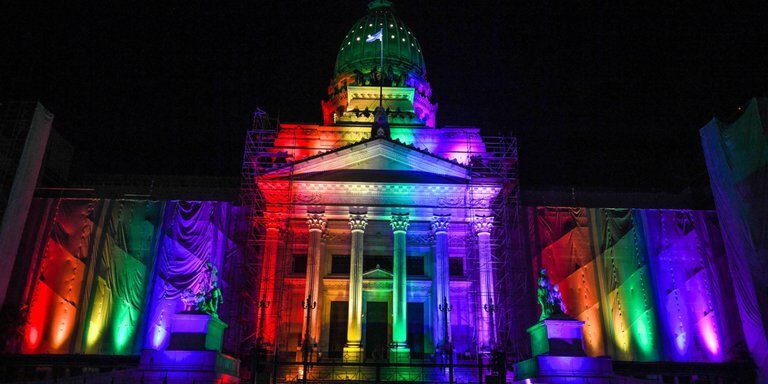
It was decades of struggle and more than 15 hours of debate in the Senate with a packed square in front of Congress that erupted in celebration.

Share

In the early 1990s, activist Carlos Jáuregui, from the Gays for Civil Rights Association, sought to pass a civil marriage bill, but it failed. In 2002, the Buenos Aires City Legislature approved a Civil Union bill presented by the Argentine Homosexual Community (CHA). César Cigliutti and Marcelo Suntheim (President and Secretary of the CHA) were the first to enter into a civil union.
In 2009, Representatives Vilma Ibarra (Popular and Social Encounter) and Silvia Augsburguer (Socialist Party) introduced a bill for Equal Marriage, developed in collaboration with activists and LGBTQ+ organizations. It received preliminary approval in the Chamber of Deputies on May 5th.
The Argentine Federation of Lesbians, Gays, Bisexuals, and Transgender People (FALGBT) was one of the organizations involved in creating that bill. While it was awaiting Senate approval, in November 2009, Judge Gabriela Seijas of Buenos Aires declared unconstitutional the articles of the Civil Code that prohibited same-sex marriage.
On December 1, FALGBT activists Alex Freyre and José María Di Bello attempted to marry, but a court order from Judge Marta Gómez Alsina prevented it. They finally married on December 28 in Tierra del Fuego, becoming the first same-sex couple to marry in Latin America and the Caribbean.
1. First gay marriages
In December, an event was held at the Paco Urondo Cultural Center to commemorate this historical event, celebrate what has been achieved, and reflect on all that remains to be done:
On April 15, 2010, Martín Canevaro, an activist with 100% Diversity and Rights, married Carlos Álvarez of the Xangó Group. They were also able to do so thanks to a ruling by the Buenos Aires courts.
2- The first lesbian marriage
In April 2010, the first lesbians to get married were the iconic activists Norma Castillo and Ramona “Cachita” Arévalo, who passed away in 2018:
3. Faggot!
On June 1, 2010, the theater director, playwright and actor Pepito Cibrián Campoy, as part of the voices in favor, read in the Senate debate the text by Federico García Lorca: 'Marica'.
4. The March Against
Catholic and Evangelical groups gathered in front of the National Congress with signs demanding, “Children have the right to a father and a mother.” Among those present were testimonies such as: “I’m not against gay people, not at all, I just think it’s unnatural. How can a child understand that their father or mother’s name is Carlos? It doesn’t exist.”
5. The Vigil in front of Congress
It began on the 14th and lasted more than 15 hours until the sanction:
6. Conscientious objections
During the session, senators expressed conflicting viewpoints. When Senator Liliana Negre de Alonso spoke of 'conscientious objection,' Senator Miguel Ángel Pichetto responded: "That's more characteristic of Nazi Germany than a democratic state."
7. "They're going to take our boys away"
Senator Hilda “Chiche” Duhalde, in her speech, addressed the issue as a “fight between the government and the church.” She considered it a rushed process and questioned, “If it’s about accepting, then let’s accept everything that comes our way.” And while she said that we shouldn’t question a man’s or a woman’s sexual orientation, she warned that with this law, “they would come and take our children away.”
8. But finally: IT BECAME LAW
9. Yes, I want to
The first marriage took place in the city of Frías, Santiago del Estero. José Luis David Navarro and Miguel Ángel Calefato exchanged vows on July 30, 2010.
In the Autonomous City of Buenos Aires, the first couple to marry were Ernesto Larresse and Alejandro Vannelli.
10. Cristina enacted it
On July 21, 2010, President Cristina Fernández de Kirchner, in an event at the Casa Rosada, enacted the Equal Marriage Law.
Then, in 2011, during the opening of the legislative sessions, the re-elected president said: “ The Equal Marriage Law gave back rights that Argentinians didn't have . Those who didn't share this view should feel proud, not upset. Did you see that nothing happened? Did you see that no one was forced to marry? That everyone continues to make their own choice freely.”
We are present
We are committed to journalism that delves into the territories and conducts thorough investigations, combined with new technologies and narrative formats. We want the protagonists, their stories, and their struggles to be present.
SUPPORT US

FOLLOW US
Related notes
We are present
This and other stories are not usually on the media agenda. Together we can bring them to light.