

First signs of coming out: A chapter in the biography of Carlos Jáuregui
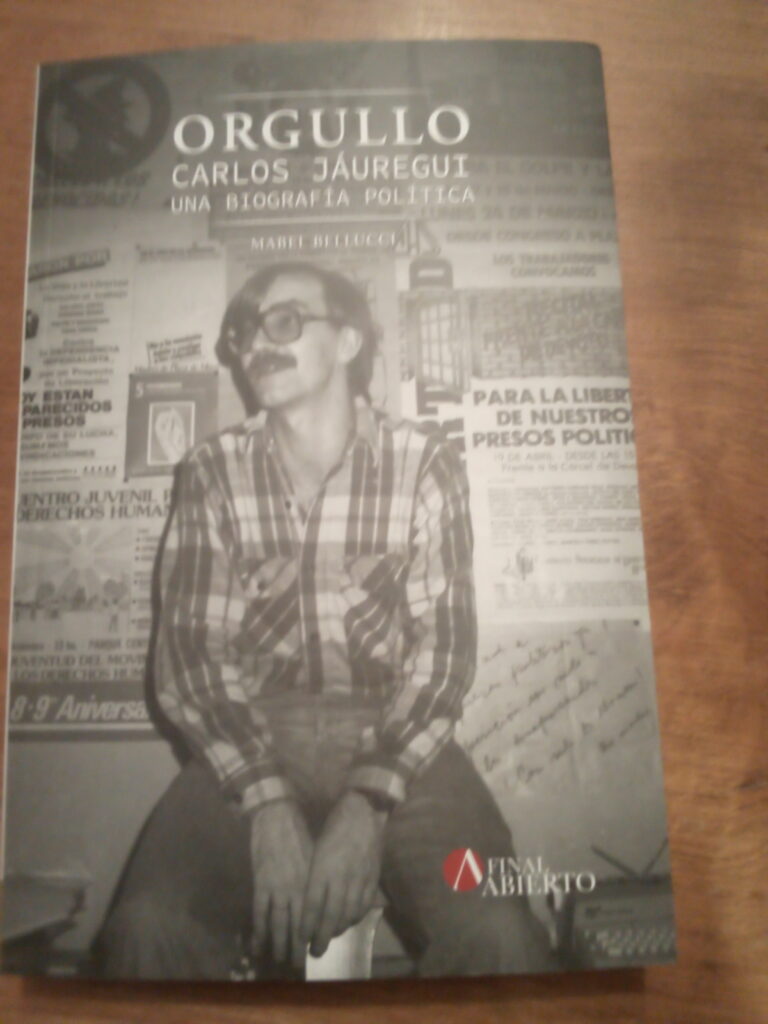
"Pride: Carlos Jáuregui. A Political Biography" by Mabel Bellucci has been reissued. We share an excerpt about the context of sexual rights at the beginning of democracy.


Share

With these signs of the end of the horror, the so-called democratic spring began to make its preliminaries from 1983 until the end of 1986. This period is also known as the unveiling, a name in the image and likeness of the process opened in Spain from the death of Generalissimo Franco, in 1975, with the Moncloa Pact.
The democratic spring unveiled a gray, somber social and cultural landscape, a legacy of boots and concentration camps. During those early years, social engagement with politics was eloquent: on television, on the radio, in the print media. The emerging cultural productions explored a distinct identity, accompanied by an explicit complicity from their followers, who multiplied like bubbles. Cultural agendas and customs began to open up in accordance with the new need for visibility and the reclamation of public spaces. Thus, a seemingly lost illusion was recovered: enjoyment and celebration were possible again. Love hotels reappeared, along with daring clothing, bodies eager to be seen, an underground , gay bars , [1] couples cuddling in the streets. In those days, political mobilizations were commonplace: the Mothers' Thursday marches in the Plaza de Mayo; Marches in support of Nicaragua and Cuba, dozens of events for the freedom of political prisoners, feminist and women's demonstrations. The universities were buzzing with student activists, and spontaneous assemblies were forming in every bar.
With Pandora's box opened, themes related to the subordination of women were promoted by feminist dance groups, which replicated the debates and events taking place in other parts of Latin America, Italy, and France. From 1984 onward, women entered print, radio, and television media, as well as theater and film. This created a climate conducive to the initiation and visibility of singular events on the local agenda, linked to new artistic and lifestyle styles. Post-Franco Spain discovered that after a long dictatorship, it was time to address taboo subjects: homosexuals, women, and the marginalized [2] . Dissenting magazines appeared, similar to the Spanish magazine El Viejo Topo —many with an alternative style, others commercial. Initially, they operated within a restricted circuit. The arrival of exiled writers and the development of human rights and cultural movements that promoted democratic opening found a platform there. It was a conflictive period due to the tension between the new and the old.
The early 1980s were a chaotic mix of trends and figures who interacted, mostly outside the established order. Veterans of alternative culture acknowledge that the end of the dictatorship was the best moment of the democratic era due to that compelling need to experiment with the new. This marked the beginning of a diverse range of social sectors coming to the forefront, including the gay movement . Truthfully, in its early days, it received little media coverage, and the focus was primarily on the first reports about AIDS. Most of the press picked up articles published in international media. From the moment Time and Newsweek featured the topic on their covers around 1986, the international media frenzy surrounding the so-called "pink plague" became a major issue. Consequently, the gay liberation movement in Argentina was overshadowed by this problem. As a result, the press downplayed or suppressed the first demonstrations and actions undertaken by gay rights groups in response to the disease. In other words, AIDS reintroduced condemnation. Its importance severely impacted the political strategies for shaping a movement. Another significant fact: even at that time, homosexuality was still listed as a mental illness by the World Health Organization (WHO). Although the international scientific community had considered homosexuality not to be a pathology since 1973, it wasn't until May 17, 1990, that the WHO removed it from the International Classification of Diseases and Related Health Problems. For its part, Amnesty International (AI) maintained that lesbians and gay men detained because of their sexual orientation were prisoners of conscience. It is therefore not surprising that the public interventions of local LGBTQ+ leaders, though few, had to be aimed at clarifying their identity beyond the context of illness . Despite this adverse and unfavorable climate for information, the exiles who returned to the country contributed their share by initiating the debate surrounding the fight for sexual rights. In a way, it all represented an invitation to explore the limits of excess, the boundaries of what was tolerable.
At that time, homosexual discourse was caught in a delicate balance between asserting its demands and a pervasive sense of suspicion. Indeed, in the majority's pursuit of democratic openness, minorities perceived their exclusion. Nevertheless, they held onto the hope of being addressed by a state that was opening itself up to everyone around the universality of rights. Flavio Rapisardi, a leading gay figure, in his article “The Left and the Body of the Revolution: Argentine Left and the ‘Sexual Minority’ Movement,” published in Cuadernos Del Sur, no. 36, addressed the expectations surrounding this pivotal moment:
“With the significant collapse of the military regime, some gay men began to reorganize in private homes to reflect on the experience of being gay. Few, with a few exceptions, knew about the Homosexual Liberation Front (FLH) [3] . Their discussions led to the development of an agenda in keeping with the times: they began to talk about rights and about having their own spaces. The social-democratic discourse appealed to the gay community of Buenos Aires, which voted overwhelmingly for Alfonsín. Peronism was frightening because of its stance that did not prioritize individual rights and reproduced the disastrous theory of civic-military unity. Alfonsín's victory was experienced as their own. Santa Fe Avenue, a space frequented by gay people, was a celebration on the day of his victory. Those who had migrated to the Greater Buenos Aires area dared to return to the capital to celebrate what they believed was the beginning of a new era, not with red and white flags—the colors of the UCR flag—but by strutting through the streets. However, they soon realized that nothing had changed: police raids using edicts and the Background Check Law became increasingly frequent”.
Edicts 2ª F and 2ª H - whose texts respectively say "those who exhibit themselves in public streets or public places dressed or disguised in clothing of the opposite sex" and "persons of one or the other sex who publicly incite or offer themselves to the carnal act" - were crucial supports for the police, through raids, searches and arbitrary arrests, to be able to persecute, detain and repress homosexuals in their meeting places.
During the post-dictatorship period, the issue of homosexuality became integrated into a context shaped by human rights organizations, which, on the one hand, provided political support and, on the other, served as a channel for conflicts. Simultaneously, there was a confrontation with the State over the use of violence as a means of intimidation against the homosexual community. However, one thing remained unclear: the ruling party's role in defining what should be considered criminal . In this area, and as we will see, the Radical Civic Union (UCR) maintained ambivalent positions throughout its term, caught between the concrete actions of the police forces and the rhetoric of defending individual liberties. The fact is that while the intelligentsia of the Alfonsín government strove to announce institutional guarantees where freedom, peace, respect for human rights, and democracy would ultimately be the reassurance of the Radical administration, the then Minister of the Interior, Antonio Tróccoli, stated that homosexuality was "an illness" and that "we intend to treat it as such." Finally, he declared that “if the police have acted, it is because there were displays or attitudes that publicly compromise the rules of the game in a society that wants to be protected from manifestations of this kind. Therefore, there is no persecution; on the contrary, it must be treated like a disease.” These scandalous responses appeared in a report by journalist Enrique Symns for El Porteño , issue no. 29, in May 1984 [4] . These statements left the door open to the actions of the repressive police apparatus, which was still in good standing. The pointed interview was titled “Tróccoli and the Rules of the Game .” There was no shortage of questions that were scandalous for the time, addressing not only male homosexuality but also sexuality in general, drugs, and, of course, voluntary abortion.
The question remains as to what motivated the official to subject himself to a complicated, at times reckless, interrogation without any compensation, not even a political advantage. Apparently, the minister was more adept with the establishment than with alternative media outlets. Consequently, his arguments weren't exactly polite . Despite this, these anachronistic statements didn't trigger a ripple effect. Moreover, no one dared to challenge him . Respect for certain codes of conduct was considered essential to the functioning of the institution itself. Morality was seen as an integral part of the state's role. To the astonishment of some, the response fell to psychologist Arnaldo Rascovsky, who challenged the official's statements with a judgment as anachronistic as the one he was trying to discredit. In this regard, in an article signed by Gerardo Yomal, “Give me another mother and I’ll give her another world,” published in El Porteño magazine, No. 32, July 1984, Rascovsky declared that “homosexuality is a state of being,” concluding with the following statement: “If society has made him homosexual, it will have to bear his homosexuality and see what it can do to help him. Repressing it is worse; the repressed homosexual becomes a criminal.” Immediately, the Commission for the Defense of Everyday Freedoms was organized with the sole objective of repealing the police edicts and the background checks. There was no doubt that both the proposal and its name were a direct challenge to Antonio Tróccoli. The public faces of the commission were Enrique Symns and the visual artist, Gumier Maier. It was said that these two figures were accompanied by more than 1,153 signatures, and only this voluminous number was attached without any identification of the names. This proposal was published in a box, written almost casually, in the supplement *Cerdos y Peces* (Pigs and ), which at that time was a separate publication of the magazine, marking the commission's only public appearance. Clearly, for the passionate readers of *El Porteño* , such a call to action did not go unnoticed. In fact, the authors urged calm, asking those who write to them to send their personal information so they can contact the Commission. Finally, the staff of the marginal , as its own creators described it, * Cerdos y Peces*, bid farewell to the magazine to pursue new ventures.
Thus, homosexuality was understood and punished by the State and by scientific and moral discourses, using responses riddled with dangerous concepts. For all these reasons, it was somewhat naive to believe that the political transition would lead to a deepening of democracy, which, on the contrary, remained seriously inadequate in curbing the repression of sexual minorities.
One of Michel Foucault's most revealing lessons that political regimes need to discipline. For discipline to truly take root, it's best to begin with the body.
[1] “Homosexual” was the most commonly used term at the time. In the nineties, it was replaced by “gay.”
[2] Moreno, María. “The Generation of the Eighties”. In Radar Supplement, Page 12 , Argentina, December 23, 2003.
[3] The Homosexual Liberation Front (FLH) was a federation of homosexual groups active in Buenos Aires from 1970 until the beginning of the military dictatorship in 1976. For more information on FLH, see Bazán, Osvaldo. * Historia de la homosexualidad en la Argentina* (History of Homosexuality in Argentina). 2004. Forastelli, Fabricio. “Politics of Restitution: Homosexual Identities and Struggles in Argentina.” * : (The Marks of Gender Configurations of Difference in Culture). 1999. Olivera, Guillermo. “Politics of Homosexual Representation in Argentina.” * : * (The Marks of Gender Configurations of Difference in Culture). 1999. Rapisardi, Flavio and Modarelli, Alejandro. * Fiestas, baños y exilios: Los gays porteños en la última dictadura* (Parties, Bathrooms, and Exiles: Gay Men in Buenos Aires during the Last Dictatorship). 2000. Rapisardi, Flavio. “The Left and the Body of the Revolution. Argentine Left and the Sexual Minority Movement” Cuadernos del Sur Magazine . 2003. Baigorria, Osvaldo and Ferrer, Christian (eds.). Plebeian Prose: Essays 1980-1992 . 1997.
[4] From 1981 to 1986, the magazine El Porteño (1982-1993) was edited by Gabriel Levinas. The columnists, exclusively men, viewed the publication as a platform for the alternative avant-garde with a distinctly denunciatory tone, unlike traditional journalism, which was lacking in its criticism of the military regime. With the political opening, it aligned itself with finding weaknesses in the Alfonsín government. If we turn to authoritative voices to discuss this publication, we should cite Roxana Patiño in her article “Argentine Literary and Cultural Magazines of the 80s.” Regarding this, she recounts: “From El Porteño, a dissident cultural discourse was constructed which, interwoven with satire and humor, was tolerated by the regime. It took advantage of the liberalization that occurred during the Falklands War to launch an opposition discourse that the government was later unable to suppress. Within the specifically cultural sphere, El Porteño covered the arrival of exiled writers, the emergence of human rights movements, and other artistic movements that promoted democratic opening. Thus, it managed to survive the transition and was highly representative of this period.” Enrique Symns, writer and journalist, represented the cultivator of that innovative element in graphic production, leaving a committed imprint with a marginal style. His direct, unsubtle, and charismatic approach, with a knack for scandalizing, led him to launch Cerdos & Peces (Pigs & Fish) , the magazine's first supplement. Later, this supplement would become its own independent publication. Symns discovered in post-Franco Spain that after a long dictatorship, it was necessary to venture outside the established cultural circuits of the 1970s. He then proposed to Levinas the idea of creating the supplement that became Cerdos & Peces (Pigs & Fish). There is no doubt that El Porteño was built with a similar spirit to Viejo Topo . The words of Miguel Riera, one of the editors of that iconic publication of the Madrid cultural movement, recount the following: “There were three of us in charge of El Viejo Topo . It was conceived in a rather naive way in 1975. In those years, every young person had a magazine or publishing project under their arm. There was extraordinary creativity. At that time, we set out to create a platform for debate for the left, which was tearing itself apart. We created a magazine model that was different politically and culturally, but in format, it was somewhat similar to what Rolling Stone , the American version, was at the time. The Ministry didn't authorize it, and in the end, they told us we could publish as long as it was a monthly magazine, and at a price I don't remember now, but it was outrageous. This forced us to produce a more substantial magazine, with a different design, which was an extraordinary novelty since it ended up being the first political-cultural magazine with an innovative and creative design. That's how it started, in a somewhat foolish way; you could almost say that censorship forced us to do it.” “He made the magazine.” Finally, Willy Vigo, Jáuregui’s traveling companion on that journey through Europe, recalls an event that was revealing in guiding the gay champion’s future activism in human rights organizations: “ In the autumn of 1981 in Madrid, Carlos stumbled upon an issue of El Viejo Topo dedicated entirely to denouncing the horrors committed by the military dictatorship in Argentina. I remember the shock that Carlos felt reading those testimonies of survivors, victims of state terrorism.” (Interview conducted by the author in 2008).
*
Share
We are present
We are committed to journalism that delves into the territories and conducts thorough investigations, combined with new technologies and narrative formats. We want the protagonists, their stories, and their struggles to be present.
SUPPORT US

FOLLOW US
We are present
This and other stories are not usually on the media agenda. Together we can bring them to light.