

Transgender employment quota: “The enactment of a law is necessary and urgent”
The Women and Diversity Committee of the Argentine Chamber of Deputies met yesterday for the second time this year to discuss bills on labor inclusion and quotas for transgender and transvestite people. Currently, there are 11 initiatives in Congress that address this urgent issue affecting one of the most vulnerable groups, using diverse strategies.

Share

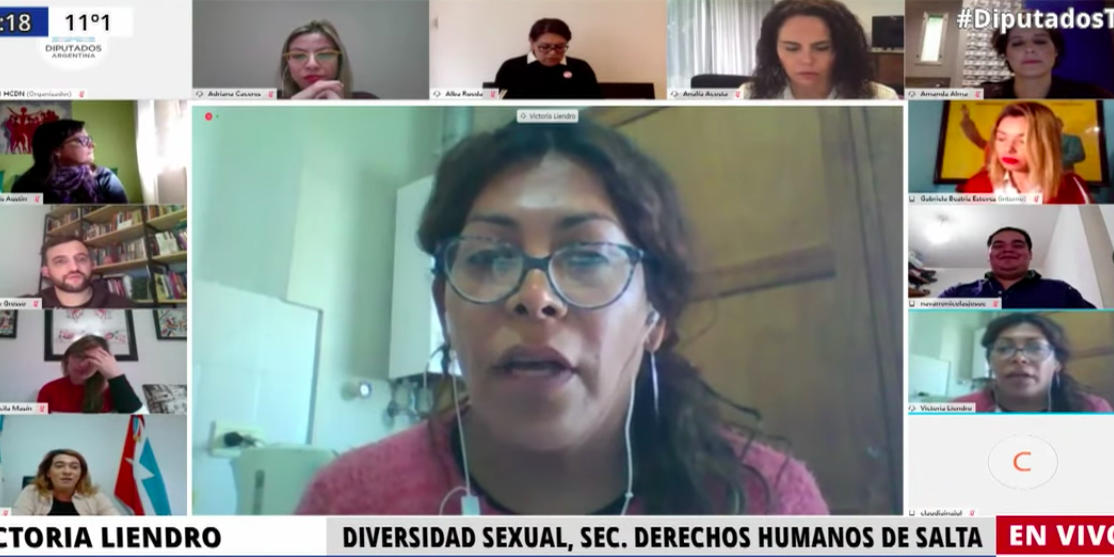
These meetings, convened by the commission chaired by Representative Mónica Macha—who spearheaded one of the first projects, the Diana Sacayán National Law—include trans and gender-diverse activists and leaders from various provinces, as well as legislators and government officials. Alba Rueda, Undersecretary of Diversity Policies at the Ministry of Women, Gender and Diversity, participated in yesterday's meeting, which, like the previous one, was held virtually.
“We start from unequal societies, and this social movement has a long history of struggle against them, with irreplaceable contributions from activists like Lohana Berkins, Claudia Pia Baudracco, and Diana Sacayan. Defending the rights of trans and gender-diverse people is a commitment of our democracy, a belated tribute to all those trans and gender-diverse people who died and gave everything for this cause,” she said. Rueda is the first trans person to hold an Undersecretary of State position in the country. “We need trans people in government so that the government can change,” the official stated. She explained why the debate and passage of a law that includes trans and gender-diverse people in the workforce is crucial to begin changing the structural violence suffered by her peers, whose average life expectancy in Argentina ranges between 35 and 40 years.
“The trans and travesti employment quota is an absolute priority for this government and a top priority on our agenda,” she said. “This government’s political decision is a fundamental step toward the recognition of these rights, but we need coordinated efforts with all three branches of government to fulfill this long-standing demand that has been postponed throughout Argentine history. The 20th century was marked by the pathologization of LGBT+ identities. In the 21st century, we have a historic responsibility to eradicate violence. The passage of this law is necessary and urgent .”
Beyond the variations among the different projects, leaders and legislators agree on one thing: the urgent need to guarantee employment access for transgender and transvestite people. This was expressed by Representative Cristina Alvarez Rodríguez, author of one of the bills. Her proposal allocates 1.5% of the workforce in the national government, decentralized or autonomous agencies, non-state public entities, and state-owned companies to transgender people.
“ The lack of rights for the trans/travesti population is a death sentence. And this is intolerable. The State must be the first to promote equal opportunities ,” the legislator said. “Passing a national law establishing a trans employment quota in the national public sector is a way to put a stop to a chain of normalized violence suffered by this population. Having a job means having dignity, it means planning for the future, it means having a pension, it means having self-esteem, it means having a life.”
The job access projects began to be debated on Tuesday the 23rd in the Women and Diversity Commission. After that first meeting, Macha (who had presented a project in 2018 but it lost its parliamentary status) spoke with Presentes: “The transvestite and trans community is one of the most vulnerable. It suffers a combination of discrimination and exclusion that contribute to its low life expectancy. We understand that when there is the possibility of formal employment, of changing one's trajectory so that it is not linked to prostitution, people's life paths are different. Access to formal employment means reversing this,” says Macha.
Another project that aims at the labor inclusion of transvestites is the Lohana Berkins project, presented by Gabriela Estévez.
In this second information meeting, the following also presented: Lucía Portos, Undersecretary of Gender and Sexual Diversity Policies of the Ministry of Women, Gender Policies and Sexual Diversity of the province of Buenos Aires; Ursula Sabarese, Director of the Diversity, Sexual Dissidence and Gender Identity area of the Undersecretariat of Gender, Diversity and Dissidence of the Secretariat of Human Rights and Gender of the province of Chaco; Delfina Brizuela, professor, representative of the Diversity and Dissidence Space, of the Municipality of Río Gallegos in the province of Santa Cruz; Nicolás Navarro, the director of the Diversity area of the Provincial Council of Women and Gender Equality of the province of Jujuy; and Victoria Liendro, head of the Sexual Diversity area of the Agency of Women, Gender and Diversity of the Secretariat of Human Rights of the province of Salta.
]]>We are present
We are committed to journalism that delves into the territories and conducts thorough investigations, combined with new technologies and narrative formats. We want the protagonists, their stories, and their struggles to be present.
SUPPORT US

FOLLOW US
Related notes
We are present
This and other stories are not usually on the media agenda. Together we can bring them to light.