

Argentina: What's behind the attacks on diversity flags
Few things embody a collective sense as clearly as a flag, an ancestral artifact intended precisely to indicate, concentrate, summon and shape collective identities.

Share

By Ricardo Vallarino*
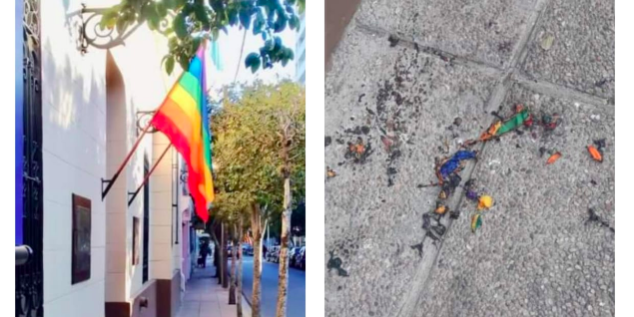
The attacks on the rainbow flag perpetrated between Saturday and Sunday in four Argentine provinces reveal the depth of the conflict and the magnitude of its scale. The conflict is profound precisely because its meaning is plainly visible. Few things embody a collective identity as clearly as a flag, an ancestral artifact designed precisely to signify, concentrate, summon, and shape collective identities.
These attacks on the rainbow flag were distinct in that they revived old pretexts that motivated the attackers: they perceived, or claimed to perceive, an affront to national identity. And in a sense, it was, given that raising the rainbow flag was intended to make our community visible and welcoming, to express the intention that public and governmental spaces wish to adapt to LGBTQ+ experiences and identities; and such a welcome necessarily implies the recognition of the patriarchal violence that founded all the institutions that the Argentine flag represents.
In this sense, replacing one flag with another is a gesture acknowledging that something has always been wrong with the establishment of a flag sewn only to be viewed through patriarchal eyes. And for patriarchal eyes, the slightest alteration to that meaning signifies the total negation of the Argentine Nation.
The Argentine nation project was built on the usefulness of women for reproduction, of Afro people for exploitation, of the extinction of Indians for the territory, and of the correction and/or elimination of LGBTIQ+ people to produce and reproduce without deviations.
But the national flag, before becoming a standardizing and warlike symbol of white order, was born as an emblem of an emancipatory struggle. In that sense, it is perfectly compatible with, and even replaceable by, the flag of diversity. And let's not forget that Belgrano, its creator, was accused by contemporaries of being too "soft," that is, a homosexual, or a person who did not conform to their gender identity before his time. Something that generations of anxious historians felt the need to clarify was not the case.
“Today, the internal enemy is women and LGBTIQ+ people.«
However, attacking the flag by spewing hateful rhetoric is not the same as attacking it by invoking the constitution and the very essence of the nation. Hatred underlies these attacks, whether consciously or unconsciously, and it doesn't matter if the verbalized insults are sincere or dishonest, because in politics what matters are the real effects, the interests, and the explicit intentions.
This becomes clearer with the locations of the attacks: cities like Córdoba, Rosario, Mar del Plata, and San Luis. The sites of the attacks speak to us of key locations within the federal system. It was a defensive attempt against the expansion of queer, lesbian, and trans people. We find ourselves inland, where Argentina's borders were extended thanks to Indigenous blood—Indigenous people who, moreover, were accused of all kinds of corruption of customs, analogous to anything that didn't fit the rigid masculinity of nation-building.
The ultimate meanings of the homeland
Those who burned flags, destroyed plaques, and defied orders from the democratically established authority not only invoked the homeland and the constitution to legitimize their actions, but also emphasized the figure of the ex-combatant. This figure also touches upon the very core of the ultimate meanings of homeland. Ultimate in the literal sense: a soldier is one who puts their body on the line for the homeland, their life for the nation. And the army is that arm of the State that presumes to defend life against foreign attacks, against the “internal enemy.” That internal enemy today is women and LGBTQ+ people. The last one was another phantom called Marxism. This is the association that conservatives stir up across the continent, and which, given our conflictive history with communism, seems so absurd to us; but it is ultimately about the invading and corrupting agents of the homeland who live either in the present-day memory of the anti-rights movement.
We have a single, tragic war in our recent past, waged by usurpers of our homeland. The figure of the veteran often has two faces: that of the war hero and that of the victim of the dictatorship. Those who insulted us yesterday displayed the first face; those who defended us today, the second.
The rainbow for everything
We are witnessing a historic rupture, and that is why the reactionary unease surrounding the flag is twofold. On the one hand, it is yet another manifestation of a strange multitude that is coalescing, acquiring rights, and "advancing" across a territory, but at the same time, its political nature is unclear. It is simultaneously nation and foreignness, a subjugated ethnic group or a European colonizer: an external and internal enemy.
This paradox in understanding the meaning of the nation arises because the nation has been built precisely on the myth of the part representing the whole, which is none other than the myth of the Catholic nation (heterosexual, cisgender, sexist, patriarchal, white). What changes is not only the conflict itself but also the perspective we need to understand it. It is nothing other than the paradigm of diversity, where existence itself is not a negation. But nothing is gained without something being lost. It is the reactionary fundamentalism we lost in '82 and the democracy we gained in '83.
The people who committed these attacks are products of a political experience that knows double standards. They have the law, legitimacy, and authority on their side, but they chose not to resort to physical aggression. Instead, they resorted to symbolism. In their minds, there is a democratic conviction.
But why do they reject such beauty? One cannot help but recognize that the answer lies hidden within the question. For such resistance to cease, all that remains is for those who burned the flag to witness, at sunrise after rainy and dreary days, the rare and fleeting phenomenon that reveals in all its magic the brilliant matter that composes a simple and homogeneous beam of light.
*He has a degree in Philosophy (UBA) and is a member of the organization 100% Diversity and Rights.
All our content is freely accessible. To continue producing independent, inclusive, and rigorous journalism, we need your help. You can contribute here .
We are present
We are committed to journalism that delves into the territories and conducts thorough investigations, combined with new technologies and narrative formats. We want the protagonists, their stories, and their struggles to be present.
SUPPORT US

FOLLOW US
Related notes

We are present
This and other stories are not usually on the media agenda. Together we can bring them to light.