

“Social transvesticides are hate crimes”
In the first six months of 2020, 42 transvestites and transgender people died. This underscores the urgent need for workplace inclusion, a topic recently begun to be addressed in Congress.

Share

By Ana Fornaro and María Eugenia Ludueña
Photo: Ariel Gutraich/Presentes Archive
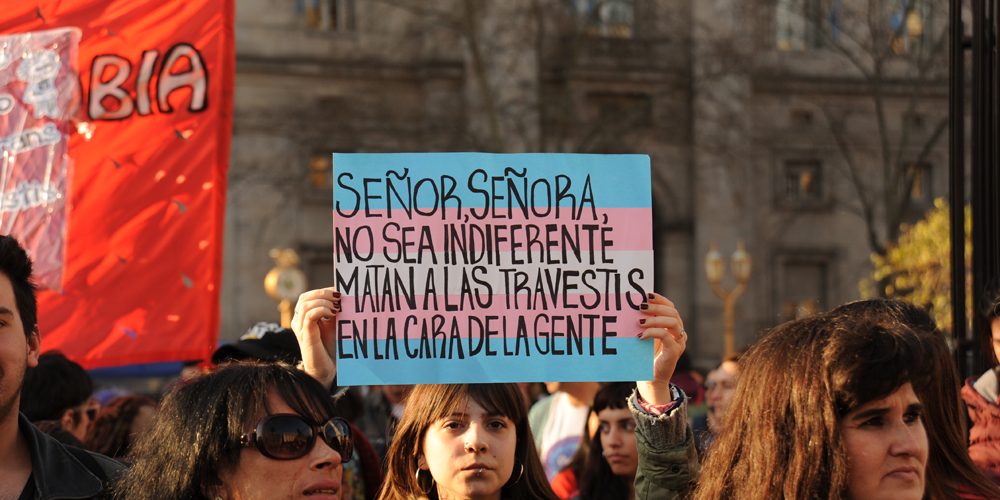
For the fifth consecutive year in Argentina, Pride Day was commemorated with the call for the Plurinational March Against Transvesticide and Transfemicide. Amid the coronavirus crisis and lockdowns, trans and travesti activism (one of the populations most affected by the pandemic in Latin America) was unable to take to the streets to protest these deaths. From various spaces, the cry "Stop transvesticide and transfemicide" still resonates strongly on social media, seeking to break through social indifference through online discussions and actions. "We are not on the country's emotional agenda, and that is what this call to action is about. We tell those sectors of the women's and feminist movements who still perceive us as 'other' in this struggle, that both you and we are 'us,' as Marlene Wayar says. The power is collective, as is the responsibility to assume to prevent crimes against different populations based on gender, class, or ethnicity," says activist Violeta Alegre.
“When we talk about transphobic murders, we also include preventable deaths,” stated the organizers of the virtual activities on the 5th March's Instagram account. Although there are no official figures, various organizations have been documenting these deaths. La Rosa Naranja, one of the organizations that monitors these cases, reports that in the first six months of 2020 alone, 42 trans women and transvestites died. Two were murders: Roberta Carabajal (45 years old), murdered in February in La Plata; and Karly Palomino (33), murdered in March in Ciudadela. Besides sharing a gender identity and a violent death, they also shared other characteristics: both were migrants and survived through sex work, like many people in the trans and travesti community affected by structural violence.
Most of the documented deaths are social transvesticides, meaning they result from a lack of access to basic rights, such as health, work, and education. “For us, social transvesticides are also hate crimes. There is cruelty involved. It's a violent attack from the very first moment you're denied any rights. Our sisters die in hospitals, they don't have jobs, and the State doesn't take responsibility. We don't want charity, we want work. 99% have never had access to the labor market,” says Marcela Romero, president of the Association of Transvestites, Transsexuals, and Transgender People of Argentina (ATTTA).
Access to historical reparations and employment for the trans and travesti population is directly linked to their survival in a region where their life expectancy does not exceed 35 years. Despite the gender identity law and some initiatives at the municipal and provincial levels to implement a state employment quota, trans and travesti people continue to die below the poverty line.
“We are a community experiencing a social emergency in this pandemic,” says Claudia Vásquez Haro, president of Otrans Argentina. “Ninety-one percent of our population lacks formal employment. Between 85 and 90 percent of trans women and transvestites survive through prostitution. If we had jobs, we could quarantine at home. Without work, we cannot envision a life of equality.”
Inclusion and employment quota for transvestites and trans people
The Transvestite and Transgender Employment Quota has as its precedent the sanction in the Province of Buenos Aires of the law promoted by the Human Rights defender and transvestite activist Amancay Diana Sacayán, which determined that the provincial public sector must employ, in a proportion of no less than one percent (1%) of the total of its personnel, transvestite, transsexual and transgender people.
This year, eleven bills aimed at increasing the employment of transgender and transvestite people nationwide are before Congress. This week, the issue began to be addressed in the Chamber of Deputies' Committee on Women and Diversity, chaired by Mónica Macha (Frente de Todos), who spearheaded one of the first bills establishing a job quota for transgender and transvestite people: the "Diana Sacayán" law. Macha had already presented the bill in 2018, developed in conjunction with various organizations, but it failed to pass.
On Tuesday the 23rd, there was a virtual meeting of that Commission where representatives and organizations spoke. “The transvestite and trans community is one of the most vulnerable. It suffers a combination of discrimination and exclusion that contribute to its low life expectancy. We understand that when there is the possibility of formal employment, of changing one's trajectory so that it is not linked to prostitution, people's life paths are different. Access to formal employment means reversing this,” says Macha.
Fourteen trans and travesti activists participated in the meeting, outlining urgent issues and their specific contexts. The virtual format allowed for broader participation, including representatives from across the country. From Tierra del Fuego, trans activist Victoria Castro (100% Diversity and Rights) said: “We still lack access to healthcare, employment, and education, and without these things, we die. From childhood, our bodies have been exploited with silicone implants; we stand on street corners, and no one cares anymore.”
“Work is a matter of life or death,” explains Vásquez Haro, who also participates in the federal transvestite and transgender network in Argentina, which has a presence in 18 provinces. From there, she worked on another project with National Deputy Gabriela Estevez (Frente de Todos), the Lohana Berkins Transvestite and Transgender Formal Employment Inclusion Project. “For six years, projects have been submitted and then lost their parliamentary status. We advocate for a paradigm of inclusion rather than quotas; simply entering the public sector isn't enough. Companies aren't going to magically imitate this; we need the State to guarantee our employment beyond the public sector. We need to establish training scholarships for those who don't meet the qualification requirements. We want to work in any field and sector, not just those designated by the heterocispatriarchy.”
Trans activist Alma Fernández states: “We say trans job quota because we understand that society and governments must begin to address the neglect and vulnerability of our community. We live to 35, and only 1 percent reach 60. We need to overcome this destiny of being forced into prostitution at 13. We call any hate crime aggravated by our identities 'travesticide.' We call all historical neglect of our community by governments and society 'travesticide.'”
We are present
We are committed to journalism that delves into the territories and conducts thorough investigations, combined with new technologies and narrative formats. We want the protagonists, their stories, and their struggles to be present.
SUPPORT US

FOLLOW US
Related notes

We are present
This and other stories are not usually on the media agenda. Together we can bring them to light.