

Police abuse in Río Gallegos: “They kicked me and denigrated me for being gay”
A 27-year-old gay man reported that on May 1st he was beaten and assaulted by homophobic infantry officers and police.


Share

By María Eugenia Ludueña with collaboration from Hilo Violeta*
A 27-year-old gay man reported that on May 1st he was beaten and assaulted by homophobic riot police and officers from the Sixth Police Station in Río Gallegos (Santa Cruz province). He stated that while he was detained for approximately six hours, in the context of the pandemic, they broke his jaw, fractured his ribs, and left him with bruises all over his body, mocking his sexual orientation. The complaint is being handled by Judge Marcela Quintana in the First Court of Instruction.
Jorge Astorga, the victim, filed a complaint yesterday with the INADI (National Institute Against Discrimination, Racism, and Xenophobia) office in Río Gallegos regarding the police violence he suffered. The local office has already requested the opening of an investigation and told Presentes that it is providing support to the victim. Discrimination against a dissident sexual orientation can result in harsher penalties for those who perpetrated institutional violence within two security forces: the Infantry and the police.
[READ ALSO: SPECIAL NEWS REPORT ON CORONAVIRUS]
The complaint
According to Jorge Astorga, the victim: “On May 1st, I suffered abuse of power at the hands of the police and the riot squad. I was with my mother, heading home at 2:45 in the morning—we live five blocks away. The riot squad stopped me, didn't ask my name or why I was out at that hour, and forced me into the truck. Once inside, I asked them why they were arresting me, and one of the riot squad members replied, 'Look how you talked, faggot, queer.' The abuse began: punches, blows, and it continued like that all the way to the 6th precinct in the Evita neighborhood. They dragged me out by my hair and through the entire station to a barbecue area.”
Insults and rape threats
Jorge recounts that he lost his shoes and socks along the way, and that the violence continued afterward at the hands of the police officers. “There were three or four officers from the station, including a woman. They kept kicking and punching me, laughing at me for being gay, for how I was dressed. They denigrated me for being homosexual. When I arrived, they took my earrings and didn't give them back.” Jorge says that at first he didn't want to reveal his name until he knew the reason for his arrest. But at one point, while he was still being “denigrated by homophobic people, I was sitting in a chair when the shift supervisor came and asked me if I was going to sign any papers. I said no, and then one of the riot police officers pulled me out of the chair and kicked me on the ground. One of them pressed down on my feet, another on my back, and another choked me with his boot until I couldn't breathe. I agreed to tell them my name and signed the papers; there were four of them.”
[READ ALSO: JOURNALISTIC MAPPING OF HATE CRIMES IN ARGENTINA]
To this day, he doesn't know what he signed. “They didn't show it to me. I asked to contact a family member, and they denied it. They kept telling me I had no rights. They said I'd watched too many movies . They even denied me permission to go to the bathroom, telling me to wet myself. They picked me up all beaten up, and on the way to the cell, they threatened to take me to other prisoners to be raped. I thought it was going to happen. But in the cell, there were two people detained for violating quarantine. They were only being held; they had been treated well.”
Revictimization
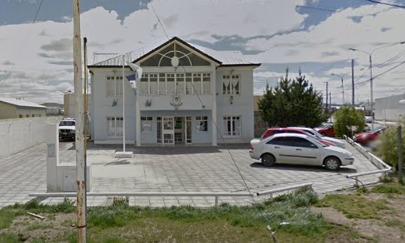
Jorge spent the freezing early morning in Río Gallegos "barefoot and freezing cold," unable to believe what he was experiencing. At 9:30 a.m., he regained his freedom and went home. “I went to sleep, and later that afternoon I went to the Río Gallegos Regional Hospital. They did tests and X-rays that showed I had a fractured jaw and cracked ribs, in addition to bruises all over my body. I left at 2 a.m. and went to the 101st Police Station to file my report. They treated me very badly and told me they didn't take reports, that I had to go back to where the incident had happened. I didn't want to run into the shift and relive everything. I mustered up my courage and strength and went. The shift supervisor wasn't aware of what had happened on the night shift. I couldn't believe it. Later I went to talk to headquarters, and they weren't aware of it either. Even if I had been violating quarantine—although I was outside of permitted hours, I was accompanying my mother—it wasn't a reason to give me that beating or the treatment I suffered. They told me that at most I deserved a citation or to be detained. They suggested I wait one or two months, because this takes a long time.”
Time passed and Jorge received no response. “I expected some kind of sanction or investigation for those in those forces, but they continue working as if nothing were amiss.”
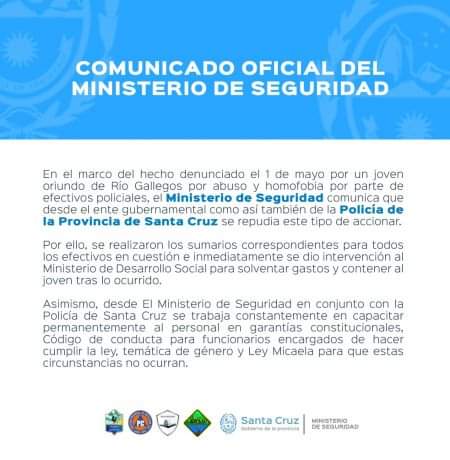
Today, the Ministry of Security of Santa Cruz reported through a statement that the personnel involved were subjected to disciplinary proceedings.
The intervention of INADI
“We have received the administrative complaint and are supporting the case. We are also coordinating with the Secretariat of Human Rights so that they can file a criminal complaint. INADI has already opened an investigation,” Lucrecia Vivanco, INADI delegate in Santa Cruz, told Presentes. “This is a very serious incident that reveals prejudice and hateful discrimination against people with diverse sexual orientations, and it has set off all our alarm bells. It is an act of institutional violence that we find unacceptable and that must be strongly condemned .”
He added that "the interventions that INADI has had in Santa Cruz in the context of the pandemic have had to do with situations that again violate groups that are already vulnerable and discriminated against, such as sexual diversity."
Coronavirus and police abuses
“Beyond this particular case involving sexual orientation, the Santa Cruz police have been committing acts of violence throughout the province. We recently saw violence in Pico Truncado, and the latest femicides are linked to officers who were the victims' partners,” Romina McNamara, a member of PA.DE.HU (Patagonia for Human Rights) and part of the Women's Roundtable—an organization in Río Gallegos that brings together diverse groups including neighborhood, social, labor, and pastoral organizations—told Presentes. “The pandemic has given them a certain authority on the streets, and they're emboldened.”
Jorge says it hasn't been easy for him to speak out. He's driven by the same thing that motivates so many victims: “Just like what happened to me, it must be happening to many people in the neighborhood, in the city. Many of us stay silent for fear of reprisals. I want justice to be done. I want the people involved in that shift to be held accountable for what they did. Nothing like this had ever happened to me before, nor had I ever suffered discrimination. The fact that these situations of homophobia, and especially from the police, still occur terrifies me. It's not easy to file a complaint and speak out. But we have to stop being silent and demand justice.”
*This article was produced in collaboration with Noticias de la Patagonia Austral, a program on @FMUNPA 99.9, Radio Universidad Nacional de la Patagonia Austral, and Hilo Violeta , news with a gender perspective from University Radios of Argentina grouped in ARUNA (Asociación de Radios Universitarias Argentinas).
All our content is freely accessible. To continue producing independent, inclusive, and rigorous journalism, we need your help. You can contribute here .
We are present
We are committed to journalism that delves into the territories and conducts thorough investigations, combined with new technologies and narrative formats. We want the protagonists, their stories, and their struggles to be present.
SUPPORT US

FOLLOW US
Related notes


We are present
This and other stories are not usually on the media agenda. Together we can bring them to light.