

Usha: the pioneering drag artist who bridged the gap between show business and activism in Paraguay
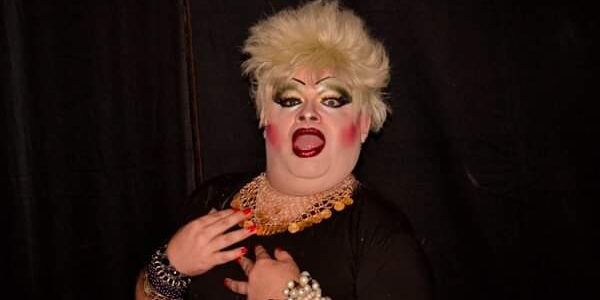
Usha Didi Gunatita was the transvestite who left a permanent mark on the historical memory of Paraguay.

Share

By Juliana Quintana
Artist, performer, actress, activist, LGBT rights advocate, makeup artist, grandmother, friend, sister, aunt, Usha Didi Gunatita was the drag queen who left a lasting mark on Paraguay's historical memory. May 13th marked five years since she passed away from a heart attack in her apartment in downtown Asunción.
He was born in Caaguazú on February 16, 1971. His sister Lucía would ask him why he kept his nails long. “I play guitar a lot,” he would tell her. But Lucía already knew her brother was gay. When he turned 13, his mother died, and shortly afterward, he moved to the city center. He started working at the nightclubs “Playboy” and “Trauma,” performing nightly shows.
[READ ALSO: City councilman from Ciudad del Este assaulted LGBT activists at the Festival ]
Once, they received a doll and a toy car as a Three Kings' Day gift, but when they went to play, Usha asked Lucía to lend him her doll. "That's why Mom hit us so hard. I was five years old and he was ten," she recalls. Her childhood took place during the final years of the Stroessner dictatorship, and Usha had to hide to go out with boys her own age because homosexuals were persecuted and tortured.

While the list of 108 “immoral” individuals was compiled in 1959, several similar lists existed, along with a constant crackdown on LGBT people and those associated with them. The Palmieri case in 1982 reignited the witch hunt and led to the arrest of twenty trans women, including Carla, one of the first trans women recognized for her defiance of the police, and Liz Paola Cortaza, a trans woman and survivor of the Stroessner dictatorship. Common practices included humiliating them, cutting their hair, and subjecting them to hard labor in prison.
“It wasn’t supposed to be known. Otherwise, they would have taken them away and killed them. People thought that if you hung out with homosexuals, you were going to become gay, or something like that. I think people are very ignorant. He loved what he did, that’s what I admired about him. He practiced every day, and during the dictatorship, no less,” Lucía tells Presentes.
In 1994, Edilberto Álvarez, better known as Babi, arrived in Asunción from Presidente Franco (Alto Paraná department) and met Usha at the Stop bar, located on 14 de Mayo near Oliva, across from Playboy. Stop was the only bar that welcomed trans people, residents of Chacarita and Bañado Sur.
“At that time, Usha was in charge of cleaning the place. At night, the trans women put on shows, but Usha’s was different because she took popular songs and made fun of herself: she did an exaggerated gallop, spun around, and used more grotesque language,” Babi recalls.
The rise of CHOPA, Trans Faces and Lazos
In the mid-1990s, the Paraguayan Homosexual Community (CHOPA) was formed, the first LGBTI organization in Paraguay. Miguel Angel Auad, known as Petunia, brought the idea to Paraguay, inspired by the Argentine Homosexual Community (CHA) and other gay rights movements he had encountered in the United States. Their work focused on providing support related to HIV/AIDS, which at the time had a devastating impact on the gay community due to the lack of government support.
CHOPA focused on providing assistance and support to people living with HIV who required hospitalization and medication. These efforts required funding, and to raise money, they organized events, including large parties and talent shows, such as the Miss Paraguay pageant and the Night of the Roses. Babi was one of CHOPA's founding members, and his work began with assisting the trans community: that's how he met Usha.
“She lived on a street near Humaitá and 15 de Agosto. When Usha took over that house, whenever someone approached her and asked for help, she opened the doors to them. To people who had nowhere to sleep, people who had been kicked out of their homes. Usha always welcomed people. Later, Usha was always involved in LGBTQ+ events; in fact, she did a lot with the beauty pageants. She was always there and was in charge of making us laugh,” she says.
[READ ALSO: Violence in quarantine: the double confinement of LGBT people ]
As a young man, Omar Marecos, a Paraguayan theater professional, began frequenting CHOPA meetings in 1995 and attending Usha's shows at pubs like La Barca, El Audaz, Spider, Punto G, and Luna. He would sneak away to see the best shows by Liz Paola, Sandra, and Usha. "The most powerful, charming, transgressive, and the one who fluctuated between transvestism and drag queenism was Usha," he says. Besides his training in theater and dance, much of his identity as Envidia was influenced by Usha. "I'm the link that connects the generation of the dictatorship with this generation that has more of a drag art tradition."
“It seemed to me that there were so many free and empowered people for those times, laughing, talking, and Usha was the life of the party. At fundraising events for people living with HIV, Usha was the host, the comedian, the humorist; she kept everything flowing. Usha, Sandra, and Carmen were the best people I ever saw,” says Omar, who is also known as Envidia Metenés, his drag persona.

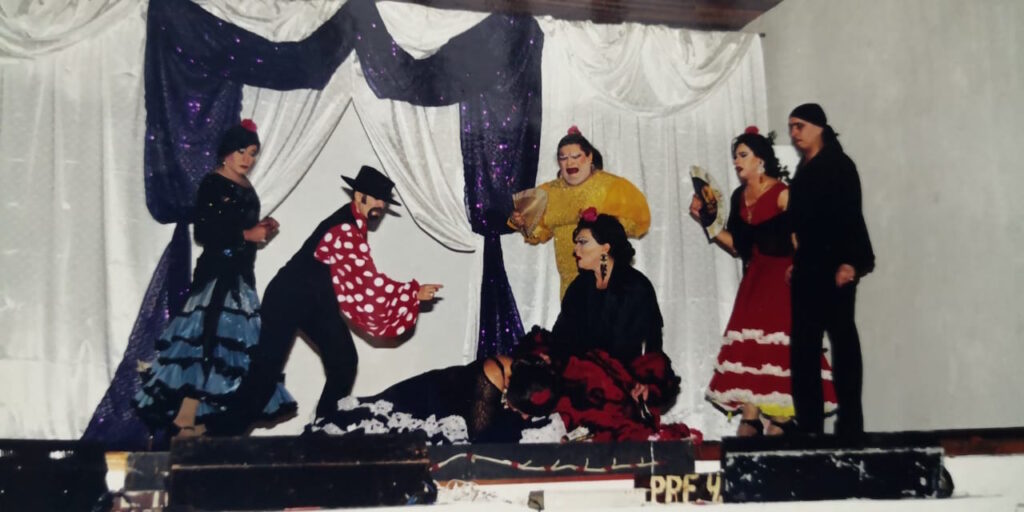
Around 1996, a group called Trans Faces was formed, composed of seven artists recognized in the underground scene: Kupple, Quiels, Lumiers, Cesarito, Kinsinha, and Usha. Their shows were events held in various nightclubs, where a group of drag performers or transvestites portrayed famous characters from the entertainment world, and were characterized by their large-scale productions.
Researcher Edilberto Álvarez (Babi) and Lumiers say that Trans Faces was a training space for Usha, there she polished her style and people began to know her for embodying Evita Perón, Damas, Pimpinela, Tita Merello.
“There was a class difference between Stop and bars like Honorabile Societé, but Stop was the one that started bringing people together through Usha, with these gay guys doing solidarity activities. Usha was very much at the forefront of Amigos del Stop, which helped LGBT people in emergency situations because there were girls dying in jail, they didn't have a coffin, they didn't have anything to eat. Usha was one of the people who really got things moving. There was a strong trans art movement at that time,” Babi explains.
The house of Humaitá: shelter and refuge
Usha was very supportive and a beloved figure in Asunción: you'd find her in the plazas with the craft vendors and the taxi drivers. "You'd go downtown to run an errand and you'd always bump into her. She also had a religious side. She always made promises to Saint Blaise and was always present at neighborhood festivals, supporting their activities. She had no problem being anywhere from the municipal theater to a street party to raise funds for paving," Babi points out.
She brought rice, noodles, sugar, yerba mate, and bread to the prisoners. At Christmas, she dressed as Santa Claus and visited the children at the cancer hospital, distributing gifts in her sister's neighborhood. She was also a vital resource for those who found refuge in her. She welcomed people experiencing violence, insecurity, or illness into her home.
[READ ALSO: 2019: Year of the anti-LGBT lobby in Paraguay ]
During that time, alternative family models were emerging. LGBT people who owned apartments or rented large houses would sublet rooms to other, younger gay or trans people. For a few years, he ran a place downtown known as "Humaitá's house."
“ Living and working downtown was challenging enough, but managing a house with people like us was triply challenging. That's the environment in which gay people are generally raised. I knew her as the homeowner, and also as a friend, as a human being,” says Nilson González, also known as Leslie Palmer.

Theater, television and “Claricaturas”
The mythical figure of Usha held many mysteries. For example, it was never known what happened to her right eye or how she learned everything she knew. The actor Aldo Calabrese was part of the cast of Gordas , a play directed by Hugo Robles, for which Usha was the opening act. Much of their relationship developed backstage, and he recalls that once, while watching her apply makeup before a performance, she told him that she did makeup for corpses. On another occasion, he asked her who taught her those techniques, and Usha replied, "The mirror was my teacher."
[READ ALSO: Paraguayan trans women marched and denounced the police and the justice system ]
According to those who later became her colleagues and theater teachers, she sewed and embroidered her own costumes, and even invented her own false eyelashes. She wore eye makeup and used extravagant props: her rings and hairstyles had a very personal touch that survives to this day in new generations of drag and transvestite performers. For theater director Hugo Robles, Usha presented an anti-heroine, not a diva. She portrayed everyday characters like a chipa vendor, a market worker, a little girl, and that set her apart from other shows of the time.

“Seeing a man dressed as a woman was common in bars but not in theater or television. She broke with that and started getting invited to social events and bachelorette parties. That's where she began communicating not only with the LGBT community but with the community in general. The connection she made with ordinary people—a housewife, a bus driver, everyday folks—seemed super interesting to me,” Robles reflects.
In 2013, she participated in the play "El Despojo" (The Dispossession), directed by Omar Marecos and featuring activists from the Panambi Association. There, Usha delivered an intimate monologue summarizing her entire life. She recounted when she decided to dress as a woman and when she began performing. Later, Usha's character made the leap to television with "Telecomio." On Channel 9, she appeared on "Claricaturas," a comedy program starring comedian Clara Franco.

Television producer Maby Rojas invited her to participate in the Claricaturas casting. “When we finally managed to finalize the deal so she could be on television, it was a huge personal achievement for her. We cried a lot because for a national channel to allow me to include a drag queen on my team of comedians was a very big step.”
Usha introduced Paraguayan music and popular elements to performance art. Her classics included: “Rata inmunda” by Paquita; “Se dice de mí” by Tita Merello; “Marinero de luces” by Isabel Pantoja; and others by Diana Barboza, América Ferreira, and Gloria del Paraguay. Those who knew her agree that her defining characteristic was her ability to make everyone laugh. She embraced her plus-size figure, her glass eye, and her traditional clothing. Her authenticity seems to be the key to her ability to navigate between these two worlds: television and entertainment, and the world of the streets and social activism.
All our content is freely accessible. To continue producing independent, inclusive, and rigorous journalism, we need your help. You can contribute here .
We are present
We are committed to journalism that delves into the territories and conducts thorough investigations, combined with new technologies and narrative formats. We want the protagonists, their stories, and their struggles to be present.
SUPPORT US

FOLLOW US
Related notes

We are present
This and other stories are not usually on the media agenda. Together we can bring them to light.