

Housing: Survey reveals "landlord violence" towards LGBT+ people
A survey conducted by Inquilinos Agrupados revealed that 100% of trans and transvestite people in Argentina will not be able to pay their rent.

Share

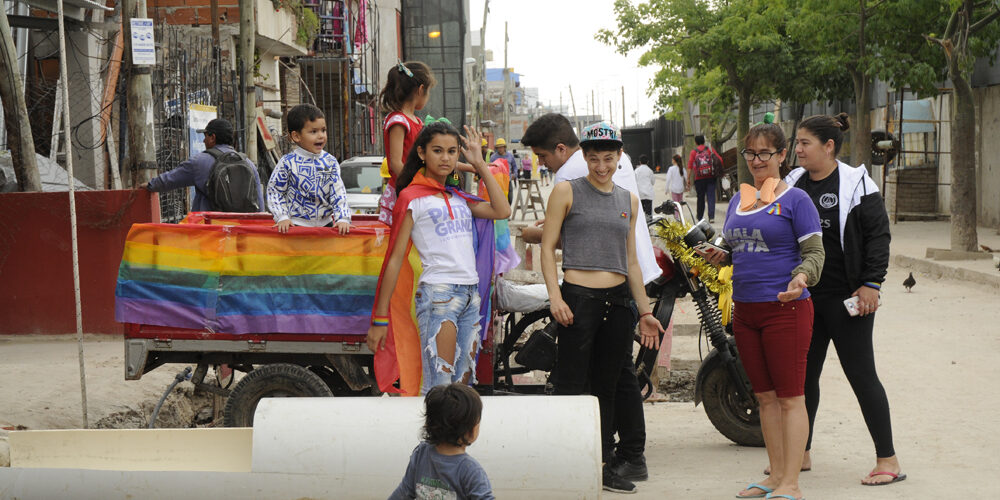
Photo: Ariel Gutraich/Presentes Archive
One of the consequences of the Covid-19 lockdown measures was the inability of tenants to pay their rent. According to a survey conducted by the National Tenants Federation (FIN), 6 out of 10 people will be unable to pay their rent in May. These numbers are even higher for the LGBTI+ community. “Of all the trans and travesti women who participated in the survey, 100% live in informal housing. Furthermore, 100% of the travesti women and 93.8% of the trans women said they would be unable to pay their rent because they had lost their income,” explains Gervasio Muñoz, president of FIN and a leader of Inquilinos Agrupados (Tenants United).
According to Muñoz, this is the first time a survey by the Federation has reflected the housing conditions of a sector of the LGBTI+ population. “The group interviewed consisted of 150 trans and travesti women affiliated with the Association of Sex Workers of Argentina (AMMAR). Since the quarantine began, street work has completely ceased, and these women have reported numerous instances of harassment and threats of eviction by landlords.”
“When you don’t have a home or when you’re going into debt to pay rent, the #StayHome imperative loses its meaning. Home cannot be a place of sexist violence or real estate speculation ,” explains Lucía Cavallero, sociologist and leader of the Ni Una Menos collective, to Presentes. “The LGBTI+ population has many problems accessing housing because we are generally disinherited, we don’t have marital homes, so in all these situations, the development of housing plans or massive subsidies would be warranted to address the inability to pay rent.”
[READ ALSO: Transvestites and trans people in quarantine: evictions and housing emergency ]
Just days after the start of the quarantine, the government published Public Emergency Decree 320/2020 , which stipulated, among other measures, “the temporary suspension, until September 30 of this year, of evictions from properties” used as primary residences for individuals or families, cultural activities, and small-scale production, among other exceptional circumstances, as well as a freeze on rent prices. Even so, reports continue to this day that the new measure is being violated.
In this situation, Muñoz explains, there is no law, no state, and no justice. “There’s a very perverse system the City Government has in place where they subsidize the individual, not the hotel. In other words, the person has to prove they’re renting a room there, which is complicated for informal rentals, and they receive a subsidy to pay for the room. But then the hotel raises the rent. On top of that, we’re talking about boarding houses where people live in undignified conditions—social cells. They’re called hotels for romantic reasons, but they’re prisons in the middle of the city.”
Who is excluded from #StayHome
Pamela (34) has been a sex worker since she was 16. Born in Salta, she moved to Buenos Aires 18 years ago and currently lives in a hotel in the Constitución neighborhood, located at the corner of México and San José streets. “The fact that we are trans women and sex workers, and often migrants, means nothing to the hotel owners. They don't care about the president's decree and they harass and threaten us to pay the rent regardless of the circumstances,” she tells Presentes.
Almost all of the trans and travesti people interviewed in the FIN survey reported that they stopped receiving income during the quarantine. “If they threaten us with eviction, we have no choice but to go out on the street, risk our lives in the middle of the pandemic to pay for necessary expenses, and that's when what we already know begins. The quarantine is violated, we are trans women and sex workers, they arrest us. The same old story,” Pamela continues.
[READ ALSO: Stories of dissident quarantines ]
Forms of property violence
According to Cavallero, cisgender women, lesbians, trans women, transvestites, and mothers with children are the population most exposed to violence during the Covid-19 isolation measures . “We coined the term 'property violence' to describe this situation in which many women, lesbians, and transvestites are exposed because they are indebted to landlords and real estate agencies, which makes them vulnerable to violence . For the LGBTI+ community, this manifests in evictions from hotels where transvestite and trans women, sex workers, and other women live, and where access to housing is informal.”
The term coined by the sociologist reflects the pressures, abuses, harassment, and other forms of intimidation exerted by landlords and real estate agencies. These forms of violence range from violent evictions to the cutting off of essential services, such as electricity, water, or gas. “There have been situations where they forced their way in because they had the key and evicted tenants, throwing their belongings into the street—that's an extreme situation. Then there are situations like being pressured by daily phone calls, having your electricity cut off, or, in the case of real estate agencies, receiving threatening letters. The conditions that make this violence possible are the lack of access to housing and the situation of income restriction, of having to go into debt to be able to pay rent,” Cavallero explains.
“ For some time now, we at the Tenants Federation have been observing that the vast majority of these acts of violence, almost entirely, are perpetrated against cis and trans women, and we wanted to start discussing this with the Ni Una Menos collective to begin thinking about some solutions ,” explains Muñoz. The Federation presented a bill proposing, among other things, that real estate agents be trained in Human Rights and Gender. “We felt it was important to raise this issue and begin to move forward. Tenants say ‘ my landlord, ’ and landlords say ‘my tenant ,’ and there’s a remnant of old-fashioned, patron-like practices, the modern version of the ranch owner who mistreated the farmhand’s daughter.”
Solidarity solutions in times of pandemic
“In Constitución, we're doing a lot of work on housing support. The hotel owners, who keep their properties in terrible condition, understood that they can't evict anyone, and when they tried, we were furious and, through various actions, we stopped the evictions,” says Marcela Tobaldi, president and founder of the Rosa Naranja Civil Association. “ We managed to get even our most vulnerable members, those without housing subsidies or who were homeless, into rooms where they could find shelter.”
Pamela explains that thanks to AMMAR's help, they received food baskets and that every weekend they meet at a soup kitchen in the Constitución neighborhood to support all the sex workers. “We also all go to AMMAR's Red House, where they help us with the Buenos Aires Citizenship Day, to understand the subsidy programs we can access, and they provide a lot of support to our migrant colleagues.”
“What we are asking for is active debt relief policies from the State. It is unacceptable that people whose ability to earn income is restricted should end up heavily indebted to real estate companies or landlords when the lockdown ends, so we are asking the State to assume those debts,” Cavallero explains. “We are also asking for a specific approach to these situations of violence against cisgender heterosexual women and LGBTI+ people, that the State enforce the eviction ban, and that this ban be extended for 24 months.”
[READ ALSO: Ministry of Health published recommendations on COVID-19 and trans people ]
According to the leader of the Ni Una Menos (Not One Less) movement, a fundamental measure is needed to regulate the situation. “A rental law would prevent us from reaching this point where the State issues an emergency decree, which is impossible to translate into effective market regulation because it's a market that has been deregulated for many years. Ultimately, what we're asking for is the development of plans that recognize housing as a right.”
All our content is freely accessible. To continue producing independent, inclusive, and rigorous journalism, we need your help. You can contribute here .
We are present
We are committed to journalism that delves into the territories and conducts thorough investigations, combined with new technologies and narrative formats. We want the protagonists, their stories, and their struggles to be present.
SUPPORT US

FOLLOW US
Related notes
We are present
This and other stories are not usually on the media agenda. Together we can bring them to light.