

Right to work: this is the map of the transvestite-trans labor quota in Argentina
It's being passed in some provinces, but in practice, only a few municipalities are implementing it. What do the bills promoting it at the national level say?

Share

By Ana Fornaro and Maria Eugenia Ludueña
Photos: Presentes Archive/Ariel Gutraich, Jessie Insfran Pérez
[News updated on July 8, 2020]
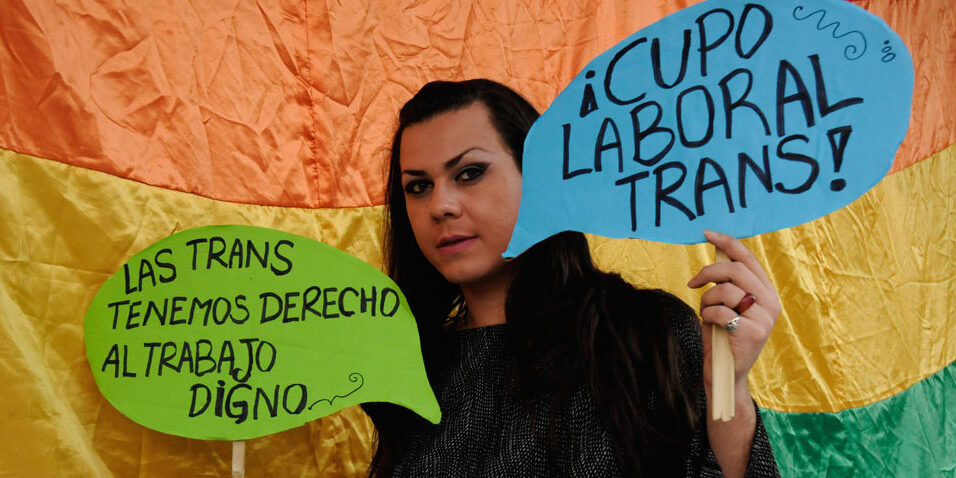
In the midst of the pandemic, measures to prevent the spread of Covid-19 have exposed the enormous difficulties faced by the trans and travesti community in making ends meet. Behind the countless urgent needs for food and the difficulties in accessing healthcare lies a basic right, essential for guaranteeing others, and one that has been systematically denied to this community: the right to employment, a historical debt.
According to a 2014 report by ATTTA and Fundación Huésped (the latest available), only 18% of transvestite and transgender people have had access to formal employment. With no options, excluded from education early on and often from their families, many of them resort to sex work or prostitution to survive.
For years, trans and travesti activists have been fighting for a state-level employment quota, as well as for policies promoting workplace integration in both the public and private sectors. There are specific examples of these policies being implemented at the provincial and municipal levels, but these demands are far from being met at the national level.
“Access to employment for transvestites and trans people is a struggle that has been ongoing since 2015, with Diana Sacayán as a pioneer, and it represents a horizon of social justice,” Alba Rueda, Undersecretary of Diversity Policies at the Ministry of Women, Gender and Diversity, told Presentes. “It involves a comprehensive set of fundamental rights for a large part of our population. The first is access to work, to be able to develop our work capacity. Then it provides the possibility of having health insurance and being protected within the social security system, and the possibility of having a pension. And it also involves the development of our work skills: social recognition and making our lives and those of our families sustainable.” She added: “ From the Undersecretary of Diversity at the Ministry of Women, Gender and Diversity, our convictions remain unwavering: the horizon of formal employment for us transvestite and trans people must be addressed through public policies. It has to do with the recognition of a right and the historical vulnerability of our community .”

What is the transvestite-trans employment quota?
The trans and travesti employment quota was an initiative of trans leader and human rights activist Diana Sacayán. She conceived it as a strategy to alleviate the exclusion of her peers: 95 percent of trans and travesti people are or have been involved in prostitution. Law 14783 was passed in the Buenos Aires Province Legislature on September 17, 2015. A month later, she was murdered in her apartment in the Flores neighborhood of Buenos Aires.
"Our problem lies at the very end."
“The nationwide health emergency highlights the lack of public policies regarding the trans community . This is related to the job quota we've been demanding in every province and municipality. This situation has hindered our fight for a trans job quota. Our predecessors put their lives on the line, and we must wage a counter-hegemonic struggle. Our issues are always relegated to the back burner. We believe that approving a trans job quota at all levels is a strategy to ensure our trans sisters have access to the labor market from a holistic perspective. There needs to be a cross-cutting gender perspective to eradicate discrimination and exclusion ,” Keili González, a trans activist from Nogoyá, Entre Ríos, told Presentes.
Eleven bills in Congress
Currently in Argentina there are at least eleven bills proposing the inclusion of transgender people in the workforce. The issue began to be debated in June, in informational meetings coordinated by the Women and Diversity Commission, chaired by Representative Mónica Macha.
This year the first three projects (because by the beginning of July 2020 there are already at least 11) were presented on March 5 in the Chamber of Deputies, and they bear the signature of female legislators, all from the same party (Frente de Todes).
Initiatives to improve employment access for transgender and gender-diverse individuals aim to guarantee their right to work. Most of these initiatives allocate a percentage of positions in the national public sector to transgender, gender-diverse, and gender-diverse individuals who meet the required qualifications. This includes all three branches of government, decentralized agencies, non-state public entities, and state-owned enterprises, both through permanent positions and other forms of contracting and outsourcing.
Projects in the Chamber of Deputies
The first three presented this year propose:
-The Diana Sacayán National Law, a transvestite and transgender employment quota project, presented by Representative Mónica Macha (Buenos Aires), proposes that at least 1% of jobs in the national public administration be filled by transvestite, transsexual, transgender, and transmasculine people.

“It’s a fundamental tool for the trans community to have other options. The Ministry of Labor also intends to include them and work along these lines,” Mónica Macha, a national deputy from the Frente de Todos coalition, told Presentes. The Diana Sacayán Bill “arose from a demand by organizations and was developed in collaboration with them,” the legislator stated.
The initiative was presented in 2016 and again in 2018 with the support of the National Front for the Diana Sacayán Law . “It focuses on quotas in the public sector, which are limited but very specific for its implementation, and includes a support system because simply hiring people isn't enough for inclusion. We can discuss other things later. I think one option is for the three projects to follow the same legislative path and come together in the Labor Committee,” says Macha, who heads the Women and Diversity Committee in the Lower House.
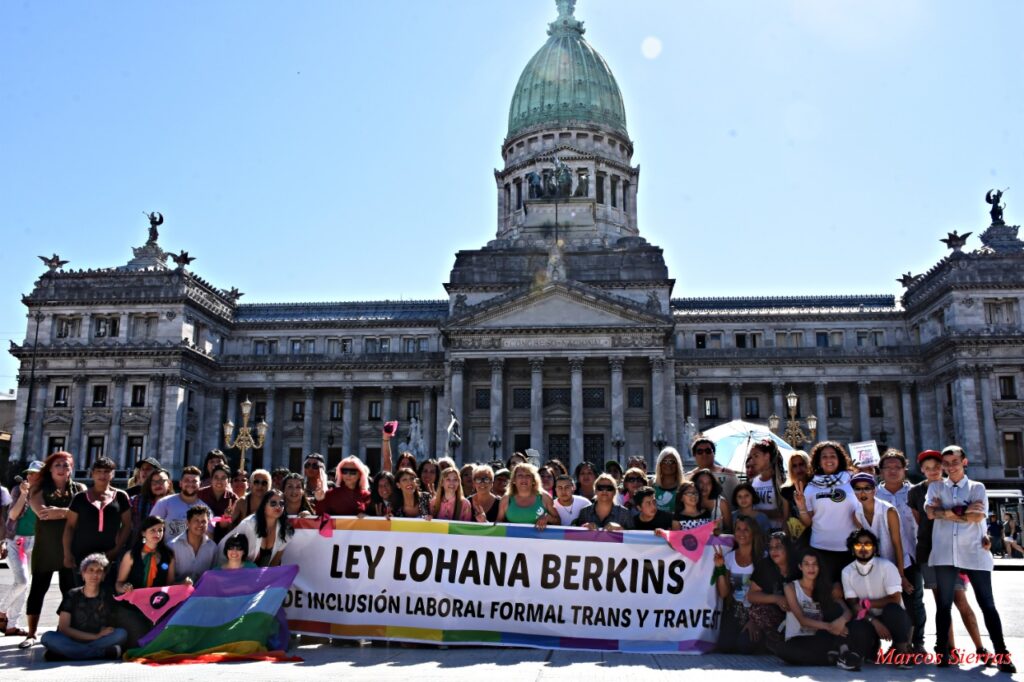
Another project is the Lohana Berkins Law, which promotes formal employment for transgender and transvestite people . It was introduced by Gabriela Estévez, a representative from Córdoba representing the Frente de Todos coalition, with the support of the LGBTIQ+ League of the Provinces and the Argentine Trans and Travesti Federal Network.
It reserves 1.5% of positions in the national public sector for transgender and transvestite people who meet the required qualifications.
It establishes a training scholarship system for those who do not meet the suitability requirements, with a commitment to immediate and effective hiring upon completion of the training. It establishes tax incentives for private companies that hire transgender and transvestite individuals. It creates an awareness program on discrimination based on gender identity and/or expression for the public administration and private companies. It incorporates into the Employment Contract Law the prohibition of discrimination based on gender identity and/or expression.
“We don’t talk about quotas, but about trans labor inclusion, because quotas, regardless of the percentage requested, establish a ceiling,” Claudia Vásquez Haro, president of OTRANS ARGENTINA and coordinator of the Argentine Trans and Travesti Federal Call, told Presentes. “For us, labor inclusion is not only about the number of trans people who have to enter the public sector, but also about providing support in the workplace. Our project encourages the government to grant companies tax breaks or exemptions so they can promote trans employment in the private sector,” the activist said. She added, “In the provinces, we are still waiting for the implementation of the trans employment quota. It hasn’t been put into effect. There are cases of government agencies hiring trans people, but civil society organizations have not yet been consulted.”

The third bill, presented by Representative Cristina Alvarez Rodríguez (Frente de Todos, Buenos Aires), is a job quota law for transgender, transsexual, and gender-diverse people in the public sector . “The State must be the first to promote equal opportunities. The enactment of a national law establishing a transgender job quota in the National Public Sector is a demand from transgender communities that we, as legislators, cannot ignore,” Alvarez Rodríguez emphasized during its presentation. She added that “access to the material conditions that allow this community to lead a full and dignified life is an outstanding debt. Passing laws that promote equality and eliminate stereotypes and arbitrary distinctions is one of our primary obligations. There are other bills in Congress that follow this line, which speaks to a need that we must address.”
What is the employment quota for transvestites in the country?
The province of Buenos Aires was the first to enact a transgender employment quota in 2015, but the last province to regulate it (in December 2019) so that it could be implemented. Four other provinces have also approved a transgender employment quota by law.
Chubut approved the trans employment quota on May 17, 2018. Río Negro and Chaco followed suit in September and November 2018, respectively. Santa Fe approved it on October 31, 2019. For various reasons, it was not implemented in any of the provinces.
“Now that the projects are approved, the organizations can continue to demand that provincial governments comply with the law. It’s a tool to specifically demand that the law be enforced,” Macha noted.
Universities with transvestite-transgender employment quotas
“Just as there are provinces that already have it and do not implement it, there are workplaces that, without having the law, are implementing it with internal resolutions, as a tool to generate another system of inclusion,” Macha highlighted.
This is the case, among others, with universities. Although not legally obligated, they quickly responded to the demand and began implementing transgender employment quotas. One of the first was the National University of Mar del Plata, in 2017 , which already has them in place . The universities of La Pampa, Comahue, and Tierra del Fuego followed suit.
In October 2019, the National University of Rosario approved the transvestite trans job quota through a resolution that provides for the incorporation of 5% (with a minimum of 3 people) per year to fill jobs in areas of the rectorate or academic units.
In the midst of the pandemic, which has exacerbated the pre-existing exclusion of so many trans people—a fact recently acknowledged by organizations such as the Inter-American Commission on Human Rights—the trans and travesti employment quota has emerged as an urgent and unavoidable necessity. "In this context of coronavirus, this inclusion should have helped us mitigate the effects of the quarantine in a different way. It's a reality that must be implemented urgently so that our trans sisters can access employment and a life project like any other citizen," says Vasquez Haro.
“From our voices, first as activists and then in management, we remain committed to embracing it,” Alba Rueda affirms. “To campaigning for trans and travesti employment quotas within the State, so that the right to employment for our entire community can finally be vindicated.”
All our content is freely accessible. To continue producing inclusive and rigorous journalism, we need your help. You can contribute here .
We are present
We are committed to journalism that delves into the territories and conducts thorough investigations, combined with new technologies and narrative formats. We want the protagonists, their stories, and their struggles to be present.
SUPPORT US

FOLLOW US
Related notes

We are present
This and other stories are not usually on the media agenda. Together we can bring them to light.