

Police in Jujuy arrested a trans woman for violating quarantine and sexually abused her.
They took her to an open field where they abused her, saying they were going to "make a man out of her." Then one of them threatened her to keep her from talking.

Share

By Elena Corvalán, from Jujuy
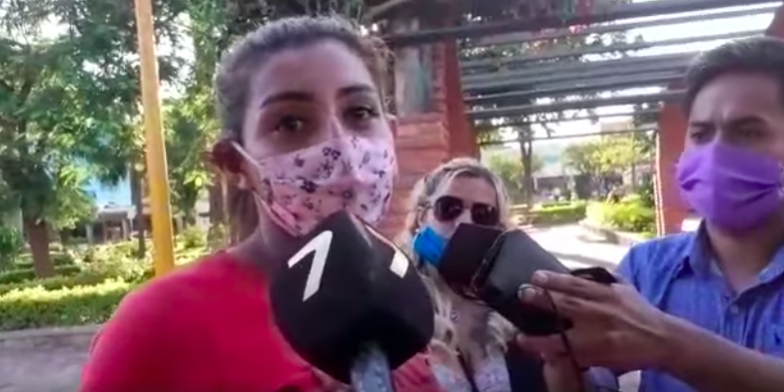
Delfina Antonella Díaz is a 19-year-old trans woman who lives in Libertador General San Martín (the city of the Ledesma sugar mill), in the province of Jujuy, where she was arrested last Sunday by four police officers—three men and one woman. They did so, supposedly, in accordance with the coronavirus lockdown measures. As she told Presentes, they took her to an open field where they sexually assaulted her, telling her they were going to “make a man out of her.” Then one of them threatened her to keep her from speaking out. She was only released the following day. And after overcoming her fear, she decided to file a criminal complaint against her attackers.
Delfina Diaz is accompanied by representatives of the organization Lawyers and Attorneys of Northwest Argentina in Human Rights and Social Rights (ANDHES) and the Ailen Chambi Movement, who last Friday denounced this fact before the Ministry of Security of the province and asked the government of Jujuy to initiate an administrative investigation, remove the police officers involved from the force and guarantee the safety of the complainant.
The assault occurred in the early hours of Monday the 13th. The young woman was with some friends on the sidewalk in front of a house in the Eva Perón neighborhood of Libertador. Police Station No. 39 intervened for a violation of the coronavirus quarantine, with the assistance of the Riot Police. According to Delfina, the police officers “very aggressively” told them to get up and “started throwing chairs into the street.” She confronted them about the violence and tried to take the chairs back inside the house, at which point one of the officers grabbed her by the neck and took her to the patrol car.
[READ ALSO: Honduras: Trans activist arrested while out looking for food: “This is not an isolated case” ]
Delfina asked her friends to tell her mother. At that moment, the female police officer punched her in the face, telling her to shut up. Delfina screamed, and the officer hit her two more times in the face. They took her around the corner, to the side of a canal, where there's an open area used as a sports field. "They stopped and started insulting me, saying they were going to make me a man, that I was a faggot. They were hitting me, kicking me in the legs." They ordered her to pull down her pants. Delfina resisted, and a police officer pulled them down. They then began touching her and hitting her genitals. According to Delfina, the policewoman told them to rape her with her baton. In the midst of the beating and sexual abuse, Delfina feigned a seizure.
"The nurse looked at me and laughed."
This frightened the police officers, who stopped their abuse and took her to a SAME emergency medical service facility. They put her in an ambulance, where Delfina revealed her survival strategy and recounted what had happened. However, “the nurse was looking at me and laughing, saying, ‘You can’t tell that story like that, it’s such a lie,’” she reprimanded her. She then spoke with one of the police officers, “They were looking at me and laughing, and the nurse wrote some things down.”
After that, they put her back in the patrol car, passed by Police Station No. 39, Hugo Salomón Guerra, where they picked up two minors and took them to Oscar Orías Hospital. But Delfina was never taken out of the car to be examined by a doctor. Instead, at one point she was left with one of the four aggressor officers: “He got in, grabbed me by the neck, and told me that if I spoke, if I said anything about what they had done to me, they would continue doing the same thing to me, they would take me to the cell, put me with the prisoners, and keep beating me,” Delfina told Presentes. She responded with an insult and was slapped in the mouth. “He told me, ‘Now we’re going to charge you with drug trafficking,’” and they took her to the Narcotics Division.
The police reported finding a hallucinogenic substance in a fanny pack the young woman was carrying. Delfina claimed the fanny pack belonged to a friend she had borrowed shortly before, and asserted that she signed the statement the police handed her because she was “so out of it” she didn't even read it. It was nearly 4 a.m.
The police stations concealed information
“My mom arrived a little while later. They told me not to scream, not to say anything. I could hear my mom crying outside, saying they wouldn't give her any information about where I was.” Delfina recounted that from the moment of her arrest, her mother “was searching in every police station” and “in all eight stations they withheld information from her.”
The young woman spent the night at Police Station No. 24 and was released at 12:30 p.m. that Monday. “The truth is, I was afraid to file a report,” but “I had to because today it happened to me, tomorrow it could happen to someone else, whether they’re trans, a girl, or a man,” she told Presentes. She added that this is the second time she has suffered police violence. The first time, about three years ago, she was arrested along with two other trans women and forced to have sex in front of a group of police officers.
Intervention of human rights organizations
When Delfina's complaint about the attack on Monday became public, the young woman received calls from provincial government agencies, such as the Provincial Council for Women and Gender Equality, and non-governmental organizations like ANDHES and the Ailen Chambi Movement. She also received calls from INADI (National Institute Against Discrimination, Xenophobia and Racism) and the National Secretariat for Human Rights.
Lawyers Malka Manestar and Marina Vilte have been supporting Delfina and her mother since the incident became public. On Friday, they filed a complaint with the Ministry of Security.
"We denounced the seriousness of how this situation unfolded," Manestar told Presentes. The lawyer emphasized the request for security guarantees for Delfina Díaz. “Often, when there are instances of institutional violence, victims are afraid to report it because of potential police retaliation. In this case, we understand that Delfina is being incredibly brave in reporting it, and for that reason, we are also determined to support her in every way we can, because we understand the seriousness of her complaint. We are not only talking about the institutional violence that has been perpetrated against her, but also about sexual violence ,” she explained.
[READ ALSO: Women and LGBT+ people who go out to report violence are exempt from quarantine ]
Manestar and Vilte also requested that the Jujuy government “implement public policies aimed at training its personnel, especially considering that the Micaela Law is still in effect, which is clearly not being applied, because Delfina suffered not only violence at the time of her arrest and all that it entailed (...), but also institutional violence” because her self-perceived identity was not respected, “instead, they used the name she has on her ID, and we know this is a complete violation of her dignity and the treatment she deserves.” Specifically, the gender identity law establishes that “a person, regardless of whether or not they have legally changed their gender identity, must have their self-perceived identity respected. And she constantly mentions that they treated her as a man,” in addition to the fact that the procedure was carried out by male police officers, Manestar stated.
A case against the victim
The head of the Jujuy Police, Chief Commissioner Juan Segovia, told Presentes that there are cross-complaints. “There is a court case against this young woman,” he said, alleging “a violation of the quarantine and public intoxication,” as well as a criminal case for “the seizure of substances at the same location.” He added that there is also a complaint filed by Delfina Díaz against the police officers, which is being handled by the San Pedro Prosecutor's Office, and “we also have to take administrative measures,” but “we have to proceed according to the judicial process.” He added that the four officers involved—three from the Infantry and one from Precinct 39—are being transferred, “to avoid any further issues or problems between this young woman and the police officers; we are removing them from Libertador.”
For Manestar, this event is an expression of “the historical, structural, and systematic violence that trans women experience, which is also related to the discriminatory, stigmatizing, and violent issues that still persist in our society.”
Vilte, for her part, considered this “a new opportunity for the Jujuy state to provide a meaningful response that begins to deepen the guarantee of the rights of our entire community. We in Jujuy have been severely impacted institutionally and in terms of justice, but we believe it is absolutely essential that this not be forgotten, because the community, over the years, has won many legal rights, but we need this cultural shift to achieve true equality.”
Vilte agreed that structural violence against gender nonconformists exists in Jujuy. In that context, any delay or arrest "always carries the implication that the identity of trans people, above all, is never respected in Jujuy."
Context of discrimination against LGBT people
As an example of the prevailing institutional violence, the lawyer recounted that in the first year of the Ailen Chambi Movement's existence, they received complaints "regarding arbitrary or irregular detentions" and "institutional violence in other areas, for example, concerning the registration of transgender children and the registration of co-motherhoods." She said there were cases of children registered with only one mother, "and we were able to make progress in three cases of irregular co-motherhoods. These were women who were married, had their marriage certificates in their favor, and their children were not being registered." Furthermore, "from these cases, we learned that until last year, we're talking about 2019, some civil registries in Jujuy refused to marry our members."
Vilte emphasized that one of the motivations for supporting Delfina Díaz is the need for “Jujuy to start setting precedents.” “The only thing we have at the institutional level here is a bit of assistance, which isn't bad, but if it's not accompanied by public policies, by respect for the rights and guarantees of the community, it's of little use, because then these cases of abuse occur, they become normalized,” she warned. In that sense, she interpreted that work “from within the institutions” is necessary, because otherwise, “this will continue to happen because violence becomes normalized.”
Walter Méndez, the INADI delegate in Jujuy, also considered it “important” to coordinate “with other human rights organizations and agencies” to prevent a similar incident from happening again. “The seriousness of what happened cannot be tolerated,” he stated in response to a question from Presentes. He added that they are working with ANDHES and the Ailen Chambi Movement to demand that the police “define their commitment to ensuring that this does not happen again.”
On the other hand, the Provincial Council for Women and Gender Equality, which shortly before the start of the quarantine opened Comprehensive Care Centers for Diversity, accompanied Delfina in formal presentations she made in the courts of the city of San Pedro, which has jurisdiction over Libertador. The Council told Presentes that they will also provide psychological assistance and will represent her in a lawsuit, should she decide to file one. The Council reported that since the Comprehensive Care Centers began operating, they have received 160 calls reporting situations of institutional violence or neglect of members of the LGBTQIA+ community.
Manestar, for her part, emphasized that during pandemic-related checkpoints they are seeing “many instances of police abuse.” In this context, what Delfina suffered "has to do with her gender identity, with the fact that trans women systematically suffer violence from the police, and it also has to do with the fact that in this context of mandatory preventive social isolation, the provincial state, by implementing palliative policies of a totally punitive and repressive nature, further aggravates the situation."
On the other hand, the Provincial Council for Women and Gender Equality, which shortly before the start of the quarantine opened Comprehensive Care Centers for Diversity, accompanied Delfina in formal presentations she made in the courts of the city of San Pedro, which has jurisdiction over Libertador. The Council told Presentes that they will also provide psychological assistance and will represent her in a lawsuit, should she decide to file one. The Council reported that since the Comprehensive Care Centers began operating, they have received 160 calls reporting situations of institutional violence or neglect of members of the LGBTQIA+ community.
Manestar, for her part, emphasized that during pandemic-related checkpoints they are seeing “many instances of police abuse.” In this context, what Delfina suffered "has to do with her gender identity, with the fact that trans women systematically suffer violence from the police, and it also has to do with the fact that in this context of mandatory preventive social isolation, the provincial state, by implementing palliative policies of a totally punitive and repressive nature, further aggravates the situation."
All our content is freely accessible. To continue producing inclusive and rigorous journalism, we need your help. You can contribute here .
We are present
We are committed to journalism that delves into the territories and conducts thorough investigations, combined with new technologies and narrative formats. We want the protagonists, their stories, and their struggles to be present.
SUPPORT US

FOLLOW US
Related notes

We are present
This and other stories are not usually on the media agenda. Together we can bring them to light.