

How is independent culture coping in quarantine?
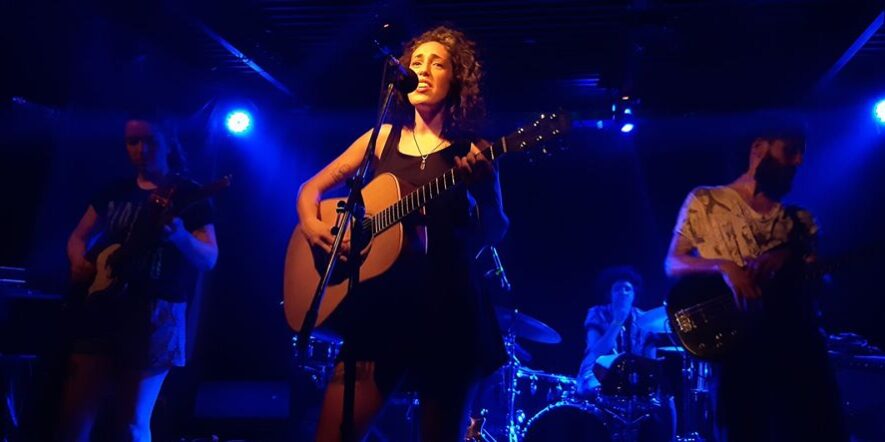
In the context of the pandemic, many artists from the Buenos Aires scene quickly migrated to the virtual, and live festivals on Instagram became everyday activities.

Share

By Veronica Stewart
The mandatory quarantine, decreed on March 20th in an effort to contain the spread of Covid-19, silenced Buenos Aires like never before. One of the city's most dynamic sectors, and therefore one of the hardest hit, is independent culture, where the offerings of concerts, plays, performances, and readings overflowed every day of the week. In the context of the pandemic, many artists quickly migrated to the virtual realm, and live festivals on Instagram became a daily occurrence. However, while artistic content may be guaranteed, the survival of the cultural centers that used to host these events is at risk.
“The outlook is bleak, bordering on apocalyptic,” Laura González, a member of MECA (Movement of Cultural and Artistic Spaces), explained to Presentes. MECA brings together 40 cultural spaces of varying sizes with a total of 700 workers; almost all of them work informally. The monthly fixed costs of these spaces total $15,000,000. “The truth is that if there isn't more substantial government assistance, a high percentage will close,” she asserted.
[READ ALSO: Transvestites and trans people in quarantine: evictions and housing emergency ]
In this context, MECA initiated a dialogue with the National Ministry of Culture regarding potential public policies and budgets to support the cultural sector. They are also in talks with the City's Ministry of Culture to secure extraordinary funding for the operation of cultural spaces. The situation in the cultural sector is critical, to the point that, in González's words, the objective of the negotiations is simply "to pay salaries and minimize debt. Many cultural spaces are non-profit civil associations, so they have no margin, no profit, no savings. Those who work in culture live day to day."
State aid
On April 11, the National Ministry of Culture established the Develop Fund through Resolution 260/2020 , with the aim of providing financial support to various cultural spaces during the Covid-19 pandemic. The total amount to be awarded is $30,000,000, which will be distributed among the projects selected through a call for proposals that began on April 13 and will remain open until May 12. These spaces must have a maximum capacity of 300 people. The selection criteria are: the space's track record and economic sustainability model, its impact on the community, the number of permanent employees, and the space's projected impact within the context of the aid program. To participate, cultural centers must complete a form on the Ministry's website.
LGBT cultural spaces
For Coni Majdalani, co-director of Feliza , the most difficult aspect of this situation is the uncertainty. “We already know that the entertainment sector will be the last to reopen, but without a clear outlook, it’s very difficult to have a plan of action,” she told Presentes. Echoing González’s analysis, Majdalani stated that it’s impossible to sustain the space for many more months under these conditions without some kind of assistance. Meanwhile, Camila Milagros Hoyo Veigas, director of Cultura Ambigú, emphasized the need for government intervention to prevent the closure of independent and self-managed cultural centers.
[READ ALSO Covid-19: Aid Campaigns ]
Although this situation applies to all cultural centers, the reality of LGBT spaces has its own particularities. “ We work with the most vulnerable population,” Lisa Kerner of Casa Brandon told Presentes. “Some are self-employed and will have access to government assistance, but others don't even have that. There is a much more vulnerable population that doesn't even know how to access these government resources. It's like confronting a system that constantly undermines them.” Casa Brandon and many other LGBT cultural spaces function as refuges for a community that, in many cases, has nowhere else to turn, and that comes to them not only in search of entertainment or artistic stimulation but, in Kerner's words, “to connect, to live together, to reflect.”

González expressed particular concern for the trans and travesti population, given their difficulty in finding employment outside of community circles. “The problem for the LGBT community is that it is generally more disadvantaged than society at large, so the interaction of minorities shapes identities, bodies. Any minority that cannot come together suffers more than society in general,” she added. For her part, Hoyo Veigas explained that “we are working with identities that fall outside the norm, and by falling outside the norm, they cannot find stable jobs. Ambigú is very trans and travesti, very marginalized, so it affects them differently than a cultural center that adheres to heteronormativity.”
Possible scenarios
The word that resonates most strongly in all these accounts is, perhaps, uncertainty. As singer-songwriter Paula Maffía explained to Presentes, outlining a possible scenario for when all this is over is futurology. However, reflecting on her own experience in the independent cultural scene, Maffía highlights how other critical situations, such as the Cromañón nightclub fire and many years of Macri's administration in the city and later at the national level, "strengthened a scene that was fragmented and highly depoliticized, raising its awareness as a political agent and energizing it." Feminism as a response to male violence in the early days of the Ni Una Menos movement had a similar effect: bringing together "various disciplines under the banner of cultural space as a trench," Maffía affirmed. “We’re making gold out of scum. I think this situation, besides being a huge economic blow and a wake-up call to how we’re working, will also bring new ways of caring for spaces, thinking about alternative subsidies, face-to-face patronage, online festivals. I don’t know how we’re going to solve it, I only know that we’re going to get through this because independent culture is also a virus.”
[READ ALSO: How quarantine is experienced at the Hotel Gondolín, home to 47 transvestites and trans people ]
For her part, Majdalani said that this “is going to affect us on every level, especially in person-to-person contact. I think it’s going to leave a deep mark because so many people are very affected, and obviously art is going to have to adapt to that.” She also expressed the need to rethink performance from a different perspective on physical closeness with others. González, on the other hand, explained that “the Buenos Aires and Argentine character is all about getting together, about the street, about public spaces, about celebrations. I don’t think that will change, because it’s deeply rooted in Argentine culture. I think that as soon as the quarantine ends, we’re all going to go out and hug each other.”
We are present
We are committed to journalism that delves into the territories and conducts thorough investigations, combined with new technologies and narrative formats. We want the protagonists, their stories, and their struggles to be present.
SUPPORT US

FOLLOW US
Related notes
We are present
This and other stories are not usually on the media agenda. Together we can bring them to light.