

COVID-19 – Argentina
Argentina has been under mandatory preventive isolation since March 19th and will remain so until May 24th. The country has entered phase 4 of the quarantine. The Ministry of Health publishes constantly updated reports on its website regarding the number of infections and deaths. As of May 11th, 6,034 cases had been recorded, of which 305…

Share

Argentina has been under mandatory preventive isolation since March 19th and will remain so until May 24th. The country has entered phase 4 of its quarantine. The Ministry of Health publishes constantly updated reports regarding the number of infections and deaths. As of May 11th, 6,034 cases had been recorded, of which 305 resulted in death.
At the beginning of the lockdown, trans activist Violeta Alegre Ríos published a letter addressed to the president asking how trans and travesti women who live from self-managed productions and/or prostitution will be able to comply with the measures: “Many of us do not have family and social support to take the proposed measures.”
Among the measures taken by the government is a ban on evictions for the duration of the quarantine. The President of Argentina reaffirmed this on Public Television in response to a question from Diana Zurco, the station's first transgender broadcaster .
Trans people, the most affected population
“ The most affected and vulnerable population during the pandemic is that of trans women. Because the number of trans women who still work in prostitution is very high in the province of Buenos Aires,” Daniela Castro, director of Sexual Diversity for that province, which has 17 million inhabitants and a large part of the LGBTI+ population, told Presentes.
“Our colleagues who used to receive a daily income no longer have the resources to guarantee a meal. The province of Buenos Aires is in crisis due to the emergency and because a large part of the LGBTI+ population lives here. We are receiving an enormous number of calls for help. The most urgent need is food , and we are working hard on this,” she reported.
To address this, the Ministry of Women, Gender Policies, and Diversity, headed by Estela Díaz, is working on several fronts. On one hand, together with the provincial Ministry of Development, they are "ensuring food baskets for these women in prostitution. We requested additional funding specifically to reach them, and it's already starting to be implemented," Castro stated.
On the other hand, with the National Women, Gender and Diversity program, they are working to allocate funds from the Hacemos Futuro program specifically for transvestites and transgender people. “It’s one of the first programs implemented. It provides 8,500 pesos. We already have more than 5,000 applications from our colleagues,” Castro said.
“We are strengthening food assistance for trans and gender-diverse people by incorporating them into the social programs of the @MDSNacion . Given the health emergency, it is essential to preserve the health and protect the rights of the most vulnerable,” the national ministry reported on its Twitter account.
The National Institute Against Discrimination and Xenophobia (INADI) reported that they are also working with the Ministry of Social Development to provide food assistance to transgender and transvestite individuals. "Through the Secretariat of Social Economy, all transgender and transvestite people in our country who do not have formal employment or who are in a situation of social vulnerability are being enrolled in the 'Potenciar Trabajo' (Strengthen Work) program," they stated. The program helps them complete their education, receive vocational training, and also supports entrepreneurial ventures they may develop within the framework of the informal economy.
"We successfully arranged for two trans women, who returned from Spain and were at risk of becoming homeless in the City of Buenos Aires, to find a place to complete their quarantine under the conditions recommended by the Ministry of Health of the Nation," shared INADI, where Ornella Infante, a trans activist, is in charge of the Directorate of Policies and Practices Against Discrimination.
National program for transvestites and trans people
Among the new measures announced by INADI is a specific program for transvestites and transgender people. This is the National Program for Socio-Productive Inclusion and Local Development : Potenciar Trabajo (Strengthening Work). It consists of the allocation of a supplementary social wage "corresponding to 50% of the Minimum Living Wage in order to satisfy basic needs and/or strengthen productive initiatives implemented by the beneficiaries."
Here you can access the requirements and the form.
Useful information for asking for help
Ministry of Women, Gender Policies and Diversity of the Province of Buenos Aires: (0221) 421 4035 and (0221) 421 3450
Sexual Diversity, Province of Buenos Aires Direcciondiversidadsexual@ministeriodelasmujeres.gba.gob.ar
INADI: You can request help via WhatsApp from 9 a.m. to 3 p.m. at the numbers 1164921079 / 1161853968 or by writing to 0800@inadi.gob.ar .
Line 144: for advice and support for victims of gender-based violence. This is not an emergency line. In case of emergency, call 911.
PBA Mental Health Helpline: 08002225462
If you see homeless people in the province of Buenos Aires, please report it to: 0800 666 7232
Campaigns: We all take care of each other
Social organizations and LGBTQ+ activist groups are calling for donations of money or essential supplies to be distributed among members of the community. The LGBTQ+ Network: “We Take Care of Each Other” is an initiative of 100% Diversity and Rights, along with La Rosa Naranja and members of Orgullo en Lucha (Pride in Struggle). The network is already working to reach various cities in Argentina.
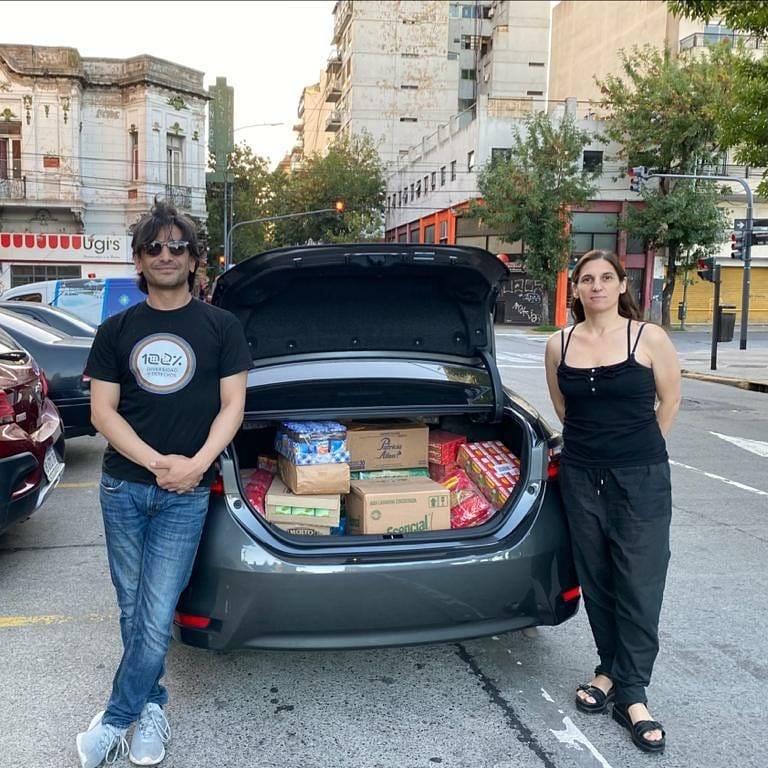
To donate to We take care of each other: http://bit.ly/noscuidamosentretode s
Read also:
trans people deprived of liberty
Otrans Argentina, based in La Plata, expressed concern “about the sanitary conditions, prevention and containment of the coronavirus in prison settings, as well as the lack of food.” The organization is requesting donations for “fellow inmates housed in Penitentiary Unit No. 2 in Sierra Chica,” who are not receiving visitors due to the preventative isolation measures.
They are asking for food, but also fabric and surgical interfacing. Transvestites and transgender people deprived of their liberty want to use the six sewing machines they have to make face masks for themselves and for others who need them.
To donate: contactootrans@gmail.com

Health and access to medication
Other significant situations involve complaints from people living with chronic illnesses who have difficulty accessing medication. “Starting today in the province of Buenos Aires, a mobile unit from the Ministry of Women, Gender Policies and Diversity is distributing medication and prescriptions to those who urgently need them and cannot leave their homes,” Daniela Castro told Presentes.
With some municipalities closing their borders and police forces in charge of controlling movement, a complex situation has arisen. “The security forces include sectors that have historically discriminated against LGBT+ people, and it is sometimes difficult to get them to allow movement, for example, for transvestites and trans people who need to go to a health center or pharmacy,” says Castro.
Read also:
The Ministry of Health, in line with international organizations, reported that HIV-positive individuals with a healthy CD4 count (above 350 cells/mm³) and an undetectable and controlled viral load are no more at risk from the coronavirus than a person who is HIV-negative. If they require leave, they can take it without compromising the confidentiality of their diagnosis. This is specified in Article 7 of Resolution 627/2020, , regarding isolation measures.
If you need medication, the Ministry's AIDS Department provides phone numbers where you can find out how to proceed . If you need to travel, it is recommended that you carry documentation proving you are going to pick up medication and print (or write by hand) the following document.
Read more
Share
We are present
We are committed to journalism that delves into the territories and conducts thorough investigations, combined with new technologies and narrative formats. We want the protagonists, their stories, and their struggles to be present.
SUPPORT US

FOLLOW US
Related notes

We are present
This and other stories are not usually on the media agenda. Together we can bring them to light.