

Being trans in the '90s: postcards and stories from Uruguay
The public debates surrounding the Comprehensive Law for Trans People allowed a narrative to emerge in Uruguay focused on state violence during the dictatorship and the early years of democracy. Another story, that of survival strategies, activism, and the creation of essential networks and connections, remained in the background. A series…

Share


Written by: Diego Sempol and Karina Pankievich *
The 1990s were marked by the neoliberal push, which eroded the centrality of party politics in daily life. Traditional forms of activism entered a profound crisis. Despite this context, for the Uruguayan trans population, those years were a turning point: for the first time in Uruguay, a transvestite politics emerged, politicizing gender identity, creating its own organizations, and demanding in the public sphere an end to police repression and the creation of dignified employment opportunities.
This activism dealt with the narrow margins imposed by the governments of Luis Alberto Lacalle and Julio María Sanguinetti, which promoted a model of subordinating integration of sexual dissidence anchored in the notion of tolerance: the State was willing to reduce violence and exclusion, as long as neither normalizing visibility nor demands for equality in any area were required.

In that context, the demands of the Transgender Coordinating Committee, and later the Trans Association of Uruguay, focused on achieving “negative rights”: the end of discrimination and liberation from forms of police domination and control. These objectives would be achieved later, at the beginning of the 21st century, thanks to a sustained effort. The turning point was the approval, in 2002, of the law on sex work, which legalized the activity and undermined forms of police surveillance of transgender people in the streets.

This first wave of negative rights enabled a second phase, this time focused on positive rights, when the tolerant integration model was replaced by one based on equality and civil rights. The change occurred gradually after the Broad Front came to power in 2005. During this progressive period, the law allowing changes to gender and name on identification documents was passed in 2009, and the Comprehensive Law for Transgender People was approved in 2018.
The debates surrounding the comprehensive law profoundly shaped the social consciousness and molded trans memories of the recent past in the public sphere. The first public eruption of these memories of state violence during the dictatorship and the early years of democracy occurred on September 20, 2017, during the presentation of the bill in the Acuña de Figueroa room of the Legislative Palace. When given the floor, activist Antonella Fialho stepped down from the podium, approached the audience attending the session, and said:
Now, more than ever, they won't silence us. It's time to break the silence. They made us urinate on ourselves, waterboarded us, made us clean dungeons… so many atrocities. We are politically aware. That's why no more tears, no more silence, no more keeping quiet. Yes to the comprehensive law! Legislators, we have broken the silence, are you listening to us?

And, waving her hands with closed fists, she began to chant, inviting all those present to join in: “Trans, consciousness, memory and resistance! Trans, consciousness, memory and resistance!” The room erupted, and all those present chanted the slogan in unison just before Fialho closed her speech with a resounding applause.
The episode marked the emergence of a series of testimonies that broke a long silence and challenged Uruguay's recent past and the official narratives about state violence during that period. However, the debate during the law's approval and the subsequent pre-referendum reduced the public space for trans experiences to be expressed, making some aspects of them more visible than others.
[READ ALSO: Uruguay's trans law: reparations pensions will begin to be paid today ]
The accusation by some legislators that providing reparations to victims of state violence was creating a privilege ultimately reinforced the testimonies denouncing the forms of violence suffered. The strategies of trans people to confront and survive persecution—that is, the resistance Fialho described—were relegated to the background.
In this way, formal and informal support networks, the role of humor in coping with adversity, and spaces for encounter and integration disappeared from public accounts. These aspects were very much present in the few public testimonies of transvestites produced in other contexts, prior to the debate on the comprehensive law, when there was still a significant silence regarding state violence. One example is the book * Recuerdos del travesti más viejo de América del Sur * (1991), by NN Argañaraz and Antonio Ladra, with the testimonies of Gloria Meneses about the Montevideo carnival, her friends and boyfriends, the parties, and the Afro-Brazilian temples she joined.


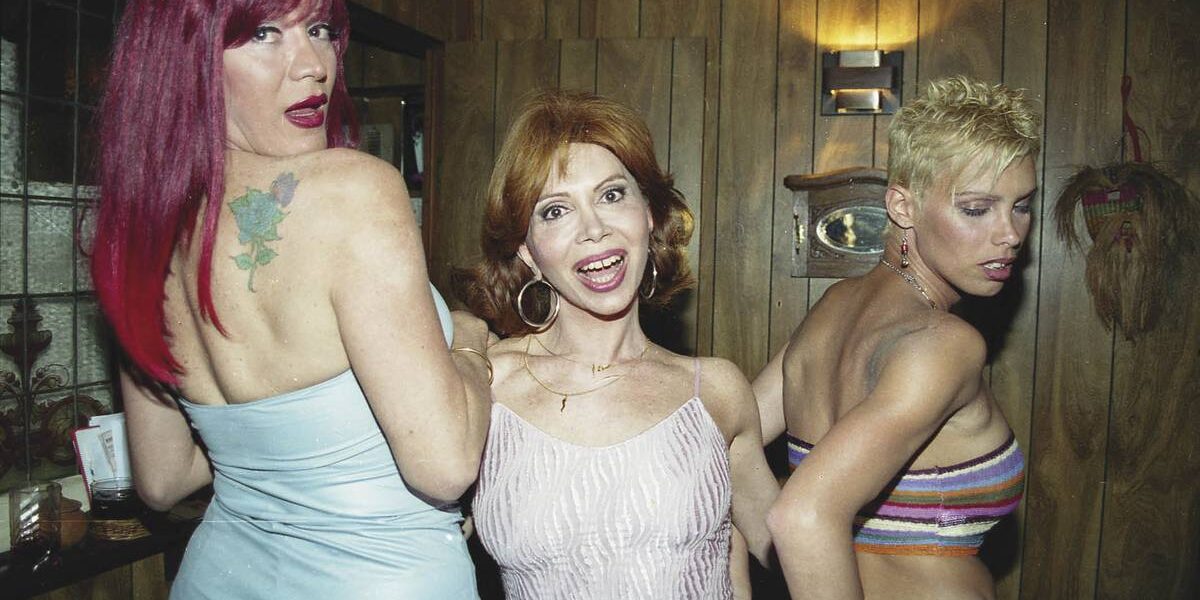
Forbidden parties and queer culture
We didn't have places to meet. Clubs often wouldn't let you in, and on the street you were working, always at risk. So, finding a place to meet was crucial. Twenty years ago, it was almost impossible to rent an apartment or a house. We all lived in boarding houses. It was very difficult to find someone to act as your guarantor, or even to get the landlord to agree to rent to you, even with everything in order. Sometimes landlords were afraid or wanted to avoid problems with the neighbors. At that time, it was thought that if you were a "transvestite"—as they were called back then—you were bound to cause trouble with the police and create a dangerous environment, full of alcohol, drugs, violence, and robberies.
That's why when one of us managed to get a house, we all took advantage of it.
I remember that in Paso Molino, the late Alicia used to throw parties, and there would be between 30 and 40 of us girls. We'd get together beforehand with family and some acquaintances, and then at night we'd have a huge party with all the girls.
They were forbidden parties: it was hard to find a place, and then, on top of that, you had to be careful to avoid complaints from the neighbors, the police… Back then, we also held happenings every 29th of the month in Madame Lulu's little apartment. We all brought fritters and cakes, and within those four walls, we'd set up a record player and dance together. Those were our meeting places.
He was a podiatrist, but at night he transformed into Madame Lulu. We jokingly called him "the lady of the seven veils" because he was constantly changing his clothes. He'd grab a curtain and make a turban, or a sheet and improvise a dress. We spent our nights like that, laughing amongst ourselves during these gatherings. We loved them because it was a place where we could relax a little and escape the repression we suffered daily.
Also, going out dancing in the '80s and '90s was complicated. The club owners would tell you, "The house reserves the right of admission." If they saw you dressed too much, too made up, they wouldn't let you in. It happened to me several times. "No, you can't come in, you're too dressed up. They'll take you away, and I don't want any trouble." They had to see you as gay to let you in. There was also the fact that if you were trans, they looked at you askance. The circuit in the '90s was Ibiza, Arcoíris, Metrópolis, and Spock. Then there was Escorpio, where we were more accepted, and the tango club Lo de Margot, which once a week was for trans people, and you could go in. We went there several times, and the truth is, the place was lovely.
Birthdays were one of the most frequent excuses for us to get together. I remember Doriana had recently returned from Paris and celebrated her birthday at her house. She was one of those who left during the dictatorship, at its worst, and stayed in Europe for years. She even worked for a while as a dancer at the Le Carrousel cabaret. But in the late 80s, she returned to Uruguay, and she always invited us to her birthday parties. Everyone came to her celebrations.
In the 1990s, some vestiges of what had been known as "queer culture" still remained. For much of the 20th century, Montevideo had tenement houses, meeting places for Afro-Uruguayans, gay men, and women heads of household. Many friendships were forged around a communal sink while washing clothes, or eating from a pot to which everyone contributed.

In “'Queer' Memory: A Time, a Mark of Identity, of Gender and Race…,” Beatriz Ramírez eloquently portrays these networks and their impact on people's daily lives. Sometimes people met there, sometimes in the hustle and bustle of the night, sometimes at the police station or during long hours of detention.
Before, it didn't matter if you were trans or not; they saw you as gay and put you on the bus, and then you'd argue about whether you were trans or not. It didn't matter. And if they saw you were effeminate, you were dead. There was a kind of continuum between transvestites and gay men, many connections and shifts between the person who sewed for carnival costumes, the dancers in one or another troupe, and the transvestites who worked in a cabaret or at night. Martha Gularte and her daughter Katy would go to the occasional birthday party of trans friends.
These networks still existed in the 1990s, allowing people to move between these different settings without major problems. That's why these intimate and popular parties on the fringes of possibility are almost a kaleidoscope of discrimination and old patterns of encounter and recognition, micro-spaces of resistance where intersectionality brings to light encounters that are quite improbable today. Together, they confronted exclusion and violence by relying on support networks and exchanging work and services. In doing so, they built an alternative space for sociability, access to clandestine body transformation techniques, and a commercial circuit of objects and products specific to this micro-society.
This text and photos were originally published in Lento magazine.
We are present
We are committed to journalism that delves into the territories and conducts thorough investigations, combined with new technologies and narrative formats. We want the protagonists, their stories, and their struggles to be present.
SUPPORT US

FOLLOW US
Related notes
We are present
This and other stories are not usually on the media agenda. Together we can bring them to light.