

There are now two trans mothers receiving the universal child allowance
Roxana is the second trans mother in Argentina who successfully obtained the AUH (Universal Child Allowance) for her son.


Share

By Silvina Mernes
As soon as she learned that her disabled sister was pregnant, Roxana López decided to take care of the baby. She accompanied her sister throughout the pregnancy, was with her during childbirth, and has been caring for Mateo since he was born. For him, she is his mother.
Roxana is a trans mother who lives in the city of Concordia in Entre Ríos and, to support herself and her son, she works from home as a seamstress.
It was only a year ago that she learned she had the possibility—and the right—to apply for the Universal Child Allowance for her son. Darío Pérez, coordinator of the Sexual Diversity Area of the Municipality of Concordia, informed her of this when she went there to participate in the workshops offered.
[READ ALSO: Trans Dad and Mom: The Story of the Argentinian Family That Became a Comic Book ]
“I started the process for the Child Allowance last October, always with the support of Mr. Darío Pérez,” Roxana told Presentes. She began with some skepticism: “I didn’t think they would give it to me, being a trans mother. I also thought it would take a long time, three, four, five years.” But none of that happened. “I received the card a few days ago and I’ve already activated it. Now I just have to go to the bank to collect the money,” she said happily.
While the process was resolved fairly quickly, it wasn't that simple: it was necessary to demonstrate to ANSES (the agency responsible for granting these allowances) that the woman, who is the child's biological aunt, is also their primary caregiver. This was done by invoking Addendum 63, a tool that the Ministry of Social Development incorporated to expedite and simplify the transfer of AUH (Universal Child Allowance) status when one person is listed on the allowance, but another is the primary caregiver.
[READ ALSO: Trans mom: "I'm going to raise him with the freedom that was denied to me" ]
“We had to provide proof of a series of requirements. For example, we submitted a school report to attest to how the child attends school, the hygiene conditions, and so on. We also provided a vaccination certificate, which always indicated Roxana's presence,” the coordinator of the Diversity Area, who oversaw all the procedures for processing the AUH (Universal Child Allowance), explained to Presentes . The application was ultimately approved.
“I’m so happy about my achievement, my effort, my sacrifice, my consistency. And most of all for my son, because this is something else I can give him. I’m a hard-working, determined mom, I always take the long way around. And this helps a lot,” Roxana emphasized, now holding the card in her hand.
She also considered that her case "is another door that has opened, not only for me but for other trans mothers or for grandmothers who raise their grandchildren without receiving the AUH (Universal Child Allowance)."
The first case
Roxana is the second trans mother in Argentina to successfully obtain the AUH (Universal Child Allowance) for her child. The first was Georgina Soledad Leguizamón. Also from Concordia, her case took considerably longer to resolve: eight years.
Georgina has been caring for her son Dylan Daniel since he was born in March 2010. The process for obtaining the allowance should have been simpler because she was listed on the birth certificate. “The boy was in my care and had my last name because I acknowledged him. But when he was born, I hadn't yet legally changed my gender,” Georgina explained in an interview with Presentes .
Despite the fact that the Gender Identity Law has been in effect in Argentina since 2012, that difference between the name that appeared on the birth certificate and Georgina's new identity was the excuse to put obstacles in her way.
“When I went to ANSES to apply for the child allowance, they told me I couldn't receive it because I wasn't the mother,” said Roxana, who regularly returned to the agency to begin the process. But the obstacles didn't stop: they told her some document was missing or demanded new ones. The process dragged on. “I spent eight years going back and forth without any answers, always waiting and always respectfully. The humiliation I suffered during that time when they denied me the payment was immense,” Georgina lamented. “But I kept going because that allowance was something that belonged to my son,” she emphasized.
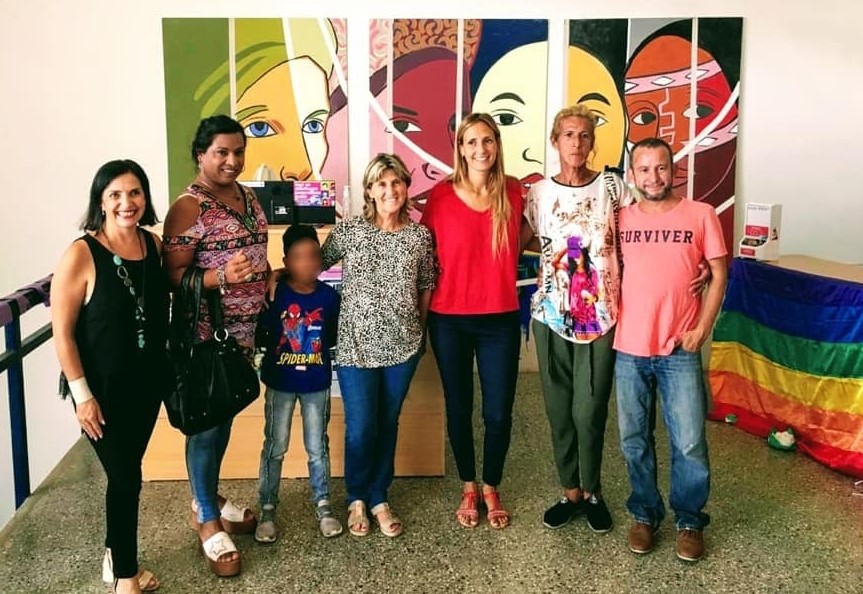
The situation began to improve when she approached the Diversity Area and received advice and support from the team of the Directorate of Preventive Management and Promotion, and from the legal area of the Municipality of Concordia.
Faced with ANSES's persistent refusal, the team decided to take legal action. They filed an expedited legal action (similar to an injunction) and, with the intervention of Judge Rodolfo Jáuregui of Family Court No. 2 in Concordia and attorney Lorena Pignataro, they finally obtained the benefit in August 2018.
The case of Georgina – considered a test case – highlighted the lack of adaptation of Anses to the Gender Identity Law.
Political decision
Given their individual circumstances, the cases of Georgina and Roxana are unprecedented in the country. Both occurred in the city of Concordia, in the province of Entre Ríos. “These cases didn't happen by chance: they were achieved thanks to the truly serious and committed work we've been doing with our colleagues,” Darío Pérez emphasized.
He highlighted the political decision of the previous mayor, Enrique Cresto, to create the Sexual Diversity Area within the municipality. “It was one of the first in the province, when there wasn't even one at the provincial level yet,” he recalled, emphasizing the “complete freedom” with which they have been able to work and give the area “content and a theoretical framework, which has always been about greater equality, inclusion, and rights, and which remains the guiding principle to this day.”
[READ ALSO: Tiziana, a trans girl from Salta: dancing, resisting and growing old ]
María de los Ángeles Petit, institutional advisor to the Concordia municipal government, expressed a similar sentiment: “Every municipality must understand the importance of having a Diversity Area within its organizational structure. Because all cities need these spaces where people can go to learn about and defend their rights,” she stated in an interview with local television.
This space—which reports to the Directorate of Preventive Management and Promotion of the Municipality's Secretariat of Social Development—works continuously on the inclusion of transgender people. “We work with programs like 'Hacemos Futuro' (We Make the Future), which allows our colleagues to receive training and finish school,” said Darío Pérez, adding that “many of them have learned to read and write, and others are currently enrolled in school.”
“And we continue for more: we want to include our colleagues in housing programs that the Municipality has and, if possible, try to make some modifications to the regulations of the IAPV (Autonomous Institute of Planning and Housing) so that they are taken into account,” she also announced.
After highlighting the coordinated work they maintain with the Anses delegation and the Ministry of Social Development of the Nation, the municipal official assured in statements to Presentes that they will continue “working side by side and coordinating policies of inclusion, equality and respect for the entire community, but mainly for our trans comrades.”
[READ ALSO: Together and United: the trans cooperative that cares for the elderly ]
“It is a great source of pride that these first two cases occurred in Concordia. This is not only due to the efforts we made in the Area, but also to the empowerment of our colleagues, who have grown stronger. They empowered themselves, took up the fight for their children as subjects of rights, and asserted their rights,” Pérez stated.
“It is very important to recognize that beyond our management, which is simply accompaniment and knowing how to coordinate, there is the empowerment and strengthening of our colleagues so that they can demand their rights,” she added.
Finally, she emphasized: “We want these cases to be known, so that our colleagues throughout the country can take them as a starting point and be encouraged to become subjects of rights.”
]]>We are present
We are committed to journalism that delves into the territories and conducts thorough investigations, combined with new technologies and narrative formats. We want the protagonists, their stories, and their struggles to be present.
SUPPORT US

FOLLOW US
Related notes
We are present
This and other stories are not usually on the media agenda. Together we can bring them to light.