

Feminisms and journalism: 10 survival stories
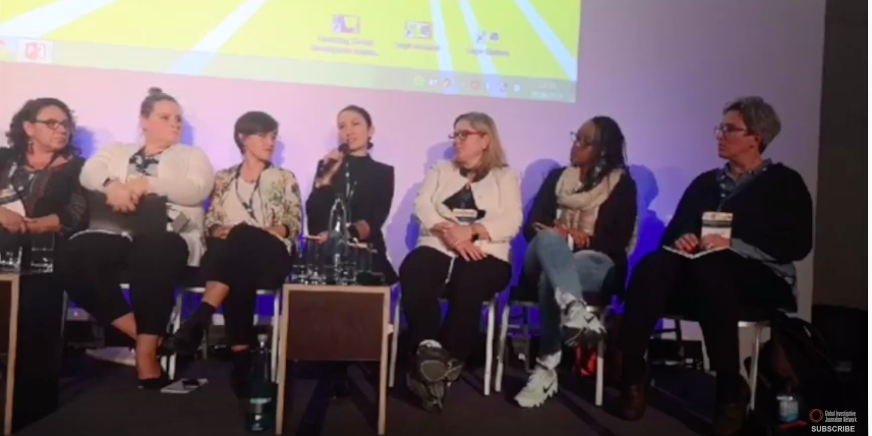
Ten women journalists shared their experiences and lessons learned in one of the most impactful sessions of the 11th Global Conference on Investigative Journalism.

Share

“I confess that when I was invited to participate in this talk, I felt a little intimidated and a little angry about the title. Why a session for women investigative journalists? Is there a similar call for male journalists at this conference?” said Alejandra Xanic von Bertrab, a Mexican journalist, Pulitzer Prize winner, and co-founder of Quinto Elemento Lab.
We were in Hamburg, in the enormous, sterile hall of a German university, HafenCity Universität (HCU), listening to a string of confessions rarely shared in public. Xanic was the last of ten speakers at the talk titled "Survival Strategies of Women Investigative Journalists." She said this after sharing that what she had heard so far had "shaken her to the bone. It's surprising how relevant it is and how much we can learn from each other."
Ninety-nine percent of us sitting there listening to the lessons learned from ten women journalists—the most awarded in the world of investigative journalism—were also women. At the beginning of the session, one of the very few male journalists who had come to the talk threatened to leave when he looked around and thought he'd made a mistake and shouldn't be there. The female reporters in the audience and the moderator, Sheila Coronel, asked him to please stay and listen, and they applauded loudly until they convinced him. Journalistic curiosity about what these outstanding journalists had to say about the challenges and experiences the profession holds for women hasn't yet taken hold in newsrooms with such force. And while none of those who shared their lessons learned and experiences were journalists who write about feminism or gender, their experiences reflected many of the issues debated in those fields: attacks for being women, discrimination, and even rape by a colleague.
This panel reflected how much work remains to be done within newsrooms and also the enormous impact of women at the 11th Global Investigative Journalism Conference (#GIJC19). The event carries significant weight: it is the world's largest gathering of investigative journalists. It is convened by the GIJN (Global Investigative Journalism Network), a global network of 182 organizations dedicated to in-depth reporting. This edition broke its own records, bringing together 1,700 colleagues from 130 countries in Hamburg at the end of September. The majority of the organizing committee members were women. There was gender parity in the talks and workshops, and childcare services were available for those who wished to attend with children. The Conference closed with a speech by Maria Ressa, the Filipina CEO and executive editor of Rappler, who received a standing ovation from the audience.
Rappler is a Philippine news outlet that has been attacked by the Rodrigo Duterte government and by trolls. Patricia Evangelista, one of the reporters who participated in this survival strategies panel, was also a winner of the 2019 Global Shining Light Award for her investigations into extrajudicial killings in the Philippines' war on drugs.
A matriarchal newsroom
“Rappler is a matriarchy, a family where your bosses are like aunts who understand premenstrual syndrome and the post-traumatic stress that some assignments generate. They also know when you need a break.” Among her strategies, Evangelista emphasized that beyond Rappler’s strict security protocols, it’s crucial for her to have bosses who combine journalistic rigor and insight with a strong culture of care and support. “It’s also a media outlet with a tradition of women journalists. I come from that lineage; thanks to the journalists who survived torture, dictators, and threats, I’m able to be here,” she said.
Learning to say no
“Which story would you prefer I tell you? My Instagram story or my real-life story? You can’t tell both.” This is how Miranda Patrucic, a young and multi-award-winning journalist based in Sarajevo and editor of the Organized Crime & Corruption Reporting Project, began her testimony. “My career path was unusual. I went from being a regional reporter to a global reporter covering one of the most dangerous regions: Central Asia. Many women approached me and told me I was a hero because I was young and doing something no one else was doing. For a long time, I wanted to live like a hero, a superwoman who worked 24 hours a day, giving talks and hosting events.”
Miranda confessed: during those days of awards and conferences, when she was alone she felt like she was falling apart. She felt so much pressure that at one point she couldn't even understand what she was reading. She had panic attacks and pneumonia. “I felt like I was failing right at the moment of greatest recognition. Until my head exploded,” she said. She suffered burnout . She couldn't remember her neighbors' names. “It took me a year to recover from what I had done to myself by putting so much pressure on myself.” I learned that I'm human, I learned that I can't say yes to everything. That the day has 24 hours and it's good to choose what I want to do. I can't be perfect…at least not all the time,” she laughed.
Find non-sexist strategies for processing violence
“I want to share how female reporters in Mexico learned to cover violence,” said Marcela Turati, co-founder of Quinto Elemento Lab in Mexico and winner of numerous awards, including the LASA Media Award. A few years ago, when the magazine she worked for sent her to cover harrowing stories—mothers searching for missing children, mass graves—she would return to the newsroom wanting to talk about what she had seen and heard, but also about what it had stirred within her. She soon realized that if her bosses found her too “emotional,” they would transfer her to another section. So she did what almost everyone else did: go to bars at night with other journalists and talk about these things. She would occasionally see a drunk photographer crying.
“But lately, another question has arisen among my female colleagues: why can’t we talk openly about what happens to us and what we experience when we cover these topics?”
Turati spent the last few years mapping mass graves for her work, "The Country of Two Thousand Graves," which won the 2019 Gabo Award (Coverage). “After two years of reporting with a team of women, we realized that we were all having nightmares, or that someone would stop answering their phone because they were paralyzed with fear. Other things were happening to us.” They felt the need to do something that would allow them to express what was happening in their lives as a result of that research.
“We fostered a system of support among ourselves. We started calling each other to talk about life and check in on how we were doing. We set an emotional deadline for work because one of the journalists was pregnant. But we also learned when someone needs a break. We went to a Temazcal (sweat lodge) to begin with protection. We started talking about these issues, crying, releasing some of what we carry in our bodies, weaving our networks. And on one occasion, we called a shaman,” Marcela recounted .
At one of these energy-cleansing ceremonies, male colleagues joined in. “In the end, he thanked me for inviting him. He had been suffering from insomnia for months because of the danger he lives with. ‘I was finally able to sleep,’ he told me. Women find other ways to deal with violence. And they aren’t the typical macho ways.” This Mexican colleague coordinates many workshops for journalists and has also begun working there with these other, non-masculine ways of addressing stress, pain, and violence.
Investigate your rape until justice is served
“My story is a little different. While we all investigate traumatic things here, I ended up investigating my own rape,” shared Shiori Ito, the Japanese journalist and filmmaker who in 2015 was raped by a well-known colleague close to the country’s prime minister, becoming a symbol of the #MeToo movement. When she went to the police to report it, they told her that these things happened every day. She also received no answers from the justice system, which dismissed her complaint at the time. So she began recording everything she was told and conducting her own investigation, which she published in the book Black Box, now translated into six languages.
“The saddest thing was that despite having the evidence, nothing happened.” Shiori spoke of the pact of silence and sexism in the Japanese media, and recounted receiving attacks and threats. She could no longer work in Japan and began collaborating with media outlets based in London, where she now lives. “My editors in London were incredibly supportive, even during my recovery from the trauma.”
The rapist ended up suing her. But in December 2019, the Tokyo Civil Court ruled in Shiori's favor, finding that she "was forced to have sex without contraception while in a state of unconsciousness and severe intoxication." "My story is difficult and personal, hard to confront. But we have the ability to investigate, and therein lies our power."
Prioritize themes and sources
Oriana Zill , a producer for CBS News' 60 Minutes, one of the most-watched programs on American television, acknowledges that she was fortunate in a way others weren't. She also has a team where half the producers are women. “I asked myself how I could contribute to change. And one of the answers was to interview women to balance out the fact that so often the interviewees are men. I also try to choose topics that highlight issues affecting women.”
Oriana recounted how deeply she felt compelled, as a mother, to confront the plight of migrant children following the Trump administration's "zero tolerance" policy. At the border, thousands are separated from their parents and left alone in institutions that make no effort to reunite them with their families. "The government isn't taking responsibility for them," she emphasized. "We didn't even know how many there were." One of her latest investigations documented their cases.
Do not act recklessly
Asha Mwilu, a Kenyan journalist, was named Africa's Best Journalist in 2016. In this talk, she spoke about her investigations and how she often ignored threats and warnings that she could be the next victim of the violence she was investigating. “The biggest lesson I learned is not to be reckless.” That meant learning to say no, to ask for fair pay, and to demand safe working conditions when investigating high-risk topics. It's very important to learn to build a community around you. At the end of the day, it's your life. The story is important, but so are you.”
Don't let sexist criticism get under your skin
Minna Knus-Galan, an investigative journalist for Finnish television, lives in the country with the least corruption and greatest gender equality in the world. And yet, Minna said that despite the differences that may exist with the realities of women journalists in Mexico or the Philippines, “we have common problems.”
On his desk, he has a diagram that reminds him of the phases of the creative-journalistic process:
- This is wonderful
- This is difficult
- This is shit
- I'm shit
- This could be okay
- This is wonderful
“While it applies to both men and women, it's more useful for women because we're always under more scrutiny. And even more so if we cover tough topics, like financial crimes.” Despite her country's high gender parity rates, she was accused of being “a good but inexperienced reporter” for her investigations into the Finnish tax system, even though she had been working in the field for years.
“They’re simply sexist comments. Like when another colleague who did thorough research ended up being criticized on social media for the size of her breasts. Personally, I think it’s good sometimes to put other people on the front lines to act as buffers, instead of responding directly. We shouldn’t let sexist criticism get under our skin.”
Taking care of mental health
Juliane Löffler of BuzzFeed News recounted an investigation that marked a turning point in her career: her interview with an intersex person. When the interview was nearing publication, the person told her they weren't sure if they wanted the story to be released. Juliane said they spoke for three hours. She showed them the photos and texts and convinced them. Twenty minutes after the story was to be published, the same person called to say, "I wish this had never been made public." "It was the most bitter moment I've experienced in journalism. Since then, I've vowed never to pressure someone into doing a story again if it involves a vulnerable minority."
Juliane also shared that she conducted many interviews for another research project with people who had been sexually abused. She and a colleague spoke with their boss and ended up seeking psychological support to cope with the stress it was causing them. “Now I’m able to stop and ask myself, ‘What do I need to feel better and keep going?’ I take breaks and every now and then I go offline for a couple of days. I realize that nothing stops. This, in addition to providing insight, also gives my ego a bit of perspective. Life goes on without me. Plus, I have a small garden at home. It’s good to know there’s a place to pause that I can always return to.”
Let motherhood stop being a silent conversation
“I’d like to talk to you about something I haven’t discussed with other journalists; it’s a topic that’s generally not talked about.” Martha Mendoza—a Pulitzer Prize-winning journalist with the Associated Press based in California—raised what she defined as a “silent conversation” that arises when we become mothers and are constantly making small adjustments to balance raising children with our journalistic work. Many of these adjustments are based on camaraderie with other colleagues. A mother of four, she recounted how she often brought her children with her to interviews, such as when she interviewed a Facebook executive.
Take time to think, listen to your own voice, and return to the streets
Alejandra Xanic von Bertrab, the journalist who felt intimidated by the title of this talk, stated: “I’m not a mother, and for us it’s difficult to find balance. We don’t have to rush home; we don’t have children. And that makes our connection with the world different.” Xanic said that those without children must intentionally seek something that doesn’t come naturally to them: contact with younger generations.
She also highlighted two aspects: firstly, the need to dedicate sufficient time to thinking about research , not just conducting it ; and secondly, learning to listen to our own inner voice , "which we sometimes ignore." Xanic offered a hypothesis: because of our cycles, women are trained to understand certain things. All research has its ups and downs, its twists and turns; we must learn to recognize them. And we mustn't get lost in documents and offices, now that so much of the work is done online. We must know how to take advantage of certain times to disconnect and reconnect with the streets.
*María Eugenia Ludueña, co-director of Agencia Presentes, participated at the end of September 2019 in the Global Conference on Investigative Journalism (#GIJC19), where she shared experiences of Presentes in two talks: Coverage of hate crimes and extremist groups and Investigations you've never heard of .
]]>Share
We are present
We are committed to journalism that delves into the territories and conducts thorough investigations, combined with new technologies and narrative formats. We want the protagonists, their stories, and their struggles to be present.
SUPPORT US

FOLLOW US
Related notes
We are present
This and other stories are not usually on the media agenda. Together we can bring them to light.