

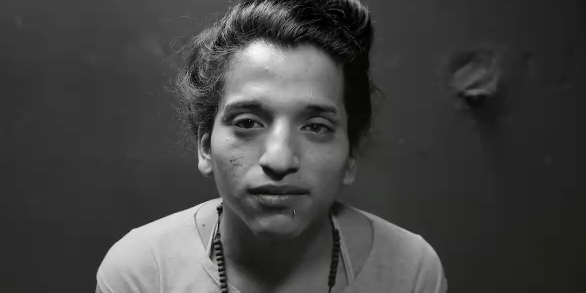
They are asking for the acquittal of Luz Aimé Díaz, imprisoned for being a transvestite, a migrant, and poor.
In July 2018, the 22-year-old woman was charged with “aggravated robbery and aggravated kidnapping.” She spent eight months in Ezeiza Prison and is currently under house arrest. The oral trial begins on September 11. By Alejandra Zani [News originally published on January 20] In…

Share

In July 2018, the 22-year-old woman was charged with aggravated robbery and aggravated kidnapping. She spent eight months in Ezeiza prison and is currently under house arrest. The trial begins on September 11.
By Alejandra Zani
[News originally published on January 20]
In a room at the Hotel Gondolín , serving her house arrest, Luz Aimé Díaz (22) awaits her trial. She is accused of "aggravated robbery and aggravated kidnapping" in a crime that her defense maintains she had no knowledge of or involvement in. This accusation earned her eight months in prison at the Ezeiza Penitentiary.
“One night in 2018, Luz was working on a street corner in the Palermo neighborhood when two people hired her for sex work. She was taken to an apartment where she performed her services and then left. Two months later, while working on the same corner, she was arrested. She was accused of a crime that occurred in the apartment where she had been, but which she knew nothing about,” Andrea Alcalde, a teacher at the Mocha Celis Trans Popular High School, explained to Presentes.
It was later learned that, shortly before Luz entered the apartment, the people who had requested her services had tied up and assaulted a 50-year-old LGBT+ man in an adjoining room. He survived the attack, though seriously injured.
Luz's presence in the apartment was considered sufficient evidence by the Judiciary, which failed to investigate the presence of other people at the scene. “These are people who have vanished without a trace. The prosecutor didn't even delve deeper or try to find them. That's why we say the justice system is patriarchal, sexist, and heteronormative, because it seeks to blame a trans woman who was simply doing her job and accuses her of organizing a crime against a member of the community, when the real perpetrators are free and likely continue committing the same crimes,” Alcalde continues. For this reason, and since July 2018, Luz has been held in pretrial detention at the disposal of Criminal Court Number 40, presided over by Judge Paula González.
A binary and heteronormative justice system
Initially, Luz was assigned a public defender who lacked gender perspective training and disrespected her identity. They called her "the transvestite." "That's why we decided to form a justice committee made up of teachers from the high school, lawyers, and a psychologist," Alcalde explains. A private defense team was also proposed for Luz, comprised of lawyer Luli Sánchez, who also worked on Diana Sacayán ; Natalia Dalessandro, who was involved in the prosecution against Lucas Carrasco; and Lara Bertolini, a trans theorist, activist, and court worker.
For eight months, Luz was deprived of her liberty in the Ezeiza Penitentiary. The Commission for Memory (CPM), through its Committee Against Torture program, stated in a 2019 report on places of confinement in the province of Buenos Aires that “the abusive use of pretrial detention has specific consequences for transvestites and trans people.” This is because “the systems of exclusion they experience before entering prison are exacerbated by incarceration and greater exposure to violence,” and the report concludes that “this context of structural inequality is not taken into account by the Judiciary when deciding on pretrial detention.” She was only granted house arrest in April 2019.
[READ ALSO: Report: Transvestites and trans people in Argentine prisons: more migrants, young people and without convictions ]
For Lara Bertolini, the binary and heteronormative judicial system operates according to a binary logic that fails to consider other identities and their specific challenges. “Luz doesn't have the same access to education as most people, nor does she have the power in society to form a gang and organize a crime. We're talking about Luz Aimé, a young woman with a severe eye disability that limits her in many ways, and this, combined with her trans identity and her lack of awareness of what happened in the apartment, suggests that she is not guilty.”
“Prosecuted for being a transvestite and a migrant”
Luz was born in Salta. At age 13, she began prostituting herself, which exposed her to extreme violence. She suffered three transphobic attacks that left her completely blind in one eye. She only has partial vision in her right eye and suffers from recurring cataracts. These attacks went unpunished.
[READ ALSO: Hotel Gondolín: an alternative housing option for transvestites and trans people in Buenos Aires ]
In 2017, at just 20 years old, Luz left her native Salta and arrived in Buenos Aires. There, she began studying at the Mocha Celis Trans Popular High School with the intention of finding new jobs. “She also started the process of obtaining her disability certificate at the Pedro Lagleyze Ophthalmological Institute,” explains Alcalde. “Imagine her living in an apartment, at night, in the dark, with a severe vision problem; she could never see what was happening inside other rooms of the apartment.”
For this reason, and as it corresponds to her by subsection C of article 32 of the law on the execution of the sentence of deprivation of liberty (law 24.660) which orders to grant the benefit in case the stay in the prison of the disabled person is inadequate due to his condition and/or receives an undignified, inhuman or cruel treatment, Luz was granted house arrest.
“She is being judged and prosecuted for being a trans woman, for having a visual impairment, and for being an internal migrant. What happened to Luz happened to all of us,” Bertolini explains. The structural violence of the judicial system is not only institutional violence, but also gender-based violence. During the investigation, the prosecutor did what was necessary to portray Luz as the main culprit, but the people who acted and brought Luz there were not taken into consideration. That is only possible because trans women and transgender people are considered criminals.”
[READ ALSO: Mocha Celis, the first transvestite-trans Popular High School in Latin America ]
The lack of equity, the vulnerability of the trans population, stigmatization, and the stigma associated with prostitution are some of the characteristics Bertolini mentions that allow the legal system to condemn trans people as criminals. “There is something called the crime of existential being, which is a crime because of your very existence. In this case, existing as transvestites and trans people is considered a crime. Given the lack of understanding of gender identities, and the fact that the State does not have a record of the multiple identities that emerge demanding equal rights, the constitutional guarantee of the presumption of innocence is lost. For Luz, this principle does not exist because being a transvestite catapults her to legal and social condemnation.”
Awaiting trial
“Luz is innocent and eager to get her life back on track, to return to her studies, and to continue her education so she can work in other fields as well,” says the teacher from Mocha Celis. “We talk to her, we visit her, and we’re in constant contact. She’s very anxious, but hopeful for a positive outcome. She feels supported, and the support of her colleagues at Gondolín is crucial.”
While awaiting the start of her trial, scheduled for February 20th of this year, Luz is under house arrest wearing an ankle monitor that tracks her movements via a geolocation system. “If she tries to violate her house arrest, they automatically call her to find out where she is. She can’t even go out to the trash can, and she’s very responsible about that,” explains Alcalde. “She only has specific permission from the court to go to the hospital for medical checkups, which is the reason she was granted house arrest, and that trip is monitored.”
For this reason, Luz cannot work or access money. Currently, she relies on the support of her colleagues at the Hotel Gondolín and on donations from people through a campaign they organized in conjunction with human rights organizations and the Mocha Celis High School, so they can bring Luz food, clothing, and supplies.
To join the campaign or offer any kind of support, you can contact them through their social media channels. On Facebook, they can be found as “ Campaign for the Absolution of Luz Aimé ,” and on Instagram as “ @absolucionparaluz .”
We are present
We are committed to journalism that delves into the territories and conducts thorough investigations, combined with new technologies and narrative formats. We want the protagonists, their stories, and their struggles to be present.
SUPPORT US

FOLLOW US
Related notes


We are present
This and other stories are not usually on the media agenda. Together we can bring them to light.