

From abandonment to dignity through sport: the story of a young trans man from El Salvador
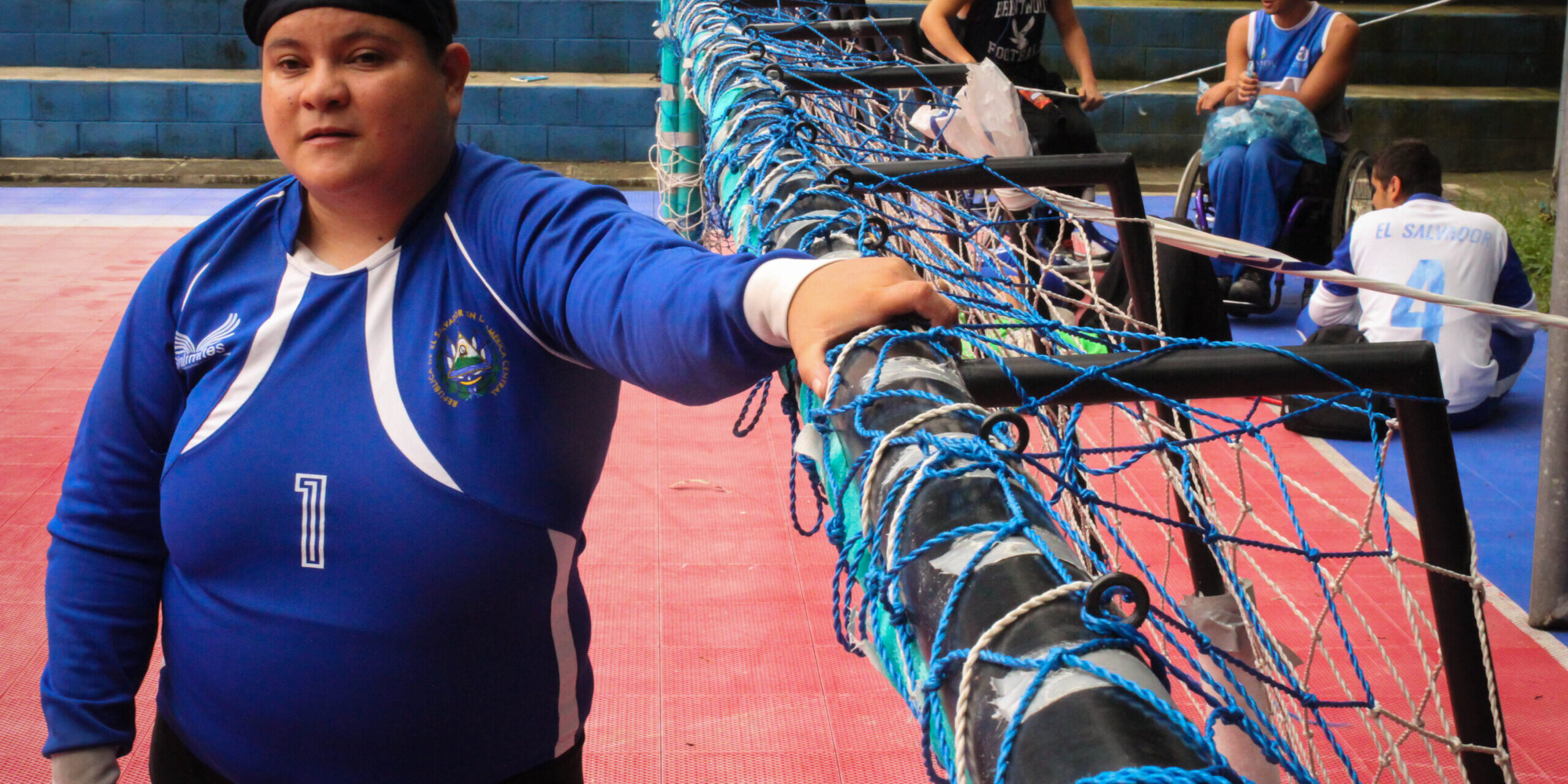
Noé Molina's story is a story of trans resilience. He survived multiple instances of abuse and abandonment and today is part of the Goall Ball team.

Share

By Paula Rosales
Photos: Félix Meléndez
Noé Sebastián Molina is only 27 years old, but his story encompasses several lives. Abandoned by his family as a baby, he survived in foster homes where he was systematically abused. It was there that he also began his gender transition amidst prejudice. After many struggles, he was able to move forward thanks to a sports scholarship for blind people. Today, he is part of the national goalball team and has a job in a factory.
Noé was born in June 1992 in the municipality of Metapán, a colonial town located 118 kilometers northwest of the capital. His father abandoned him and his mother placed him in the care of the “SOS Children’s Villages” in Santa Ana.

In 1997, Noé was living as a girl; he enjoyed playing basketball and running, attended his first classes, and says he “was happy.” Noé was assigned female at birth, but from a young age felt more comfortable identifying as a boy.
[READ ALSO: Camila's last night, a trans woman persecuted by gangs and murdered by the police ]
One day, a teenager eight years older than him tricked him into going to his room during recess and sexually assaulted him. He has raped him repeatedly since then.
“I just wanted to play, not have them do that to me. He would say, 'Come on, let's go to the room,' and he would start pulling my arms, and I would resist. He would lock me in the room with a bolt, and once we were in there, he would take off my clothes and tell me we were going to play house. I told him I didn't want to play that game,” Noé told Presentes.

An NGO that didn't listen and a State without answers
Noé reported his rapist from the beginning, but says no one believed him. The attacker kept threatening him with beatings or repeating the attack if he reported him. “Because I filed a complaint, he would do the same thing again. I spent more than a year in that hell,” he said.
SOS Children's Villages is a non-profit organization that provides shelter worldwide to orphaned and abandoned children and adolescents. In El Salvador, it has five centers nationwide.
“We put a lot of effort and care into preventing these situations, but in the event that they occur, we always promote the reporting and investigation of each case in accordance with the law,” SOS Children's Villages told Presentes when asked about these types of incidents.
“When I said I liked women, at the shelter they sent me to a psychiatrist who gave me sleeping pills. He told me that what I was doing wasn’t right,” Noé says.
Presentes also requested from the Attorney General's Office, via the access to information law, all complaints, notices, reports and police reports on the crimes: Rape of a minor or incapacitated person; statutory rape and sexual assault of a minor and incapacitated person, committed in the SOS Children's Villages of El Salvador, but there was no favorable response.

[READ MORE: Camila's last night, a trans woman persecuted by gangs and murdered by the police ]
“Our institutional system does not automatically record the level of detail indicating whether the incident occurred at SOS Children’s Villages facilities. Therefore, the information provided corresponds to the number of cases entered for the requested crimes, where the location of the incident includes: shelters, children’s homes, daycare centers, and safe houses, which are variables present in our database,” the prosecutor’s office informed Presentes.
That same year, in 1997, the ophthalmologists treating Noé diagnosed him with retinitis pigmentosa, a disability he still has. His vision is now filled with spots and shadows.

Eight years later, Noé was sexually abused again. The second assault was perpetrated by one of the caregivers. She was about 35 years old, and he was 14. When the case came to light through a complaint from another resident, the employee was fired and imprisoned for sexual assault. Upon turning 15, he was transferred to a juvenile detention center because the institution believed he might repeat the abuse he suffered with the other children at the shelter.
Life after Villages
Currently, Noé only has 10 percent vision, a condition that makes it difficult for him to get around. He always carries a worn cane in his right hand to help him navigate the streets. He left SOS Children's Villages in 2011. He was summoned to the office and told he had a month to pack his bags and find somewhere to go. With no options for accommodation, he decided to seek help from a friend he met at the school for the blind. “When I left the home, I always thought, ‘Where am I going to go or how am I going to eat?’ But thank God I had the support of a friend.”

His first job was at a massage clinic, where he worked for a few years. He was then hired at the INTRADESA clothing factory, where he worked for six years and four months until he was fired. According to him, it was due to prejudice against his gender identity and expression.

She began self-administering hormone therapy because it is less expensive than receiving it at a specialized center. The Salvadoran Congress has not yet passed an identity law that would allow women to receive hormone therapy through the public health system.
According to the Latin American and Caribbean Network of Trans People (REDLACTRANS), in 2017 the Ministry of Health of El Salvador suggested suppressing the fundamental right of trans people to receive hormonal treatments, because the State does not have sufficient financial resources.
Sport as a refuge
After losing his factory job in November 2018, Noé had to sell his few belongings to survive. He recalls gradually parting ways with his refrigerator, computer, and stereo.
Unemployed, he applied for a sports scholarship from the National Institute of Sports (INDES), which allowed him to receive food and daily training for five months in the sport he is passionate about: Goalball.
Goalball is a sport created for blind or visually impaired people. It consists of teams of three players who must prevent a ball containing bells from crossing the goal line. Noé has been playing it since 2011.

Noé is part of the women's goalball team because her identity document still bears the name assigned at birth. She plays the wing position. According to her coach, she has one of the most powerful shots in Central America.

“His performance is important for the benefit of the team. He is a very outstanding player because of his high level of knowledge of the sport. It is very important to have him on the team,” coach David Amaya told Presentes.
In October 2011, she was part of the Goalball team that participated in the XVI Paralympic Games in Guadalajara, Mexico.
To cover the forty dollar rent for the house he rents in a neighborhood dominated by the Barrio 18 gang, transportation costs, and weekend food, Noé opted to sell candy at the sports center.

At the Olympic Village he has not felt discrimination because of his gender identity and expression, although he says he would like to be transferred to the men's Goalball team.
“What would make me happiest is being myself, not hiding who I am, having an ordinary life without caring so much about what people think or say. I think I've had the strength to survive,” he said.
In the first days of November 2019, Noah is happy because he finally found a job.
He was enrolled in a training program for people with visual impairments. Within two months, he will have to demonstrate that his low vision does not prevent him from performing the labeling work at a plastics factory.

“I feel happy because I’ve been looking for a job for a year now, I have a new opportunity and I’m going to be able to get my things back, I’m going to have the life I had again,” Noé said.

This report was produced with the support of the International Women's Media Foundation (IWMF) Express Yourself! initiative in Latin America.
]]>
Share
We are present
We are committed to journalism that delves into the territories and conducts thorough investigations, combined with new technologies and narrative formats. We want the protagonists, their stories, and their struggles to be present.
SUPPORT US

FOLLOW US
Related notes
We are present
This and other stories are not usually on the media agenda. Together we can bring them to light.