

Elections in Peru: Who are the LGBT candidates and what do they propose?
There are four candidates: Gabriela Salvador (Broad Front); Carlos Polo (Broad Front); Gahela Tseneg Cari Contreras (Together for Peru) and Alberto de Belaunde (Purple Party)

Share

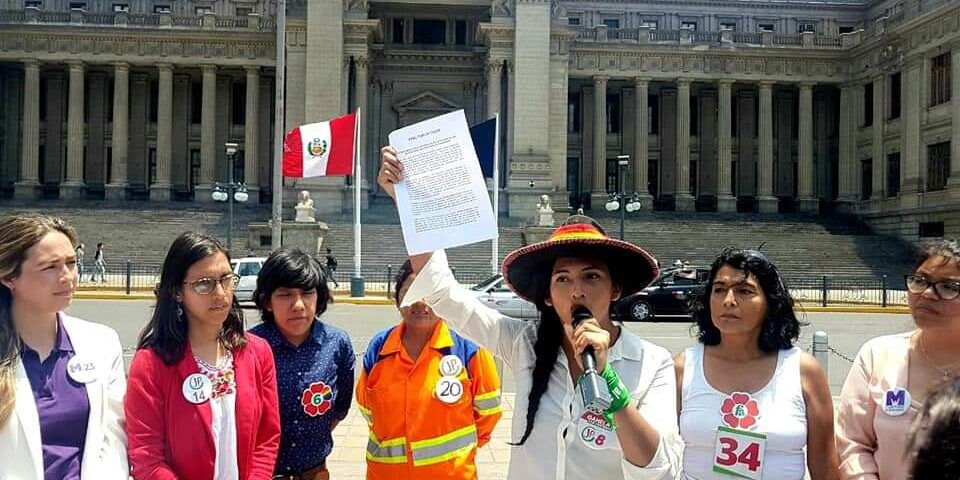
After the Peruvian Congress was dissolved on the last day of October last year, President Martín Vizcarra called for new elections on January 26, 2020, to complete the congressional term. Among the issues that are always debated during election periods are the demands of women and the LGBTQ+ community, and therefore there is no shortage of candidates who openly defend these causes across both the right and left of the political spectrum.
Broad Front party has Gabriela Salvador, a lesbian lawyer, and Carlos Polo, a vegan and gay activist; and the Together for Peru has Gahela Tseneg Cari, a trans activist. On the right is the Purple Party with its candidate Alberto de Belaunde. All four are running for office in Lima.
[READ ALSO: Closure of the Peruvian Congress: "Let the new parliamentary groups embrace diversity" ]
Who are they and what do they propose for the Peruvian LGBTI community?
Gabriela Salvador (Broad Front)
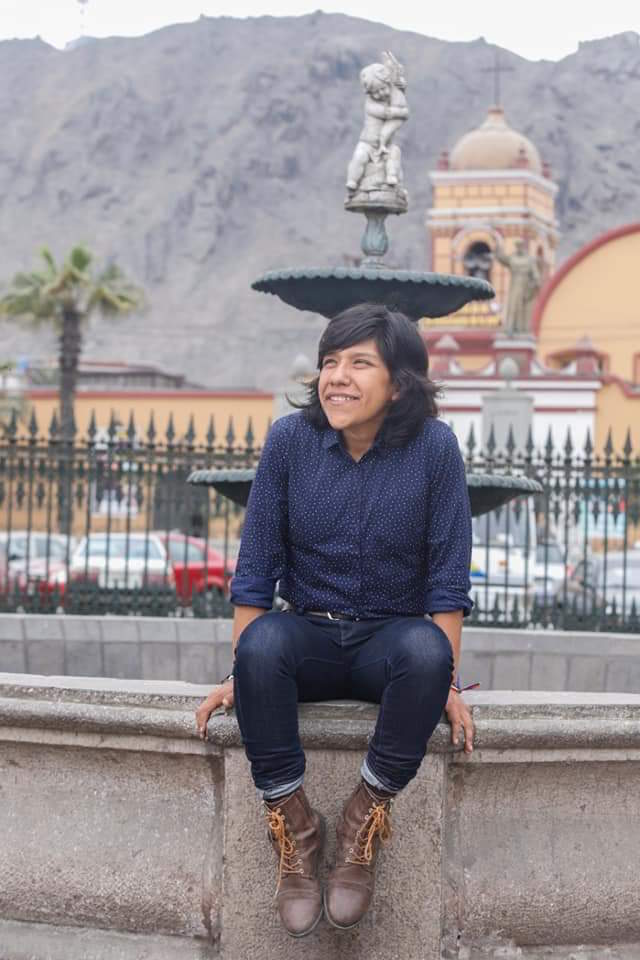
“In the area of education, the invisibility, even in the statistics, is very worrying. Not being mentioned in a report is already an indicator. Not being mentioned in a work plan is already an indicator. We talk about girls, we talk about women, but we don't talk about lesbian, trans, bisexual women. Are we present?”
She is 34 years old, a lawyer, and an environmental specialist. She was a political advisor in the dissolved Congress and decided to run in these January congressional elections as candidate number 6 for the Broad Front. She identifies as a lesbian and has not hesitated to emphasize this in every interview she has given, stating that she seeks to advance a rights agenda that brings visibility to LGBTQ+ issues, especially in the education and health sectors.
Salvador has indicated that he will push forward pending bills such as the Gender Identity Law and the Equal Marriage Law , but he will also promote oversight and accountability of the institutions responsible for ensuring that people are not discriminated against and receive all the protections and guarantees of the State. To this end, he will closely monitor the measures implemented by the Ministries of Health, Education, and Justice. He will also advocate against the criminalization of protest, since every time the LGBTQ+ community attempts to hold a peaceful demonstration, such as the "Kisses Against Homophobia" on Valentine's Day in February, it is met with repression, detention, restrictions on movement, and expulsion from public squares by the police, under the authority of the Ministry of the Interior.
Carlos Polo (Broad Front)

“Dishonesty is one of the things that bothers me the most, the fact that I didn't have any LGBTQ+ role models in my childhood, the fact that I was told that girls like boys and boys like girls, living with all those lies hurt me a lot, it made me believe that I would never be happy, and that's why what bothers me most now is dishonesty and I think dishonesty abounds in our politics.”
Polo is a professional translator, but he has distinguished himself as a vegan and anti-speciesist activist, as well as being a gay rights activist and atheist for several years. His personal story is quite unique, as he is the son of two activists with completely opposing views: his father, Carlos Polo Samaniego, is a well-known anti-rights figure and director of one of the organizations that has most actively sought to undermine the lives of LGBTQ+ people and women worldwide, the Population Research Institute ; and his mother, Cecilia Villanueva, is president of the Latin American Movement of Mothers of LGBTQ+ Children .
From a young age, Polo was forced to study at a Sodalitium school, participate in the Marches for Life organized against abortion, and subjected to a series of sexist ideologies, so his childhood was marked by the rejection of his homosexuality, until he came out of the closet and his maternal family embraced him with respect.
Among her proposals are to support gender-focused policies, especially regarding the homolesbotransphobic harassment suffered by children , which is part of the Broad Front's government plan, although in this, her first candidacy for general elections, she is more focused on animal protection, since she already has a fellow candidate (Gabriela Salvador) more focused on LGBTI rights.
Gahela Tseneg Cari Contreras (Together for Peru)
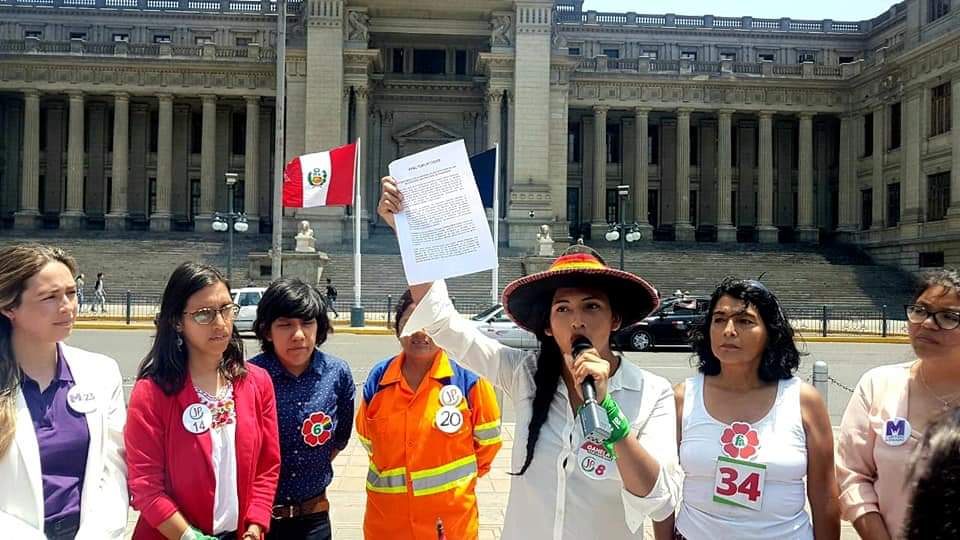
“The problem isn’t our bodies, the problem is this hypocritical society that rejects us in the street but seeks to satisfy itself with us in private. The problem is that we were born into a flawed society that we hope to change, which is why we are here fighting. I wasn’t born a feminist, but I am certain that I will leave this world fighting.”
With the slogan “I vote for equality,” Gahela presents herself as a woman of multiple identities. She is Afro-Peruvian in a context where racism is ever-present. She is also a trans woman and a migrant. After studying law, she began her activism on the left several years ago with the Nuevo Perú , which allied with the Juntos por el Perú to participate in these elections.
She champions demands for gender identity and marriage equality, as well as trans employment quotas, LGBTQ+ participation quotas in political parties, a focus on diversity in education, and women's right to choose what happens to their bodies through the decriminalization of abortion , in what she has called "gender reform." Her presence follows the legacy of trans women who have attempted to win seats in the Peruvian Parliament, as Belissa Andía did previously, also within left-wing parties.
Alberto de Belaunde (Purple Party)

“I don’t have an absolute guarantee that all 140 candidates are convinced, but there is conviction and partisan commitment from them, yes, and it is a campaign proposal, so I think it is absolutely honest to say that the Purple Party will promote equal marriage and the gender identity law from Congress.”
A lawyer and former congressman for the party of former president Pedro Pablo Kuczynski, Peruanos por el Kambio (Peruvians for Change ), De Belaunde is seeking to complete his elected term with another right-wing party, the Partido Morado (Purple Party ). In his previous term, he promoted civil unions as a contract for lesbian and gay couples, alongside fellow former congressman Carlos Bruce, who is gay. This contrasted with the proposal made by his colleagues Indira Huilca and Marisa Glave in the same Congress to achieve marriage equality, despite their not being LGBTQ+ activists. Neither bill was approved or even debated in the dissolved Congress. Although the Partido Morado , when it first emerged, did not fully support marriage equality and only advocated for civil unions, De Belaunde states that they now support it and that it is a party platform for a party that defends the neoliberal economic model to support marriage equality, the gender identity law, and a gender perspective in education.
]]>We are present
We are committed to journalism that delves into the territories and conducts thorough investigations, combined with new technologies and narrative formats. We want the protagonists, their stories, and their struggles to be present.
SUPPORT US

FOLLOW US
Related notes
We are present
This and other stories are not usually on the media agenda. Together we can bring them to light.