

Trans workers in Paraná fight for their jobs: they took their case to the national government
In addition to regaining their jobs, they seek to promote public labor policies for the trans population.

Share

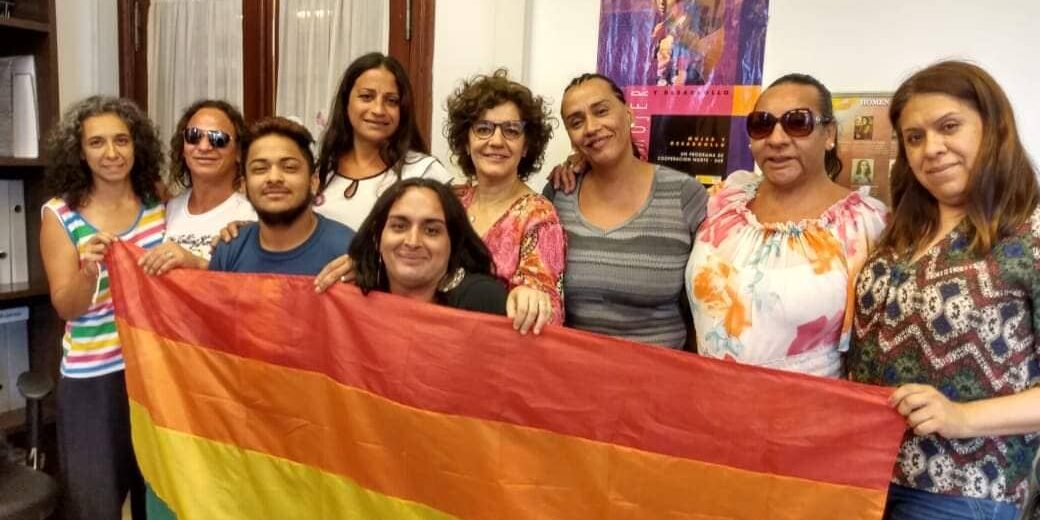
The six transgender individuals who filed a lawsuit after their contracts with the Municipality of Paraná were terminated took their case to officials of the national government. In doing so, they hope not only to regain their jobs, but also that their case will be the starting point for promoting public policies that allow access to formal employment for the entire transgender community in the country.
Iara Aranzazú Quiroga, Vanesa Aramí Bello, Matías Lucas Damián Berón, Gabriela Abigail Manrique, Paola Natalí López, and Fernanda Ramírez traveled to Buenos Aires on Friday, January 3, to meet with officials from the Ministry of Women, Gender, and Diversity, headed by Elizabeth Gómez Alcorta. They were received by the Secretary of Equality and Diversity, Cecilia Merchán, and the Undersecretary of Diversity, Alba Rueda.
The contact with the officials occurred after the Superior Court of Justice (STJ) of Entre Ríos revoked on December 27 the ruling of the Criminal Judge of Children and Adolescents, Pablo Barbirotto, who had granted the injunction against the termination of the contracts –presented by the group on November 28– and ordered the Municipality of the capital of Entre Ríos to immediately reinstate the workers.
[READ ALSO: Trans workers in Paraná denounced the municipality for unfair dismissals ]
The administration of then-mayor Sergio Varisco appealed that first instance ruling, and then the STJ reversed Barbirotto's decision and rejected the reinstatement claim, considering that the municipal administration "did not commit any legal irregularity by omitting the contract renewal once the period of the public employment relationship had expired."
In the meeting with the national officials, the workers reported "the current situation after the two court rulings (one in favor and one against in the first and second instance, respectively)" and raised the need to create a "coordination" with different state bodies to achieve the reinstatement of the six trans people who were dismissed from their jobs in the Municipality.
“They listened to us,” Fernanda Ramírez, one of the laid-off workers, told Presentes , reflecting on the meeting. Iara Quiroga added, “We left happy because we’re going to continue construction, regardless of what the courts decide.” She emphasized that Merchan and Rueda were willing to contribute to finding a solution. To that end, the possibility of forming a working group was raised, comprised of representatives from the Municipality of Paraná, the Government of Entre Ríos, and the National Ministry of Women, Gender and Diversity, with the objective of “resolving this particular situation and promoting the inclusion of the trans community in Paraná in general.”
[READ ALSO: Judge in Paraná ordered the Municipality to reinstate trans workers ]
Iara also pointed out that the Paraná case could be considered a starting point for developing future public policies aimed at facilitating access to formal employment for the trans community. During the discussion, the officials assured them that the trans employment quota “is a key priority” for the Ministry and indicated that the intention is for “the quota to be implemented throughout Argentina.” Therefore, they emphasized the importance of “recognizing and incorporating these local processes of promoting and guaranteeing rights in order to strengthen and replicate them” nationwide.
In addition, the ministry offered "possible courses of action that could resolve the current vulnerable situation until the situation is resolved more permanently."
[READ ALSO: Transgender employment quota approved in Paraná, Entre Ríos ]
The meeting “was very productive as it allowed us to explore alternatives and develop strategies to address our particular situation, as well as the situation of the entire trans community in Paraná and, indeed, the country,” stated Iara, Vanesa, Matías, Fernanda, Paola, and Gabriela. “It was crucial to feel the sisterhood among us, because knowing that there is a trans colleague (referring to Alba Rueda, Undersecretary of Diversity) in these spaces allows us to think about changing things. We are deeply grateful for her willingness to listen to us and explore alternatives,” they added.
The path
The path to accessing contracts in the Municipality of Paraná – which meant for them entry into formal employment – began in 2018, when the Municipality commissioned Iara, Vanesa, Matías, Fernanda, Paola and Gabriela to carry out a project to survey the trans community of the city and learn about their living conditions and their sociodemographic characteristics.
The data obtained through the survey—which began in September of that year—revealed the social, economic, and civic vulnerability of this group. As a result, and based on the final report, the Municipality began implementing policies aimed at recognizing and restoring the rights of this group and achieving their inclusion in the workforce.
The six service contracts granted through Decree No. 217 were a result of that policy. Therefore, upon losing their jobs on October 31st, the group decided to embark on a path of struggle to recover those positions and the right to decent work.
On November 28, they filed an injunction in the Entre Ríos courts, demanding their reinstatement or permanent state employment. On December 6, in a landmark ruling incorporating a gender perspective, Judge Pablo Barbirotto of the Juvenile Criminal Court granted the injunction and ordered the Municipality to “issue the necessary administrative acts for the reinstatement of the plaintiffs, effective November 1, 2019, through the renewal of their contracts under the same conditions as before, with the corresponding payment of salaries accrued in November of this year and until the selection and appointment mechanism for transgender employees, as regulated by the municipality, is effectively implemented, in accordance with the quota established in Ordinance No. 9834.” The Municipality was given three business days to comply with the ruling. However, the administration of then-Mayor Varisco appealed. And the Superior Court of Justice (STJ), with the vote of the judges Miguel Giorgio, Claudia Mizawak and Germán Carlomagno, partially granted the appeal, revoked Barbirotto's ruling and rejected the reinstatement request.
“If there is one thing the administration cannot be accused of, it is that it has engaged in discriminatory acts—in a negative sense—against the plaintiffs,” reads the ruling of the Superior Court of Justice, which was written by Judge Giorgio. “I do not find that the administration acted (…) in violation of any legal norm, exercising its discretionary power in a manner—moreover—entirely reasonable within the institutional context of the Municipality of Paraná (whose situation is public knowledge), and therefore, the illegitimacy of state omission required for the injunction is not present in this case,” the judge states in another paragraph.
In the same ruling, dated December 27, the STJ also partially granted the injunction and ordered that the six workers be paid their wages for November, considering that "the effective work performed by the plaintiffs" during that month had been verified.
To the Court
Following the STT's unfavorable ruling, the workers decided to continue the legal process and are considering appealing to the Supreme Court. "The idea is to appeal because we need the work," Iara told Presentes . "Hopefully, we can reach an agreement regarding our contracts and our permanent positions, that public policies for our community, which we've been fighting for for a long time, can be implemented, and that we can secure employment with the Municipality. Because we don't want to go backwards," she added.
She then recounted that they had held informal meetings with members of the current municipal administration, headed by Mayor Adán Bahl. “But they were always conducted outside of formal channels, which is what we're concerned about,” she lamented. Fernanda, for her part, hopes that the new municipal authorities will show “a humane gesture” and resolve the reinstatement of the six women. “Hope springs eternal,” she concluded.
]]>We are present
We are committed to journalism that delves into the territories and conducts thorough investigations, combined with new technologies and narrative formats. We want the protagonists, their stories, and their struggles to be present.
SUPPORT US

FOLLOW US
Related notes
We are present
This and other stories are not usually on the media agenda. Together we can bring them to light.