

Tiziana, a trans girl from Salta: to dance, to resist, and to grow old
The story of the first visible trans girl in Salta allows us to imagine the lives that thousands across the country go through. Violence, resistance, support, and activism in the days of childhood games.

Share

Photos: Legüera Produ/Acciones – Nazarena Vercellone
A, from before
“I felt it from a very young age. Oh! little one.”
Before.
I felt strange. Oh! Strange.
Before".
Tiziana clarifies so that everyone else understands. She uses intense pauses, seconds of waiting before each "before." When she speaks of " before ," she stops jumping.
– It was very uncomfortable telling my parents, so I felt sad when they cut my hair. I heard them say that a real man has to be this, that he has to keep order in the house, and I felt like I was gay, but at the same time I felt like I wasn't.
Tiziana was born on February 24, 2008, at 9 p.m. in the Maternal and Child Hospital of Salta, Argentina. Ten years later, thanks to the gender identity law passed in 2012, she was able to change her name on her official documents, becoming the first transgender child in her province to do so. In April 2018, her story reached local media, then national media, and then international media, achieving a level of visibility rarely seen among transgender children in Argentina.
“She was a little person we, her parents, really wanted,” says Graciela, the mother. “I dreamed and longed for a girl, but in that dreaming and longing, we didn’t want to know, because her father obviously wanted a boy. He said she was going to be his last child and he wanted her to be a boy.”
Graciela became pregnant with Tiziana in Corrientes. They were living there with Damián when they had to move to Salta for work.
– It was quite hard because it meant starting all over again. Finding a place to live with this family we were building. But that stage was a lot of fun, when she was still in my belly, and we played tug-of-war about what she was going to be. I called her by feminine names and he by masculine names, and we chose names: Tiziano Ezequiel if it was a boy, Damaris Saraí if it was a girl.
Both Graciela and Damián have other children from previous relationships. Tiziana is their only child together, and for both of them, she was meant to be their last.
Tiziana was born at eight months, after a sixteen-hour labor.
My daughter was very stubborn and didn't want to come out for anything in the world. Her father was there for the birth and was completely taken aback because he'd never been present for his children's births and wanted to be there for this one. It was tedious and long, but when I held that little boy in my arms for the first time, I fell in love. And it didn't matter anymore if it was a girl or a boy; I had him there, he was healthy, he was my son, and it was beautiful.
A, for relief
“Crying helped me feel good and I live peacefully without remembering those things.
I'm over it, I don't want to think about it again.
What didn't help me was when people said bad things about my mom or
that I am too young to have an identity.
I'm not actually small.
No kneading, practically no mixing: three trays of pre-made pizza bases on the round table, a technique never before seen by the guests. They had come to this house in the Don Santiago neighborhood, far from the center of Salta, for a gathering. “This is how we always make them, and they turn out perfect,” explains Mara, who makes the pizzas without kneading. Tiziana interrupts and places six trophies among the trays. “These two are from when I was a little boy, and these are the ones I’ve won since I’ve been a girl.” There are first prizes, second prizes, and honorable mentions for outstanding achievements in competitions and dance performances.
Tiziana moves around dancing. She talks dancing. She dances all the way to the store. She's light on her feet, she twirls, she jumps, she orders a two-liter bottle of Coke with a hip-hop move. The store owner is used to it, and even though he's already added up the soda, the chips, and the cheese on the calculator, she asks him to wait: she wants to calculate the total in her head.
Dirt road, house of sequins. Graciela interprets in glitter what her daughter wants and proudly shows off the latest swimsuit she made by hand and with which she won the contest.
Mara, Tiziana's sister, serves the pizzas. And yes, they're perfect.
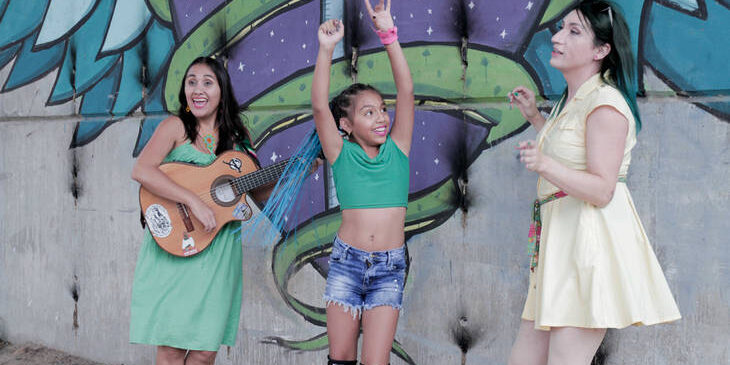
Tiziana is going to take a bath. She has dance class in an hour, and her dad is going to pick her up. Where there were pizzas and trophies, now there's a small t-shirt with black hearts. It's the pattern that Claudinna, a trans activist from Tucumán, will take to Tucumán to prepare the costumes for the music video "Hereje" by the singer Eugenia Mur, which stars the trans girl.
[READ ALSO: Letter to Tiziana, the trans girl who made history in Salta ]
"She always, always expressed her femininity, it's just that before we didn't pay attention to the signs that little person was giving us. When we learned how my daughter feels, as parents we started going back in time, mentally revisiting those signs. Now we look back at photos of when she was in diapers and her poses weren't those of a little boy," she laughs, "she was very feminine, very girly. She's always been very girly. From a very, very young age, she gave us clues that, in the whirlwind of life, we sometimes don't notice or take into account. Until she herself had the courage to tell us directly, 'Wake up, look, I'm not a boy, I'm a girl,'" Graciela recounts.
Her father, Damian, initially wanted nothing to do with it; he saw things in black and white. Until one day he saw his daughter from the kitchen window, sitting on the sidewalk, sad because the neighborhood kids wouldn't play with her and were saying mean things to her. That's when he said, "Enough is enough, I can't leave my daughter alone."
For Graciela it was different.
– From the very beginning, I experienced it with love and acceptance. I always told her that I would love her no matter what she wanted to be. When she told us how she felt, that she felt like a girl, that she dreamed and woke up like a girl, and that she looked in the mirror and saw herself as a girl, it was obviously difficult. But seeing her face light up with relief when she heard me say, 'It's okay, if that's how you feel,' and her face said, 'They're not going to scold me, they're not going to hit me.' That face marked me for the rest of my life.
Tiziana wanders among the adults with her headphones on and her cell phone in her hand. She chooses when to interact and when to remain in her own world. But she grows restless when her departure for dance class is delayed. Claudinna whispers something in Graciela's ear, and the three of them go to the room. Tiziana emerges smiling, almost triumphant, and Damián takes her to class.
A help
“They were the first ones who listened to me and understood.
They were trans and I didn't realize it. They were the best. They listened to me and made me feel good.
or as they say, accompanied.
"Feeling perfect about myself."
Graciela and Mara light a cigarette, sitting on the kitchen floor, which is part of the living room with a round table. Mara will be in charge of choreographing the music video, but for now she's resting.
– When Tiziana told us how she felt, I was obviously scared, but then I started to see things. I began researching online because I had absolutely no idea about anything, I didn't even know what the acronym LGBTQ+ meant, and I was terrified. It said that the life expectancy of a trans person is 30 to 35 years, and I don't want that to be my daughter's life expectancy. I want her to die of old age.
The family sought help at the Salta branch of the Association of Transvestites, Transsexuals, and Transgender People of Argentina (ATTTA). Its coordinator, Mary Robles, had been the first trans woman in the province of Salta to have her gender identity recognized on her national identity document (DNI) in 2012. She had also been a candidate for city council in Salta and an active advocate for the Equal Marriage and Gender Identity Laws.
Mary
“I’m from the 60s. Imagine that.”
Mary knows what it's like to be a trans girl in Salta. But she also knows what it's like to be a mother.
“By the age of nine, I already knew my orientation: to be trans. The issue was the era, because there were very few of us at that time,” she begins. “We would walk two blocks to a woman’s house who had a television. For five cents, she would let us watch Disneyland. I learned about love through princes; that was the illusion we had as girls, as boys. And when you grew up, it was different.”
At 13, Mary looked in the mirror and saw a woman. “I started having problems with my family. I couldn't accept my gender identity, nor could I accept myself. We were very poor. My parents came from the interior of the province; my father was a truck driver, hauling lumber, and my mother worked as a domestic servant. It was difficult because she wasn't home all day, and we were placed in the Carmen Puch de Güemes Children's Home.”
One day, determined to live her identity “against all social paradigms, I got up and left the children's home, never to return. At thirteen, I was imprisoned; I wasn't even a teenager yet, and I decided to be a woman. It was very difficult to fight against a prudish, hypocritical society that condemned you to a state of total vulnerability. Society ended up cramming us together or driving us to suicide.”
[READ ALSO: Campaign by "anti-rights" groups against a trans girl from Salta ]
As in the rest of the country at that time, the carnival groups were a refuge of expression for trans women and Mary, at 16 years old, in 1977, debuted in the carnival parades surrounded by other trans girls.
Mary was 19 when her sister was murdered. “I came home bald, after being imprisoned. The police were after us because of the minor offenses code; if they recognized you as trans, they'd arrest you. My family insisted I go back home because the streets would condemn me to many things, but there was one condition: I couldn't dress as a woman. So, with only my eyebrows shaved and dressed in ordinary clothes, I decided to raise two children, a girl and a boy, my murdered sister's children. And I took care of their health and education. Today I'm a grandmother of seven.”
When Graciela and Tiziana approached ATTTA, Mary gave them the contact information for the psychologist who continues to support the family today. “He helped us understand that we were the ones who needed the support so we could be able to support Tiziana. I know many mothers and fathers who have had bad experiences with psychologists. We were blessed by divine intervention to find Nicolás, because he's not only helping and supporting my daughter, but also us as parents and as a family.”
Supporting transgender children and their families, in Mary's words, becomes a process of empowerment and awareness. “Because if the current laws against transgender children remain in place, Tiziana risks going to jail, just like I did when I was 13. That's why we've been preparing this family to be their own advocates and activists for their rights. We knew people would wonder why a girl has an ID like this and would accuse her mother of many things for setting the precedent of the first ID for a transgender girl in Salta.”
A, of wings
“All they thought was that I was a man,
and that he was dressed like a girl.”
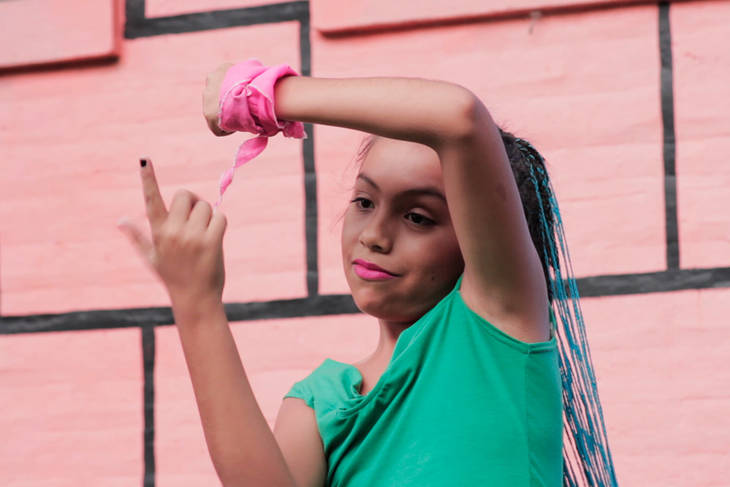
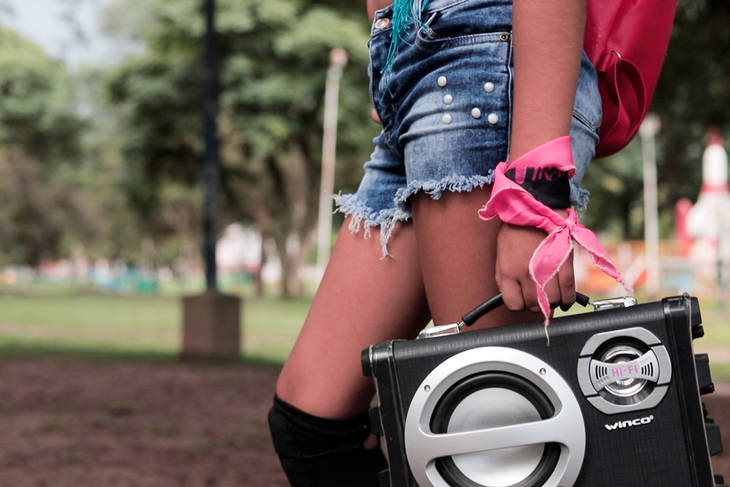
Tiziana's t-shirt is green. Claudinna's dress is yellow. And both wear the magenta bandana symbolizing the trans employment quota on their wrists. Their outfits are chosen and confirmed, while Graciela silently plans how to slip away from the music video shoot to buy synthetic material for her daughter's braids. She wants it to be a surprise.
Choosing her clothes, being able to buy girls' clothes, was quite an achievement. Her wardrobe was full of boys' t-shirts, long pants, shorts, and shorts, and now she only had two pairs of girls' jeans, three t-shirts, and a dress. But in her physical transition, what mattered most to her at that time was her hair. Today it's still what she cherishes most; it's her treasure.
Tiziana dances with her hair, moves it in the air and leaves a trail of colors: her shield.
The School
Monday, July 2017. A call from Tiziana's school interrupts Graciela's routine. "The teachers need to talk to you," Tiziana said, sounding scared. "Because, Mommy, we forgot our nails."
– By that time, she generally dressed like a girl everywhere she went, except to school, and that's when I understood why. On weekends, we'd both paint our nails, play games, and she could finally feel free like a girl. And when Sunday night came, we had to take the nail polish off so she could go to school the next day. But one Sunday we forgot, it slipped our minds. And when the teachers saw her, it was a scandal: 'How could a boy have his nails painted?'
The scandal prompted Graciela to speed up the conversation with the teachers and she brought it up with Tiziana.
“The thing is, my child isn’t my child, she’s my daughter, because my daughter is a trans girl,” she told them. “But they looked at me like I was speaking Chinese, they didn’t understand anything at all. It was a horrible year, my daughter was never respected in any way, she was always referred to with male pronouns.”
[READ ALSO: Gabriela Mansilla: “The battle for trans children doesn't end with the document” ]
Tiziana had decided to change her gender identity on her ID at age 10. “Just for the sake of vanity. She wanted to have long hair so she could put it in a ponytail for her ID photo.” And she got it.
However, at school they never stopped referring to her as Titian.
Even though she had her ID, they still called her by male pronouns. To the teachers, she was a boy dressed as a girl. I had to sign countless forms and documents so my daughter could have long hair or wear earrings, for the smallest things. It was truly a horrible experience, both for her, who constantly suffered the teachers' yelling and scolding, and for us, the helplessness as parents who felt our daughter wasn't being respected.
– One day they addressed her with male pronouns in front of me and I exploded. I filed complaints not only in the media but also with INADI (National Institute Against Discrimination, Xenophobia and Racism). Because of the media attention, the Minister of Education called me. But she also had no idea what the Gender Identity Law was.
A, for activism
To be like them:
strong, fighters.
Tiziana needs school supplies. A black and white printed list on the dining room shelf awaits its turn into a backpack with unicorns, green scissors, and an orange notebook.
“I gradually got closer,” Graciela says. “Before, I’d say, ‘No, I’m not interested.’ I was at home taking care of my children, and I really had no idea about activism. When I started seeing all the struggles, and especially the trans community’s, I broadened my horizons to include feminism. And honestly, it blew my mind. Now I’m committed to the entire struggle.”
Pia
After reaching out to ATTTA, Mary Robles, Graciela, and Tiziana met the activist Pía Ceballos. “She is my daughter’s fairy godmother and a role model not only for her but for me as well.”
Pia was a child when, perched on her father's shoulders, she watched the parade go by. "What attracted me most were those majestic transvestite-trans bodies that paraded in those unique spaces where they were allowed to circulate their dissident bodies," says Pia.
Bodies like Mary's illuminated desire with clarity: "'I want to be like that, I want to be that, I want to be them, how magnificent,' I said inside myself. My father must have heard me say it and I was immediately silenced."
Pía has an extensive resume, but when introducing herself, she prioritizes saying that she is “an activist for the rights of sexual diversity, particularly for the trans and travesti movement.” She is also currently the national secretary of Mujeres Trans Argentina (Trans Women Argentina), “which brings together trans and travesti people from across the country to advocate for the rights of our community,” and she is a member of the board of the Observatory of Violence Against Women in Salta.
Her activism began in adolescence, with an event that would mark her forever. When she was in school, one of her best friends had a clandestine abortion; her life was at risk, and this led to her being hospitalized for a couple of months. The context of her secondary education was the economic and political crisis in the country in 2001. “All of that led me to a committed activism for sexual and reproductive rights, with comprehensive sex education.”
“When I think about the dreams I had as a child, I remember when, at four or five years old, I would look in the mirror and dream of growing up. But what I saw had little to do with the image of a boy. It was a woman. At the same time, I understood that it wasn't about being a woman with a vulva, but rather something that broke the mold at that time,” she recalls. And the image of her transvestite aunt, who has since passed away, creeps into her childhood.
At 15, Pia put on some heels and went to a gay bowling alley.
– In the construction of my identity, at 15 years old I not only knew what my gender identity was, but it was a process in which I needed the support of my parents, my family, and the community. I didn't have that support, and there were many difficulties in getting them to understand me, to respect my own name, my life, and to not force me to go to a psychologist.
[READ ALSO: "Pink Boys, Blue Girls": a documentary about trans children ]
In Salta, the organization Mujeres Trans Argentina has supported eleven children, adolescents, and trans people. The most visible case was that of Tiziana, due to her family's decision to speak to the media.
“I knew my role had to be one of accompaniment, in a process that also involved training, talking, and inviting her to meetings. Graciela never missed one. And they participated in the marches, embracing not only their trans identities, but also learning about other transvestite and trans lives. This led them to connect with other experiences, other lives, and we were able to tell them that this wasn't going to be easy and that we had to walk this path collectively,” says Pía.
Contesting transvestite-trans power
Graciela and Damián gave interviews to the media at first. To protect Tiziana, they didn't want to show her face. “Until one day she stood up right in front of us, just as she is, and asked us if we were ashamed of her. We explained that obviously we weren't, that we were protecting her, because while many people would support her, many others might not, and she could have a bad experience on the street.”
In response to her parents' reaction, Tiziana argued that it was her story and that it could help another boy or girl in the same situation. "She told us she wasn't afraid, that she wanted to talk about it, and she asked us to be there for her."
When in April of this year, the anti-rights journalist, Agustín Laje, was holding a series of transphobic conferences in Salta, Graciela, Damián and Tiziana did not hesitate to go out into the street to repudiate him.
“The truth is that Tiziana was deeply affected by that situation, and we as parents were obviously affected as well. We received support from many people and organizations. Despite the rain, we were there condemning him, and my daughter shouted at him, 'Come on, show your face, I'm not a lie.' Seeing my daughter so empowered was the greatest thing that happened that day.”
From the streets to public policy
Pía Ceballos reviews some of the institutional roles that trans women are playing in Salta.
“Among the eleven ministries in the province of Salta, only in the Diversity Area of the Ministry of Government, Justice and Human Rights do we have a colleague, Victoria Liendro, who is the head of that area. Meanwhile, in Indigenous Affairs, there is a colleague as part of a social action team within that ministry.”
Regarding the municipality, we have someone in charge of an employability program for transgender people. And in education, we have some colleagues who are teachers, but they aren't working in schools. That's a major challenge.” In terms of hierarchy, she explains, they all report to other departments. “That means there are three or four managers above them, to whom they must answer.”
“Because it has to do with power and how sexual dissidence over the years has been conquering some issues related to inclusion. For example, employment quotas. Meanwhile, even today we die at 35, because our lives don't matter to the State, they are not on the agendas of public policies.”
A for Tiziana
I felt free, I felt like I could dance,
I felt like I could be a girl
I once felt that I am a butterfly.
“One day she came to me and said, ‘This is my signature, Mom,’ and showed me a capital A in block capitals,” Graciela recalls. “But it remained just an anecdote, that her signature was an A. When we asked her what she wanted us to call her, she said to me, ‘Do you remember what my signature was like?’ ‘Yes, an A.’ ‘Well, it was because I wanted my name to end in A. So I want to be called Tiziana.’”
We are present
We are committed to journalism that delves into the territories and conducts thorough investigations, combined with new technologies and narrative formats. We want the protagonists, their stories, and their struggles to be present.
SUPPORT US

FOLLOW US
Related notes
We are present
This and other stories are not usually on the media agenda. Together we can bring them to light.