

2019: Record number of violence against LGBT+ people and social transvesticides in Argentina
In 2019, violence against the LGBTIQ+ community in Argentina increased in terms of murders, street attacks and aggression, institutional violence, and discrimination.

Share

By Rosario Marina
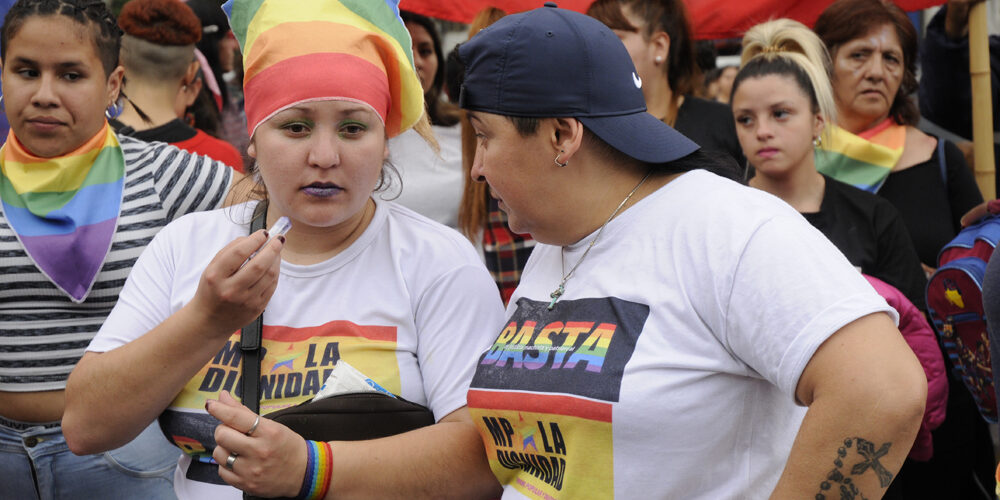
Photo: Ariel Gutraich
In 2019, violence against the LGBTIQ+ community in Argentina increased, including murders, street attacks and assaults, institutional violence, and discrimination in various parts of the country. By June alone, 68 hate crimes had already been recorded. This equates to one attack every 68 hours, according to partial data (up to June 30) from the National Observatory of LGBT Hate Crimes, created by the LGBT Ombudsman's Office of the Institute Against Discrimination of the Ombudsman's Office of the City of Buenos Aires, in conjunction with the Argentine LGBT Federation and the National Ombudsman's Office.
In hate crimes, the sexual orientation, gender identity, and/or gender expression of all victims are used as a discriminatory pretext for human rights violations and violence. “These are deliberate, conscious acts, generally carried out with malice, which include, but are not limited to, violations of the rights to dignity, non-discrimination, equality, integrity, personal freedom, and life ,” according to the Observatory's report.
From what was published by Presentes , 10 murders, 22 street attacks and assaults, and 17 cases of discrimination and institutional violence were recorded.
Trans deaths
Violence against the LGBT community is particularly directed towards trans women, explains the Observatory: "It is in trans women that discrimination is manifested with special hatred, cruelty and in its most brutal form."
According to a report compiled by several organizations and activists, 72 trans women died in the country during 2019. The average age of those who died was 40. The data is much more precise than in 2018, especially regarding age. The age of only one woman is unknown. This data is collected through social media and trans networks, which report the death of a friend or colleague, including the circumstances and location.
[READ ALSO: “Stop the Transvesticides” is a cry against all forms of violence ]
Regarding the causes of death, 80% died from illnesses, some of which were curable, and 12% were murdered. There are very few provinces where no transgender people died this year: records exist in 17 of Argentina's 23 provinces. 35% of the deaths occurred in the province of Buenos Aires, 18% in Salta and Jujuy, and 8% in the City of Buenos Aires.
“Access to healthcare is a systematic death driven by the State itself. Without the possibility of a better life, you are predisposed to all of this: to get infected, to get sick, to catch pneumonia. The State becomes responsible for all of this,” Nazarena Fleitas, from ATTTA (Association of Transvestites, Transsexuals, and Transgender People of Argentina) Presentes
The Hate Crimes Observatory report concurs with this. It indicates that in the first half of 2019 alone, “there were 6 murders perpetrated against people of diverse sexual orientations and 13 deaths due to abandonment and/or state neglect. The 19 cases of violations of the right to life were directed exclusively at trans women.”
Killer cough
In the early hours of January 24, 2019, in the city of Paraná (Entre Ríos), the death of Jésica Benavídez was confirmed . She was a 33-year-old trans woman who eked out a living as a sex worker and lived in extreme poverty. Her colleagues called her “La Nicky.”

Three days later, Antonella Mirna Di Marzo, a 30-year-old trans woman, died in the early hours of the morning as a result of a brutal hate crime, after spending three months in a coma. She had been unconscious in intensive care since October 21, when she was attacked by a man outside the Caribe nightclub in General Güemes (50 kilometers from the city of Salta).

On Sunday, February 3, a neighbor walking down the street raised the alarm : the body of a young trans woman lay at the intersection of Avenida Monseñor Bufano and Arribeños , Camino de Cintura, near Los Pinos (La Matanza, Buenos Aires Province). She had been shot in the hip, and several 9mm shell casings were found around her. She was Laly Heredia Escobar, a 36-year-old woman from Lima who had arrived in Argentina at the age of 26.

Yaritza Angélica Millones López was born on December 6, 1991, in Peru and had been living in Argentina for three years. She lived in an apartment on Alsina Street at number 2500, a central area of Buenos Aires. She hadn't answered her phone for several days, so her friends filed a missing person report. On Sunday, April 28, when police from the Homicide Division opened the apartment door, they found Yaritza. She had been murdered.

Gala Estefanía Perea , a young trans woman from the town of Famaillá in Tucumán province, was found dead in the home of her partner, Víctor Ezequiel Natalio Martínez, in the city of Lules. Gala was 19 years old. “It was a violent relationship, but she was very much in love and covered for him,” psychologist Verónica Figueroa from the Secretariat of Gender, Violence, and Women, which is part of the Famaillá municipality,
Presentes

[READ ALSO: A map records cases of violence against lesbians and bisexuals in Argentina ]
On the night of Thursday, July 4th, at the age of 61, Marcelo Giudici was found dead inside his salon in downtown Rosario, in the southern part of Santa Fe province. He was a renowned stylist in Rosario, a hairdresser trainer, an LGBT activist, and a well-known performer known for his drag persona, “La Faraona.” Marcelo was covered in blood and bound hand and foot with cables. The autopsy revealed a significant blow to the head and that he had been asphyxiated.

Days later, 186 km away, Lucía Barrera , a 37-year-old trans woman and LGBTIQ+ activist in Paraná, Entre Ríos province, was found dead inside her home in that city. She had multiple stab wounds.

The black and white video capturing the death of La Chicho Chirinos , a 49-year-old trans woman, was filmed at a funeral home. The killer, Tomás Cerletti, attacks from behind, kicks her, and stabs her again. The brutality is palpable in the silent footage. La Chicho falls to the ground, but Cerletti continues stabbing her several more times. He leaves her lying there and walks away. The crime occurred in the early hours of Saturday, October 26, near the bus terminal in La Plata, right on the sidewalk, with no attempt to hide.

Gisela Corvalán was a 47-year-old trans woman who cared for the sick and elderly, and one of the 86 inhabitants of Los Miranda, a town in Santiago del Estero. She was stabbed in her home on August 19, 2019. She bled for 12 hours and spent almost three months in the hospital. On November 13, she died at the Ramón Carrillo Hospital in Santiago del Estero.

On the first Sunday of December, Pablo Fullana Borsato , an architect, LGBTQ+ activist, and artist who was leading the Open-Air Museum project, was murdered in the town of Colón, Buenos Aires province. He was found in his home, with his pants down and multiple stab wounds. The only suspect in the case is a 19-year-old, identified by sources from the LGBT Colón collective, an organization to which Pablo belonged, as Leonel Facio.
Street attacks and assaults
Pablo Dell'Oso (24) was dancing on Saturday, January 5th with his friends at the Nabisco nightclub in Villa Rumipal (Cordoba), when he crossed paths with three boys who were looking at them.
That would only be the beginning of a month with multiple attacks across the country.
Just hours before the end of the 11th edition of the El Bolsón Diversity Festival (Río Negro), a group of young gay men and lesbians were insulted , beaten, and ultimately ejected with pepper spray from the Absentha nightclub. Several ended up in the hospital, where they were initially denied medical attention. One of those attacked was Cristian Godoy, who covered the Festival for Presentes.
On Tuesday, January 8, trans activist Lara María Bertolini was attacked in Parque Lezama, in the center of the City of Buenos Aires, by a young man who insulted her while she was walking her dog and then, from behind, threw a bottle at her that opened her head.
[READ ALSO: Map of the transvestite-transgender employment quota in Argentina ]
That same day, around 1 a.m., Franco Ramírez (25) was walking home along the waterfront promenade of the Regatas Club in Resistencia, the capital of the Chaco province. He was beaten almost unconscious and still has an internal eye injury, in addition to four external stitches.
On Saturday, January 19, Billy Molina had gone with friends to a traditional Chaya celebration at the Tiro Federal club in the city of Chamical, in the province of La Rioja. The party was winding down, the place was starting to empty out, and while she waited for her friends to leave, a man approached her. Without saying a word, he grabbed her arm, forcibly dragged her out of the club, and beat her. He then fled on a local police motorcycle. The assailant, it was later learned, is a police officer: Claudio Herrera Luna, second-in-command at the Women, Children, and Family Police Station in the city of Chamical.
On the same Saturday at 2:30 in the morning, Brian David De los Santos (24) and Leonardo Vargas (21) were victims of a homophobic attack, after leaving a downtown bar in Capilla del Monte (Cordoba province).
On Wednesday, January 30, Juan Zelaya (35) was admitted to the Padilla Hospital in the city of Tucumán after being attacked by his neighbor, Dante Daniel Vanucci. “It was a hate crime. It’s pure homophobia,” said his aunt. The attacker was arrested on Sunday, February 3.
Juan Solá is a well-known writer and a leading figure in the LGBT+ literary world. On Sunday, February 3rd, in the early hours of the morning, he was at a nightclub in the city of Mendoza with his friend Maru Leone when he was attacked by security personnel. They locked him in a room for an hour and beat him while hurling insults: “We’re going to make you shit yourself, you faggot.”
On May 1st, while returning from his home in San Miguel de Tucumán, Lucas Mathias Gargiulo , a 24-year-old trans man, was attacked, robbed, and raped. The police station refused to take his report of the rape.
In Salta, a police officer assaulted a 23-year-old transgender woman, leaving her with bruises and a laceration on her head. The attack occurred on Wednesday, April 17, around 1:30 p.m., near the tourist-friendly Mercado Artesanal (Craft Market).
[READ ALSO: Christmas for trans women: sent to men's room for not having documents ]
Yesica Freytes was hit on the head with an iron bar while people shouted "lesbian whore." It happened on Tuesday, May 5, at her mother's house in Villa Ballester, Buenos Aires province.
In the early hours of Saturday, June 15 , trans activist Yhajaira Falcon was attacked by three young men in the Chacarita neighborhood, two blocks from her home.
On Thursday, July 11, David Palomino was using the restroom at the McDonald's on the corner of Avenida 9 de Julio and Corrientes in Buenos Aires when a security guard began to assault him. "You dirty faggot," he yelled, before hitting him and dragging him out.
[READ ALSO: Report: Transvestites and trans people in Argentine prisons: more migrants, young people and without convictions ]
Days later, on Friday, July 19, a lesbian couple was attacked by a man while waiting for a bus in the city of Berisso (Buenos Aires province). “Since you’re here, dress like a man,” the aggressor, who was with his wife and children, told them. He then spat on one of them and punched her twice.
Angeline is a young Jamaican trans woman seeking asylum. She escaped from one of the most homophobic countries in the world and arrived in Buenos Aires, where she rented a room in Villa Soldati. On Saturday, June 29, when she was going to meet a friend, a group of men chased her and cut off three of her fingers, injuries that still cause her to cry every night.
In August, for the second time that year, Yhajaira Falcón was the victim of a transphobic attack in the Chacarita neighborhood of Buenos Aires. On Sunday the 18th, near midnight, the same police officer who had assaulted her in June attacked her and stole money from her as she returned from buying something at a kiosk near her home.
That same month, on Sunday the 25th in the early morning, Xoaquín López (29) was beaten. It happened in the San Francisco Solano area of Quilmes, Buenos Aires province. He was attacked in a hate crime. While two women watched and a man beat him, they hurled all sorts of insults, but especially: “This is what happens to you for being a faggot.” It is not the first time these aggressors have attacked Xoaquín.
On Saturday, August 31, at four in the morning, Reyvis Henríquez (25 years old) was kicked in the face. He was walking hand in hand with his partner, Luis, in the Almagro neighborhood of Buenos Aires when he realized they were being followed by a group of seven men. They were followed to the corner of Córdoba Avenue and Bulnes Street, where they were insulted and beaten. In an interview with Presentes, Rey recounted: “After kicking me in the face, they laughed at us and we started running. If they had wanted to rob us, they could have. They didn't because they only wanted to hurt us.”
Mauro Grosso (37 years old) was also the victim of a homophobic attack in Buenos Aires. It happened in the early hours of Saturday, September 14, in the Congreso neighborhood. Shortly after 4:00 a.m., he left the venue where an LGBT+ party was being held when, as he turned the corner onto Sarandí Street, he was attacked. “I didn’t see how many there were; two grabbed me from behind, and a possible third was hitting me the most. I started screaming, and the one holding me from behind taunted me, saying, ‘Oh, look at the little faggot screaming.’ That paralyzed me,” Mauro told Presentes.
Less than a month later, in the same city, in the Buenos Aires neighborhood of Villa Crespo, 24-year-old activist and journalist Imanol Subiela became another victim of a homophobic attack. “You fucking faggot, this time you won, all the faggots need to be killed,” his attacker told him when Subiela managed to escape.
On Saturday afternoon, October 26, in the city of Salta, two men and three women attacked two transgender women who were having lunch . One of the women suffered serious injuries to her mouth. Later, when the victims went to file a report at the police station, the police initially refused to take it. They only agreed to register it when Pía Ceballos, director of the Observatory of Violence against Women (OVcM) and activist with Mujeres Trans Argentina (Trans Women Argentina), arrived at the station.
[READ ALSO: Judge in Paraná ordered the Municipality to reinstate trans workers ]
On Sunday morning, December 8th, Marisol Nuñez , a 66-year-old trans woman, was found on the side of the Santa Fe-Rosario highway, near the riverbank. Marisol was walking along Blas Parera Avenue toward the cemetery when she stopped to buy flowers to take to her relatives' graves. She walked another block and saw a white car pull up beside her. Two men got out of the vehicle and forced her inside. They took her to an open field by the Salado River, where they tried to force her to perform oral sex on them.
She fought as best she could and managed to break free, but the only way out she saw was to jump into the river. The water tossed her around and slammed her against the bank until she could muster enough strength to hold on to the embankment of the Santa Fe-Rosario highway. But she was out of breath and fainted. That's when a man riding a bicycle saw her and called the police, thinking she was dead. But when they arrived, they found she was still breathing.
We are present
We are committed to journalism that delves into the territories and conducts thorough investigations, combined with new technologies and narrative formats. We want the protagonists, their stories, and their struggles to be present.
SUPPORT US

FOLLOW US
Related notes
We are present
This and other stories are not usually on the media agenda. Together we can bring them to light.