

Judge in Paraná ordered the Municipality to reinstate trans workers
The Justice system of Paraná, in the province of Entre Ríos, granted the injunction filed by five trans women and one trans man from the city and ordered their reinstatement

Share

By Gisela Romero, from Paraná
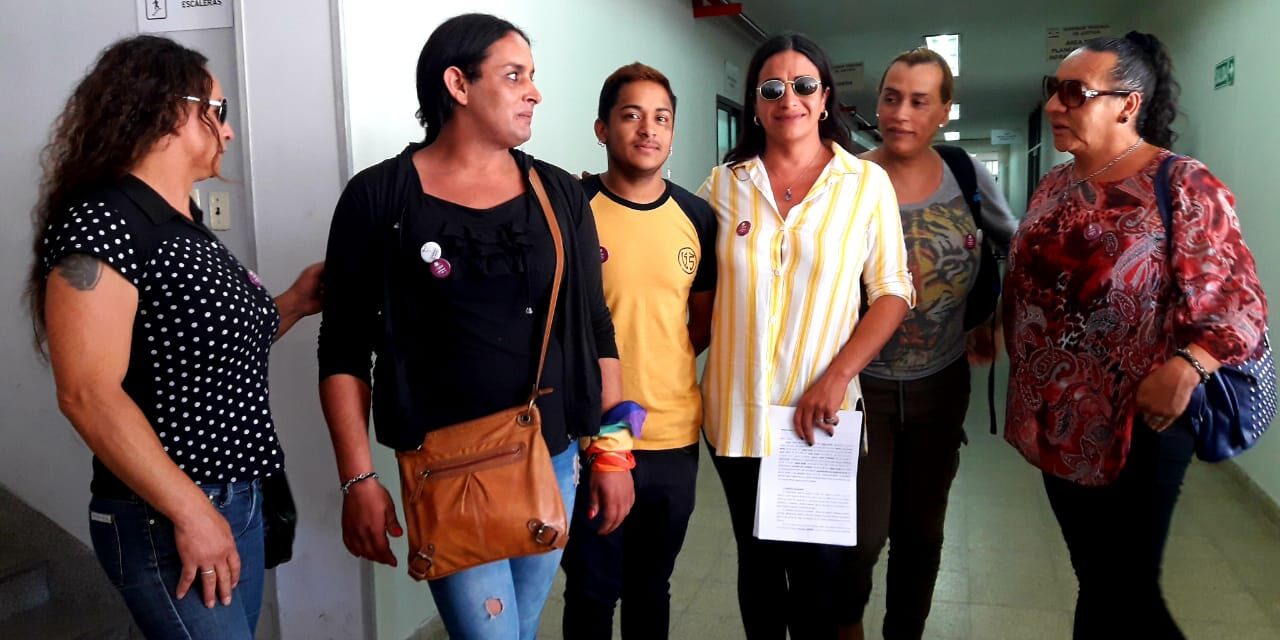
The court in Paraná, Entre Ríos province, granted an injunction filed by five transgender women and one transgender man from the city and ordered their reinstatement. Although the municipality appealed the ruling, the sentence must be carried out. Presentes obtained the grounds for the ruling, considered historic by the transgender community.
The Criminal Judge for Children and Adolescents, Pablo Barbirotto, granted the injunction filed by Vanesa Arami Bello, Paola López, Gabriela Abigail Manríquez, Iara Aranzazu Quiroga, Fernanda Ramírez and Matías Berón against the municipality of the city of Paraná, in the province of Entre Ríos.
[READ ALSO: Trans workers in Paraná denounced the municipality for unfair dismissals ]
And, in the text to which Presentes had access, the magistrate ordered “the Municipal Executive Department to, within three (3) business days from the notification of this sentence, proceed to issue the necessary administrative acts for the reinstatement of the plaintiffs, calculated from November 1, 2019, through the renewal of the contracts under the same conditions under which they provided services, with the consequent payment of the salaries accrued in the month of November of this year and until the selection and designation mechanism for trans agents regulated by the municipality is effectively implemented, in accordance with the quota established in Ordinance No. 9834.”
“I believe this is an exemplary ruling that will set a precedent. The judge resolved the case with a gender perspective, protecting fundamental constitutional and conventional rights and ensuring equal opportunities for individuals in exercising their economic, social, and cultural rights,” Aranzazu Quiroga, the group's lawyer, told Presentes.
The lawyer reported that the municipality appealed the sentence, so the Superior Court of Justice (STJ) of Entre Ríos will now have to rule on it. The appeal was filed on Saturday, and according to the court's timeline, the high court's decision will be issued in about 10 days. "However, the sentence must be carried out in the meantime. That is, they must be reinstated on Wednesday," she explained.
Historic ruling
Judge Pablo Barbirotto's ruling was very well received by the group that took legal action, who publicly thanked the magistrate and celebrated the decision.
“I thought it was a giant step forward for us, the transvestite and trans community, and that there are indeed people who think about us and see us as anyone who can perform a public service,” Fernanda Ramírez, one of the trans women who signed the injunction, told Presentes.
[READ ALSO: Map of the transvestite-transgender employment quota in Argentina ]
“I felt so much emotion, relief, and happiness that someone respected my gender identity and saw that my life choice has nothing to do with my work ability. This is a historic moment in the city of Paraná, as well as in the province,” Fernanda emphasized, expressing her gratitude in particular “for the dedication, effort, and belief in us of María Marta Zuiani, Gonzalo Molina, Dr. Aranzazu Quiroga, and Judge Barbiroto.”
Gabriela Manrique, another of the complainants, emphasized the importance of the ruling to Presentes. “I found out on Friday. I was going to school because I had an exam, since I attend night classes, and Councilor María Marta Zuiani called me and surprised me. I felt so happy and couldn't believe it, because it was great news for the group to get their jobs back. It was fantastic news,” she said.
“Now I hope I can get back to my daily life. We have to report on Wednesday to see what awaits us,” Gabriela added. She concluded, “Getting our jobs back is a dignified thing for anyone; it’s what we were aiming for as a group, and we can share that joy. I’m very happy.”
Along the same lines, Gonzalo Molina, a member of the Comprehensive Gender, Rights, and Health Program of the Secretariat for Integration and Cooperation with the Community and Territory at the Autonomous University of Entre Ríos (Uader), who accompanied his colleagues in filing the injunction, stated: “This ruling is historic. Just as we drafted, filed, and campaigned for it collectively, the impact is collective. It is not an individual ruling for the trans people who filed the injunction, but for an entire community. The justice system rose to the occasion and reaffirmed its role as a guarantor of rights.”
“The ruling also opens up possibilities for the entire trans community, whose previous connections were almost exclusively based on the criminalization of their identities. So, in this case, having access to justice to redress a wrong is invaluable, and it sets a necessary precedent that also allows us to have hope to continue fighting. In that sense, we are very happy,” she told Presentes.
The proposal from the Municipality
Doctors Walter Rolandelli, Francisco Avero, Adrian Albornoz and Guido Zufiaurre, representing the municipality of Paraná, rejected the demand of the trans workers.
Among other arguments, the lawyers stated that “if the decision is made in favor, it would constitute a violation of the separation of powers, as it would represent an interference by the Judicial Branch in the Executive Branch, since the Municipality has discretionary powers to contract, renew, or not renew temporary contracts, which are only limited by the requirement that they conform to the approved budget.”
[READ ALSO: Transgender employment quota approved in Paraná, Entre Ríos ]
Furthermore, they considered that the action filed “is not in accordance with the law, violates constitutional principles and affects the institutionality, since they seek to be recognized as having the right to payment of wages belonging to the month of November, when they ceased to have a contractual relationship with their represented company on October 31, 2019.”
Arguments of the judgment
Judge Barbirotto stated in the ruling that the lawsuit was filed in a timely manner.
Among her arguments, she maintained that “preliminarily, it is important to emphasize the crucial role of a gender perspective in resolving this case.” She argued that this “implies fulfilling the constitutional and conventional obligation to realize the right to equality, remedying asymmetrical power relations and structural inequalities, as well as making visible the presence of discriminatory gender stereotypes in the creation and interpretation of laws and in the assessment of facts and evidence.” She further stated: “If a gender perspective is not incorporated into judicial decision-making, we will continue to fail in the fight for true equality for all people—regardless of their identities—…”
“In this regard, it is well known that the transvestite, transsexual, and transgender community is among the most historically vulnerable populations in the country. The reality for this group is marked by persecution, exclusion, and marginalization, with significant difficulties in accessing equal opportunities and treatment… Therefore, the demand for dignified work for members of the trans community is ever-present,” Barbirotto noted.
The judge cites different regulations when basing his sentence, and in the local sphere he mentions article 15 of the Constitution of the province which recognizes and guarantees “…the right to diversity, pluralism and equal opportunities”.
“Furthermore, the recognition of identities that do not conform to the dichotomous male-female view of social intelligibility has excluded the trans community from family, educational, and work environments, and above all, exposed them to situations of institutional, social, and cultural violence; therefore, the disruption of their job security has a highly negative impact on their lives, and a more profound one than for other people. This should have been taken into account by the Municipality when deciding not to renew the contracts,” she further stated. She added, “Based on these reasons, the termination of these contracts cannot be evaluated in the same way as that of other workers, as the municipality is attempting to argue.”
In this regard, the magistrate summarized: “That is to say, the specific situation of the trans community cannot be equated with that of other vulnerable groups (single mothers, people with disabilities, etc.) whose contracts were also not renewed upon expiration, mainly due to all the aforementioned causes of violation, exclusion and stigmatization suffered by trans people and, furthermore, because for the particular situation of other vulnerable groups the State fortunately already provided strong social coverage that trans people do not have.”
“In short, I understand that through formal and dignified work, the effective restoration of historically violated rights begins, because formal work in the case of the trans population allows for the eradication of prostitution and exposure to circuits of violence, while also enabling social coverage of health, retirement and the rest of the essential human rights intimately linked to dignified work activity,” Barbirotto concluded.
We are present
We are committed to journalism that delves into the territories and conducts thorough investigations, combined with new technologies and narrative formats. We want the protagonists, their stories, and their struggles to be present.
SUPPORT US

FOLLOW US
Related notes
We are present
This and other stories are not usually on the media agenda. Together we can bring them to light.