

The dream of a shelter for trans women in Peru has become a reality
The Trans House of East Lima has three objectives: to perform HIV tests on all those who come to its facilities, to register acts of violence experienced by trans women, and to provide empowerment workshops.

Share

By Vero Ferrari
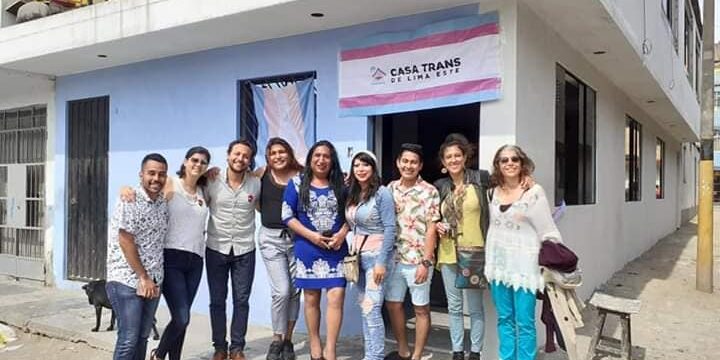
This is no ordinary Friday on César Vallejo Avenue, Block G, Lot 12, in Ate Vitarte, a district in East Lima with high rates of violence and crime. Trans women are arriving to accompany Yefri Peña to the inauguration of what will be the first Trans House in East Lima. It's a shelter for trans women who are passing through as they migrate from the highlands to the coast, who are from the area and need information about their rights. But it will also provide refuge from the cold and hunger that plague the lives of this population, the most vulnerable within a movement that has been fighting for rights in Peru for almost 40 years.
Yefri paces back and forth in her house, nervous, laughing, and worried at the same time, finalizing details for what will be an epic day for her. Finally, around 2 p.m. on this sunny day, she's going to fulfill what was initially just a dream, one of the wildest dreams she's ever had, which little by little became a reality thanks to the support of her local trans network, her friends, and a private company.
The bottle hangs on the door waiting for Yefri to break it with the hammer they got him. His mother is by his side the whole time, watching the tears of joy fall. She says you should never stop dreaming, and that now he'll be able to help his community even more. He'll create jobs for other trans women through the hair salon, and in his office, he'll address cases of rights violations. They'll also offer HIV testing and empowerment workshops because, in a world like this, you have to love yourself deeply to face death.
Miluzka Lut, an activist who has been promoting these shelters for two years, says: “There is a significant number of trans women migrating from much more hostile environments, especially from the Sierra region, from Huancayo, Huancavelica, and Ayacucho. To date, there is no organization for trans women in that part of the country.”
Despite how difficult it can be to live as a trans woman in the Peruvian highlands, they have managed to occupy cultural spaces through typical dances of the area: “We recently had a meeting in Huancayo,” Miluzka continues, “the situation is tough in terms of access to fundamental rights, it is complicated by the issue of violence, but there is something important, that they have positioned themselves in the cultural sphere with the tunantada.”
Comprehensive support
The Trans House of East Lima has three objectives: to carry out HIV screenings for all those who come to its facilities, to register the acts of violence experienced by trans women through the Cedostal system of the Lac Trans Network, and to provide empowerment and support workshops so that they can opt for job openings in the companies associated with the NGO Presentes.
Gabriel de la Cruz, director of the NGO Presentes, told this publication how his organization intervened to make the house available: “Yefri told us at the beginning of the year that she wanted to turn her house into a shelter for trans women and provide them with support in a more institutionalized way, since support has always been present among them. So we met for several months to figure out how to achieve this and what our objectives would be. I wrote to several companies we work with to ask for funding, and Uber was the one that agreed. Thanks to their donation, we were able to remodel the rooms and install all the equipment so it could start operating. But the next step was how to make it sustainable, so we've decided to hold workshops with the companies we work with so that they can also apply for job openings. The more opportunities there are, the more trans women will want to come and train in this space.”
In Peru, private companies tend to be the ones that open the most doors to the possibilities of inclusion for the LGBTI population, in contrast to the recurring abandonment by the State, especially with trans women, who only have health regulations on the issue of HIV, but their access to education, housing, justice and work continues to be denied, which causes profound violations of their dignity, places them in extreme poverty, pushes them to work in risky activities, causes them to suffer from diseases linked to poverty such as tuberculosis and to die very young.
Access to human rights
Promoting housing for a population highly vulnerable not only to HIV, but also to gender violence, exclusion, and inequality, empowers them, grants them access to human rights, and provides them with the necessary support to eliminate the legal, social, economic, and cultural barriers that have prevented them from exercising real citizenship with dignity and justice, eradicating the extreme poverty gap in which they are subsumed through participation and collaboration among themselves so that they never lose the desire to dream.
Since 2017, Casa Trans Zuleimy as an office to advocate for the gender identity law and other community-strengthening activities. But trans women have always wanted safe spaces where they could feel secure, and this desire was fulfilled again near the end of 2019. Casa Trans de Lima Este has become the first such shelter in that area of Lima, where migration from the Andes is high.
READ MORE: This is how Peru's first Trans House works
We are present
We are committed to journalism that delves into the territories and conducts thorough investigations, combined with new technologies and narrative formats. We want the protagonists, their stories, and their struggles to be present.
SUPPORT US

FOLLOW US
Related notes

We are present
This and other stories are not usually on the media agenda. Together we can bring them to light.