

Argentine court rejects transvestite femininity identity on ID card
The Civil Chamber denied Lara Bertoloni's request for recognition of her self-perceived gender identity on her National Identity Document (DNI) on Tuesday, December 10. The ruling will be appealed to the Supreme Court.


Share

By Alejandra Zani
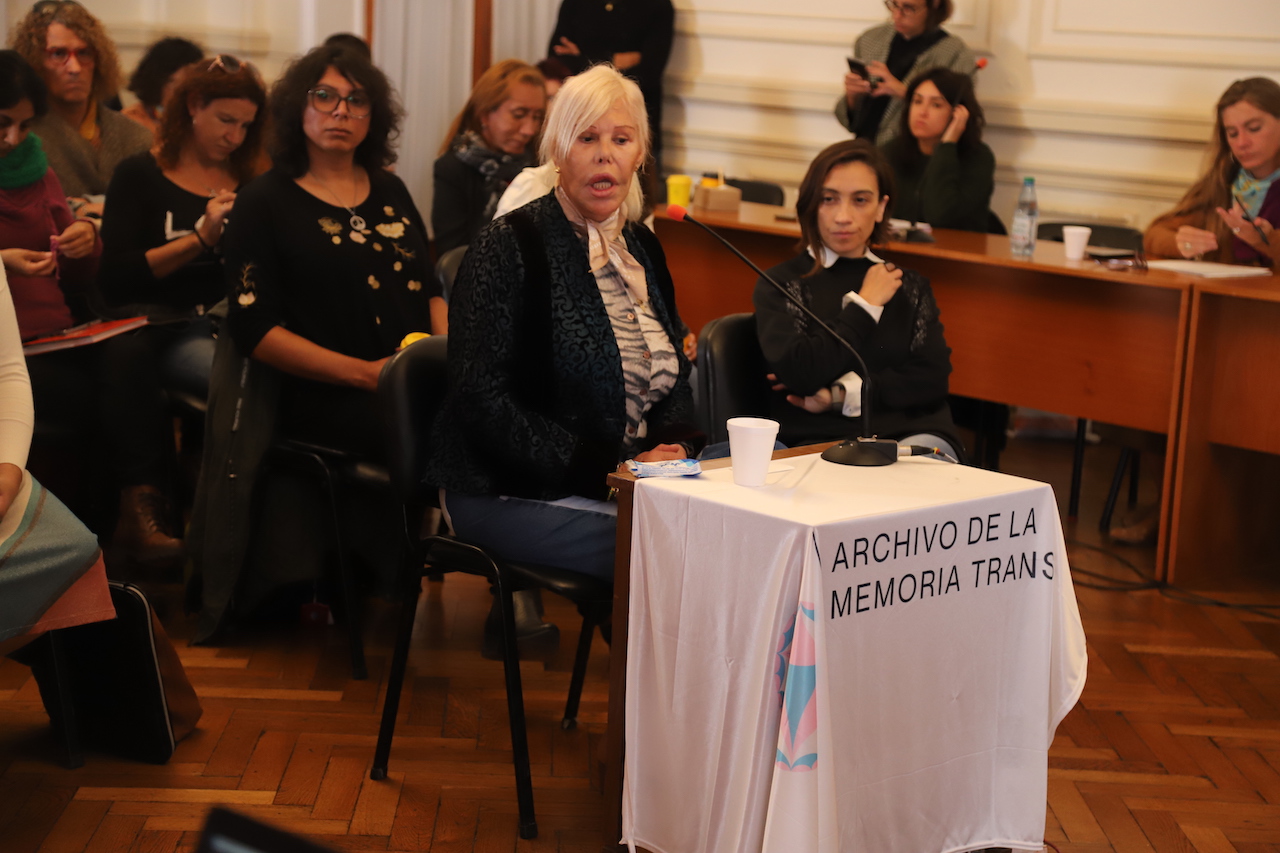
Photo: Ariel Gutraich
Lara Bertolini, a human rights advocate and law student at the National University of Avellaneda, won a landmark ruling last March recognizing her transgender identity in the sex field on her national identity document. However, the Civil Court denied her request to change her birth certificate and national identity document.
This ruling was announced while Alberto Fernández and Cristina Fernández de Kirchner were being sworn in as constitutional president and vice president with a speech that emphasized that "all types of discrimination must become unforgivable."
The request for legal gender recognition was approved by National Civil Court Judge Myriam Cataldi last March. Cataldi's decision was appealed by the National Registry of Persons (RENAPER), which refused to open a special gender field, arguing that "there are only two sexes."
[READ ALSO: For the first time, an identity document will say "transvestite femininity" ]
Judge Cataldi's ruling considered the recognition of gender identity as "a matter of human rights" and ordered the Civil Registry "to resolve these cases administratively by providing a variety of markers as gender options."
Furthermore, he added that RENAPER should be informed so that they can issue a new ID card to the interested person, who should be given the necessary assistance for sending and tracking the process, in order to ensure a fast mechanism.
According to Lara, the Chamber's ruling renders transgender, non-binary, and agender identities invisible. She believes that both RENAPER (National Registry of Persons) and the Civil Registry appealed Judge Cataldi's decision because they refuse to recognize a sex other than male or female.
“In an appeal to the Civil Chamber, they said that, since there are only two sexes, it is not possible to issue the document because that is what society establishes. Once again, transgender and non-binary identities, agender people, and all types of gender that are not governed by sex are completely rendered invisible,” Lara explained to Presentes.
Emilio Buggiani: “They are interpreting the genre in a hyper-restrictive way”
According to Emilio Buggiani, Bertolini's lawyer, the ruling violates constitutional rights, the principle of equality, and non-discrimination. Furthermore, it fails to respect the human right to identity, since "gender identity is also part of a person's identity."
According to Buggiani, the judges' ruling does not take into account the last article of the Gender Identity Law, which states that no law can be opposed to the recognition of the human right to gender identity.
“They interpret the word ‘sex,’ which is what appears on people’s birth certificates and ID cards, in a hyper-restrictive way, focusing solely on genitalia. This interpretation fails to understand sex as a social construct, as stated in the Gender Identity Law,” Buggiani told Presentes.
The lawyer questions RENAPER's interpretation of the provisions of the Gender Identity Law.
“RENAPER says that our legal system is based on a binary, male-female system, and that Lara changed her sex from male, which was the sex assigned to her at birth, to female. And therefore, that the law is being followed. But it does not recognize transvestite femininity as an independent identity that breaks that binary order,” Buggiani noted.
Lara Bertolini: “Since we are not named by the State, we do not exist”
The ruling of the Civil Chamber was signed by Carlos A. Bellucci, Gastón M. Polo Olivera, Carlos A. Carranza Casares, and is based on the Dictionary of the Spanish Language and the statements made by Judge Graciela Medina, whom they cite in the text.
“Gender identity is the awareness acquired of equality, unity, and the persistence of individuality as male or female. The Gender Identity Law would be intended to solve the problem of transgender people to align their gender identity with male or female, but it does not include the possibility of a third gender or cross-dressing,” the ruling states.
According to Lara, RENAPER and the Civil Registry cannot deny the recognition of her identity, but they refuse to recognize it in a document "because that would imply modifying the social structure and they would have to think about the transvestite-trans problem, give transvestite-trans people work, give transvestite-trans people access to rights."
According to the advocate, if the binary logic that defines sex as male and female is not corrected, the trans employment quota law can never be implemented. “What is not named does not exist, and if we are not named by the State, we do not exist.”
“To label us as a problem is to label us negatively and to return to a sense of inequality, exclusion, and stigmatization. These brief lines of argumentation go against the right to self-perceived gender as defined by the Gender Identity Law (LIG) and by international pacts and treaties. They cannot be saying this in 2019. Children and adolescents in the future have the right to have their identity recognized and validated by the State,” Lara stated.
In response, Buggiani argues that it is necessary to review the areas where the system has become outdated. “The ruling states that if the self-perceived identity of transvestite femininity is recognized, a revised labor system, prison system, and social security system would have to be considered. This needs to be addressed. Otherwise, we are excluding an entire community from the system—a large number of people affected by having an obsolete system,” she pointed out.
State must repair
According to civil law specialist Ángela Mora, the historical context in the Supreme Court of Justice must be used to request, through an extraordinary appeal, the review of the Civil Chamber's ruling.
“More than anything, it’s administrative bodies that are opposing this, not the Argentine State. Given international and national precedents, the Court must clarify the situation of groups that aren’t even excluded, because they were never included. And that’s their non-existence. This is a good opportunity for the Court to recognize that these groups exist and that the State must rectify this systematic denial throughout its history,” Mora told Presentes.
Mora stated that in the ruling, the judges cite Advisory Opinion 24/17, which includes the principle of desire. “It establishes that the desire for publicity of each person's identity must be respected. However, Lara is denied this principle because they interpret the word 'sex' in a biased way.”
“What the judges did in this ruling was to interpret the law using the classic 19th-century method. But there is another possible order for that interpretation. Now the Civil Code incorporates a theory, a philosophy of law, a way of conceiving the law, which is Robert Alexy's theory, which implies that you don't have to adhere solely to the word of the law, but rather that the word must be consistent with certain principles and values,” Mora stated.
We are present
We are committed to journalism that delves into the territories and conducts thorough investigations, combined with new technologies and narrative formats. We want the protagonists, their stories, and their struggles to be present.
SUPPORT US

FOLLOW US
Related notes


We are present
This and other stories are not usually on the media agenda. Together we can bring them to light.