

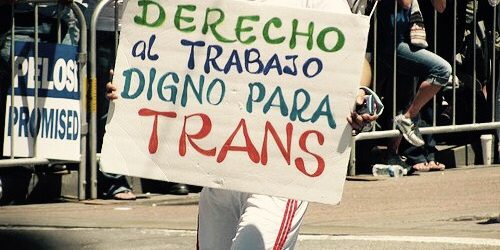
After 4 years, the transvestite trans job quota law was regulated in the province of Buenos Aires
It establishes that the public sector of the province must employ at least 1% transvestite and trans people.

Share

By Rosario Marina
After four years of being approved and then shelved, the law establishing a quota for transgender and transvestite employment in the province of Buenos Aires has finally been implemented. Law No. 14,783 was championed by transgender activist Diana Sacayán and passed in September 2015. A month later, the human rights activist was brutally murdered in her apartment. Since then, the government of María Eugenia Vidal had stalled the implementation of the law until today, when it was finally published in the Official Gazette.
“The public sector of the province of Buenos Aires must employ transvestite, transsexual and transgender people who meet the suitability conditions for the position in a proportion of no less than one percent (1%) of its total staff,” the publication reads.
[READ ALSO: The debt of the province of Buenos Aires with the #TransWorkQuota law ]
The regulations bear the signatures of the Minister of Labor, Marcelo Villegas, the Minister of Government, Federico Salvai, and Governor María Eugenia Vidal. The Secretariat of Human Rights and the Ministry of Labor will be responsible for ensuring their implementation.
During these four years, sexual diversity organizations demanded its implementation from the government of the province of Buenos Aires, but they received no response.
[READ ALSO: Map of the transvestite-transgender employment quota in Argentina ]
“We received this regulation with mixed feelings: firstly because the law was passed in 2015 and Governor María Eugenia Vidal took four years to implement it through a decree, something we believe is very late considering that many of our colleagues died of hunger, exclusion, and lack of resources, especially work, during those four years. But we must also celebrate it; we have hope that something will change,” explained activist Claudia Vázquez Haro, president of OTRANS Argentina, Presentes
For her part, activist Alba Rueda, president of Mujeres Trans Argentina (Trans Women Argentina), agreed that “this is cause for celebration: to highlight that we now have the Diana Sacayán Law regulated. This is great news for the trans community.” However, like the president of OTRANS, she cautioned about the delay: “Vidal represents that pause, that suspension of democracy in the progress of trans rights. Vidal had the text shelved until days before the end of her term.”
He also stated that they will request an interview with the future governor, Axel Kicillof, to discuss the regulations.
Next steps
The regulations are detailed in the Annex to the publication. First, the Provincial Public Administration must inform the Ministry of Labor within the next 90 days of the total number of people working under its jurisdiction. Based on this information, they must calculate the number of vacancies that need to be created to meet the quota.
Furthermore, it states that the “Amancay Diana Sacayán Job Seeker Registry” will be created, operating under the Ministry of Labor. This registry will contain applications from transgender, transsexual, and gender-diverse individuals seeking to fill open or reserved vacancies under Law No. 14,783. The information contained in this registry will be confidential.
A committee made up of the Ministry of Labor and the Secretariat of Human Rights will monitor compliance with the law, where trans organizations will have "consultative participation".
Why a quota law? Diana Sacayán
The law's rationale explains the international recognition given to the Gender Identity Law. It then cites Law No. 14,783 and reiterates its arguments: “Transvestite, transsexual, and transgender people in Argentina are among the most historically vulnerable populations in the country, suffering systematic persecution, exclusion, and marginalization, which creates enormous difficulties for them in accessing equal opportunities and treatment and in the effective enjoyment of their human rights.”
“Due to the criminalization, discrimination, and systematic exclusion to which they were and still are exposed, transvestite, transsexual, and transgender people are often victims of rejection, marginalization, and brutal violence from an early age. This translates into violence within the family and expulsion from the home during adolescence, as well as from the schools and educational institutions they attend, forcing them to live in extreme poverty, frequently having to resort to criminalized activities and economies for their subsistence. This, in turn, has contributed to a large number of transvestite, transsexual, and transgender people having records of arrests in public places, prosecutions, and criminal convictions,” the argument continues.
The text published in the Official Gazette of Argentina's most populated province acknowledges that the law was promoted "from civil society by the activist Amancay Diana Sacayán, whose work decisively contributed to the enactment of the law subject to this regulation" and indicates that the objective is "to reverse a situation of exclusion and structural discrimination based on prejudice against transvestite, transsexual and transgender people."
The Inter-American Commission on Human Rights (IACHR) had already explained in 2015 that this law has the capacity to "contribute not only to reducing the levels of poverty faced by trans people, but can also help reduce the number of murders and acts of police violence, insofar as it reduces the number of transvestite, transsexual and transgender people in criminalized informal economies, thus also contributing to breaking down stereotypes and prejudices related to gender identity."
The enactment of Law No. 14,783 was also highlighted by the United Nations Human Rights Committee as one of the positive aspects of compliance with human rights obligations in the fifth periodic report submitted by Argentina.
Municipalities that had already made progress
Despite the lack of regulations, some municipalities and universities have made the political decision to implement a transgender employment quota. Karina Nazábal, head of the Gender and Childhood Policies Secretariat of the Provincial Ombudsman's Office, presented a report last year noting that, despite the absence of regulations from the provincial Executive Branch, the municipalities of Morón, Lanús, Azul, Chivilcoy, Quilmes, Avellaneda, Almirante Brown, Merlo, Tres de Febrero, and San Miguel have adopted the Transgender Employment Quota Law. At the National University of La Plata, the Faculty of Psychology submitted a project for the Labor Inclusion of Transgender People to the Governing Council, which was approved in September of this year. Furthermore, the Municipality of Mar del Plata has also implemented it, as has the University of Mar del Plata , which already has its first transgender employees on staff.
We are present
We are committed to journalism that delves into the territories and conducts thorough investigations, combined with new technologies and narrative formats. We want the protagonists, their stories, and their struggles to be present.
SUPPORT US

FOLLOW US
Related notes

We are present
This and other stories are not usually on the media agenda. Together we can bring them to light.