

Camila's last night: a trans woman persecuted by gangs and murdered by the police
Camila was a 29-year-old Salvadoran trans woman. Her death at the hands of three police officers is the first transfemicide case to reach the courts.

Share

By Paula Rosales and Nelson Rentería
Photos: PR and VF
Shortly before six o'clock on Wednesday, January 30, Camila Aurora Díaz Córdova slung her bag over her shoulder and left her house for another night of sex work on the same street where she had worked for twelve years, in northern San Salvador. She walked listlessly and sadly: she had been trying to change her life for a long time. She had sought other jobs to survive without exposing herself to the threats of gangs and the police. She had reported the discrimination and persecution she faced for being a trans woman to the authorities. She had tried living in other cities and countries. She had sought asylum in the United States and had been deported. Things had only gotten harder.
“Here I am now, in these horrendous and deadly streets. Here I am, what can you do?” she told a friend in a WhatsApp message, as if she knew what awaited her. That morning, Camila was tortured and murdered. She was 29 years old, six years younger than the life expectancy for trans women in Latin America. Her killers tried to cover it up, but the marks on her body spoke for her. For the murder, three police officers—Jaime Geovany Mendoza, Luis Alfredo Avelar, and Carlos Valentín Rosales—are in custody and could become the first people convicted of a hate crime in El Salvador. It is the first case to be prosecuted as such, even though at least 22 trans women have been murdered since 2017, according to figures from the Salvadoran LGBTI Federation.

Camila was born on November 9, 1989, in the municipality of Santa María Ostuma, in the department of La Paz. The second daughter of a couple who were members of a Christian church, she grew up in a small, hidden village in the southeastern part of the Jiboa Valley. There, her family cultivates corn, beans, pineapple, and sugarcane. Her parents, Edith Córdova and Lino Díaz, were unable to register her birth at the local municipality because two days after Camila was born, the Farabundo Martí National Liberation Front (FMLN) launched a guerrilla offensive in its attempt to seize power.
Her mother recalls that despite the humiliations she suffered in the town, when neighbors reacted to the first feminine gestures of her transition with mockery and rumors, her daughter never lost her good humor: “If her , she didn’t say anything. She never disrespected others,” her mother told Presentes.

Discrimination and harassment are commonplace for LGBTI people in these small towns in El Salvador, where machismo and radical religious ideas are widespread. There is no place for people who do not identify as men or women.
The lack of tolerance translates into everyday violence. And this, in turn, leads to a decline in mental health that sometimes culminates in suicide. This is according to the figures from the National Survey on LGBTI Realities in El Salvador. Presented in 2012 by the now-defunct State Directorate of Diversity, 61.7 percent of the 400 people surveyed reported knowing an LGBTI person who had committed suicide.
Camila was not exempt from this ordeal. Her mother tried to change her mind about her gender identity. When Camila turned 18, she wanted her to enlist in the Salvadoran Army's Special Forces. Camila flatly refused. The pressure was so intense that she had no other choice: to enlist and wear fatigues.

Her mother, Edith, admits that at first she couldn't "condone" her daughter's behavior because it went "against God's will." Now she regrets that attitude and not even trying to accept that Camila had the right to be whoever she wanted.
Camila spent three months in the Armed Forces and received training. Until one day, fed up with military life, she refused to take the oath that would make her a soldier. Thus ended her military experience in 2007. Camila then decided that Santa María Ostuma was not the best place to live and moved to the capital, San Salvador.
Life in the city, gang persecution
In the capital, a cousin took her in and baptized her with the name Daniela. It was the first time she had been given a female name. This way of naming her was much more than symbolic. From then on, she let her hair grow, dyed it blonde, and expressed her gender identity.
READ MORE: Another trans woman murdered in El Salvador: 3 transfemicides in less than a month
Although she felt freer, her situation didn't improve. She couldn't find decent work there either. To survive, she had to resort to sex work on the streets for the first time. Her cousin began to control and abuse her. His tantrums escalated into beatings, mistreatment, and burned clothes. Eventually, he kicked her out of the house.
Camila sought refuge with other trans women. She had met Virginia Flores and Mónica Elizondo during the patron saint festivities in San Salvador. “She didn’t know where we lived, only that it was in the Zacamil neighborhood; she knew practically nothing about the areas of San Salvador. She didn’t knock on the door. When my partner was going to work, she told me, ‘Look, there’s someone lying down outside,’ I went out to see and found her,” Virginia Flores told Presentes.
Mónica and Virginia took her in at a tiny apartment in a multi-family housing complex in the Zacamil neighborhood. Her new friends renamed her Camila Aurora.
What followed was a sequence of changes of address, absences, migrations, displacements, escapes, harassment, and the same search at every step: to try for a quiet life.

Camila and Virginia have birthdays a week apart. The picture was taken at their last celebration together. Photo by Virginia Flores

Her friend Monica, 35, wanted the same thing. She had already been threatened and her house had been shot at. Monica decided to leave the house in the Montreal neighborhood. On May 20, 2011, she returned to the house, wanting to clean it and make sure it was in order. She was murdered while traveling along Route 47. According to police reports, alleged members of the Mara Salvatrucha (MS-13) gang, the same ones who had threatened her, shot her several times.
That year, Camila went to live with her sister Kelly in a neighborhood in the municipality of Ilopango. One night, while they were resting, other gang members who controlled the area knocked on their door. They arrived under the pretext of “talking” with Camila. After several knocks, they climbed onto the roof of the house to try to break through it and enter through a hole. Camila and her sister began reciting verses from Psalm 91, which was hanging on one of the walls.
No evil will befall you, nor will any plague come near your dwelling. For he will command his angels concerning you to guard you in all your ways.
“I started praying on my knees for the men to leave. The blows were intense, but God performed a miracle for us; they got tired and left. I don’t remember anything else because I fainted from fear,” Kelly Díaz Córdoba told Presentes.
Days later, the gang members returned to the house while the sisters were out and destroyed their few belongings. Camila's mattress was riddled with knife holes. They decided to return to their childhood home in Santa María Ostuma. Before leaving, they had to pay the homeowner for the damage caused by the gang members.
The threats that no one heeded
Camila wanted to return to the capital, only to find that nothing had changed. The death threats were constant. As a result, on August 27, 2015, she filed a complaint with the National Civil Police (PNC) against other gang members identified by their aliases: Coqui, Gasper, and Travieso. According to the complaint, these three Barrio 18 gang members gave her fifteen days to pay the extortion money they charged sex workers for using their territory. Otherwise, she would have to leave Celis Street, in the eastern part of the capital.
A sex worker can charge a client between $15 and $20 for her services. The gang demands $10 a week for her to work in their territory, according to Presentes. If they don't pay the fee, the gang members give them "discounts." That's what they call the beatings they inflict to prevent it from happening again. When the women still refuse to pay, they can be killed.
According to a report on human displacement by the Association Communicating and Empowering Trans Women in El Salvador (COMCAVIS TRANS), gangs are the main perpetrators of attacks against the LGBTI population . This is indicated by 79 percent of the documented complaints between March and December 2018.
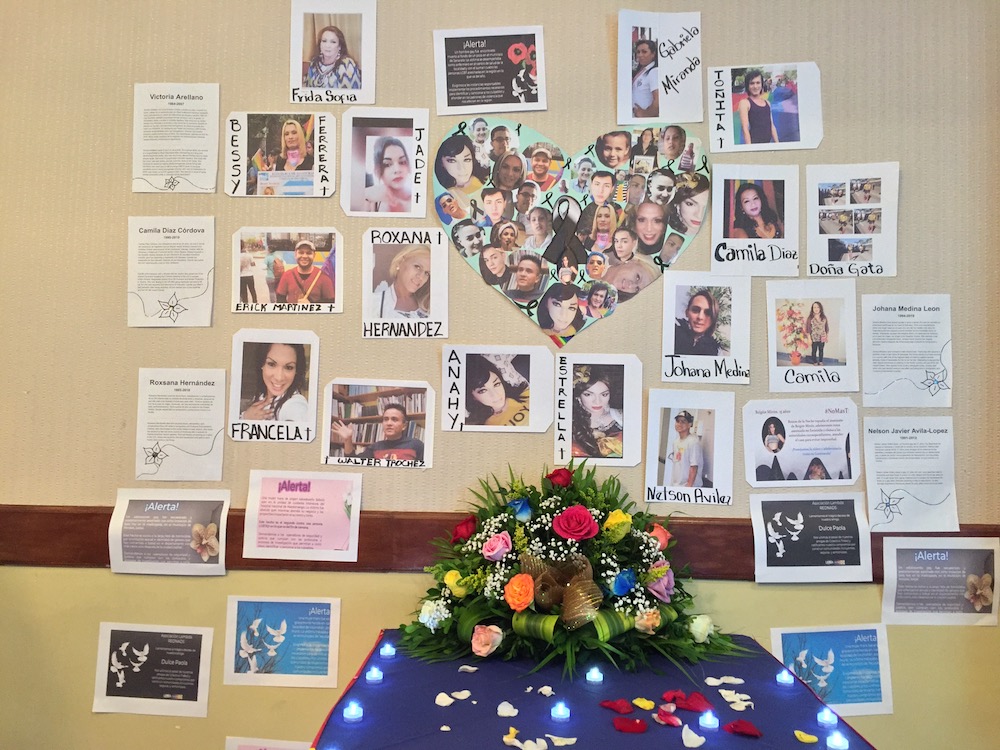
After filing the report, Camila received a slip of paper with case number 5339. The investigation went nowhere. Her complaint became part of a mountain of pending cases at the public security institution. According to police statistics, they received 2,242 extortion reports nationwide in 2015.
LGBTI rights organizations point out that rivalry can also exist among sex workers themselves. The situation worsens when trans women have contacts and relationships with gang members. These organizations also report that some on-duty police officers intimidate, threaten to kill, or make arrangements with sex workers to buy their protection and impunity.
The report “Stop Trans Genocide”—produced in 2018 by the Solidarity Association to Promote Human Development, ASPIDH Arcoiris Trans—highlights that this population repeatedly denounces violations of their rights by members of the police. The report details extortion, abuse, beatings, and public humiliation in videos recorded by the officers themselves.
Migration and asylum applications
Fed up with the violence in El Salvador, five trans women - Camila Díaz, Virginia Flores, Alejandra Barrera, Diana López and a girl identified as Arely - packed their few belongings and boarded the bus that took them to the northern border between Guatemala and Mexico.
On Monday, March 7, 2016, the five women climbed onto a makeshift raft constructed from tires and planks and crossed the Suchiate River, which divides the two countries. Camila was a guide for the migrant group. In 2015, she had already traveled the route and obtained humanitarian asylum in Mexico.
Four days after arriving in Tapachula, Mexico, they were attacked by other transgender migrants, whom they identified as Honduran. According to their testimonies, the attackers tried to rob them, beat them, and warned them to leave their territory, which was their workplace.
After filing a complaint with the migrant prosecutor's office, the group disbanded. Camila decided to settle in Mexico City for a few months. But in the end, she returned to El Salvador.

In February 2017, Camila once again attempted to fulfill her dream of living in the United States. It took her six months to travel the more than 4,000 kilometers from San Salvador to the Tijuana border. There, she lived at the "Butterfly Garden" shelter, a center exclusively for the LGBTI migrant population. During her stay, she worked cleaning houses, caring for the elderly, and in a clothing factory.
On August 8, 2017, she crossed the U.S.-Mexico border, surrendered to U.S. authorities, and requested humanitarian asylum. She carried all the evidence of the assaults and the reports of death threats. Her request was registered under code A213-086-226, and she was detained for three months at CoreCivic, or Corrections Corporation of America , in San Diego, California.
The organization COMCAVIS TRANS has documented the internal displacement of 102 LGBTI individuals between March and December 2018. Seventy-eight percent of them are trans women . Those interviewed reported receiving threats, but the public prosecutor's office did not investigate the cases. COMCAVIS TRANS also notes that from 2014 to November 2019, 116 trans women have left El Salvador seeking humanitarian asylum in various countries. Of these, six cases were denied, and deportation orders were issued. The asylum process can take months or years, and many trans women end up fleeing irregularly to Guatemala, Mexico, or the United States.
Camila was returned to El Salvador in November 2017. Her asylum process was left incomplete when she signed her deportation order. According to four sources consulted by Presentes, she was deceived by U.S. Immigration and Customs Enforcement (ICE), who forced her to sign a purported medical document, the contents of which were in English.
“What’s happening in the United States is deplorable. We’ve heard reports of torture, abuse, people being locked in freezers, and we’ve also heard cases where people have been pressured to sign deportation papers, told they’ll be reunited with their families. In Camila’s case, we know she was told she would receive medical attention, which wasn’t true,” Maritza Martínez, executive director of Somos Familia, a non-governmental organization that supports the LGBTI community in the United States, told Presentes. Presentes requested a statement from ICE via email, but no response had been received by the time of publication.
In the deportation document, which Presentes obtained, ICE stated that Camila did not provide a valid address in the United States where she would reside while awaiting a decision from an immigration judge on her asylum claim. It also alleged that Camila “did not demonstrate substantial ties to the community in the United States.”
Camila had no family in the United States to take her in. But she held onto the hope that an international organization of transgender migrant women would learn of her case and support her. That didn't happen either. According to El Salvador's General Directorate of Migration and Foreign Affairs, the United States deported 14,902 migrants in 2017. Camila was one of them.
Back in El Salvador, she changed jobs. She found an opportunity at a modest pupusa stand (pupusas are a typical Salvadoran dish) near the capital's center. She was in charge of cleaning, serving customers, and helping in the kitchen. She wanted to start her own business and sought support from human rights organizations, but the cumbersome procedures made her give up. She returned to sex work on the streets.
Camila's last hours
The day Camila died alone in a hospital after being tortured, she had planned to spend it at her mother's house. It was election Sunday. For the four days prior, she had gone to work with the intention of saving money for the trip. When she arrived in the area, she headed straight for a private security booth. A guard kindly let her use the space to change her clothes. Once she was ready, she walked to 27th Avenue North in San Salvador, a street that is deserted, poorly lit, and sparsely populated at night. Scattered along the sidewalks, several women could be seen offering their sexual services. On the surrounding streets, the auto parts stores were closed and covered in graffiti. Only the traffic lights, the billboards, and the neon lights of the occasional strip club illuminated the area.
Police said that at 3:00 a.m. on Thursday, January 31, the 911 emergency system received an anonymous tip about a public disturbance. According to the report, a person was damaging ornamental plants at a bank branch on 23rd Avenue North in San Salvador.
Officers Jaime Geovany Mendoza, Luis Alfredo Avelar, and Carlos Valentín Rosales went there in patrol car 01-3937. Upon arrival, the officers observed that the reported person was already handcuffed. It was Camila.
Hours before her arrest, Camila had been seen at the Los Chicharrones restaurant, drinking beer with another trans woman. This is in the “Zona Real,” an area of breweries and clubs, which authorities consider to have a “high crime rate.”
Later, Camila was seen walking along 23rd Avenue North. The report states that early that morning, Camila appeared agitated and disoriented; she was barefoot and her black dress was lifted, revealing her red underwear.
Witnesses said they were astonished to see the police beat her, without her being able to defend or protect herself, because she was kneeling and handcuffed behind her back.
“Poor thing, they all grabbed her and beat her. They beat her senseless, put her in the pickup truck and kept her there,” one of the people who saw the scene and asked to remain anonymous told Presentes.
At 3:23 a.m., Officer Jaime Geovany Mendoza started the patrol car, and his colleagues Luis Alfredo Avelar and Carlos Valentín Rosales stood on either side of the back of the vehicle. Camila was lying on the bed between the two of them.
A series of videos seized by the Attorney General's Office show the patrol car traveling through various streets in northern San Salvador, even outside its assigned jurisdiction. When they reached the extension of Boulevard Constitución, around kilometer 5.5, the officers threw Camila from the moving vehicle. They then returned to the 911 emergency system base. According to the Attorney General's Office, the officers knew it was a blind spot. The security camera footage captures the moment the patrol car returns to the 911 base with only the officers inside. Upon their return, they did not record any incidents in their logbook.
Around 4:00 a.m., an ambulance from the Solidarity Fund for Health (FOSALUD) transported Camila Díaz Córdova to Rosales National Hospital for treatment of serious injuries. Camila was admitted as an unidentified person.
Camila's friend, Virginia Flores, had last spoken with her at 9:07 p.m. on January 30th. She became worried when relatives told her that Camila hadn't come home to sleep. She wasn't answering calls or messages either. Virginia went to the police, the forensic institute, and medical centers. At each place, she showed them her friend's picture, hoping to find her.
Eight days after her disappearance, a doctor at Rosales Hospital recognized her in the photo. She told Virginia to look for her friend's body at the Medical Examiner's Office. She had died days earlier at the hospital, alone, on the morning of Sunday, February 3, election day.
The body that speaks
The forensic examination determined that Camila's death was caused by blunt force trauma. Her face showed bruises on her mouth, forehead, and eyes. Her back had a deep wound on the right side. Her right buttock was detached and hanging by a thread of skin. Her left forearm was broken in two, and her vital abdominal organs had suffered severe traumatic injuries.
The prosecutor's office told Presentes that the forensic examination determined Camila's injuries were caused by blunt force trauma inflicted during the patrol car's journey. It also confirmed that she was thrown from the moving vehicle onto the road .
The prosecutor in the case, Gisela Meléndez, told Presentes that Camila received "severe fatal blows to her abdomen" and ruled out that the injuries corresponded to a hit-and-run, as was initially investigated.
Although the prosecution has not been able to establish a motive for the police officers' actions, it believes there is sufficient evidence to support the claim that the murder was motivated by hatred of her gender identity and expression. “We don't have a specific motive. But there are several cases against police officers who abuse their power,” Prosecutor Meléndez told Presentes. The prosecution found no evidence that Camila Díaz was part of criminal gangs or that she had committed any crimes.
Institutional violence in El Salvador
The National Civil Police of El Salvador was formed after the signing of the Peace Accords that ended 12 years of civil war (1980-1992). The new institution was intended to leave behind the repressive practices and human rights violations committed by state security forces before and during the conflict.
But in its 27 years of operation, the police have not been exempt from accusations of human rights violations, abuse of authority, brutality, and extrajudicial killings during operations.
The Human Rights Ombudsman's Office (PDDH) documented that police officers committed a total of 116 extrajudicial killings with extreme brutality between 2014 and 2018. Some of the victims were not gang members.
“The Human Rights Ombudsman’s Office (PDDH) concluded that the loss of life at the hands of state agents is a regrettable reality in El Salvador. Despite efforts to professionalize the National Civil Police and the Armed Forces, it appears to be a systematic practice for many agents to act on their own and fail to fulfill their obligation to carry out their work within the legal framework,” says the report presented in August 2019.
According to Jeannette Aguilar, an academic and security expert, the PDDH investigation also confirmed a pattern of behavior in the documented cases, which allowed for the prior identification of the victim, the prior planning of the murders, and a cover-up scheme that extended beyond the perpetrators themselves. Aguilar believes that Camila's case also followed this pattern.
Presentes repeatedly requested an interview with the Director of the Police, Commissioner Mauricio Arriaza Chicas, but at the time of publication, it was not granted by the press office.
The accused and more threats
So far, three people have been arrested in connection with Camila's murder.
Officer Luis Alfredo Avelar, 35, studied religious studies at the Catholic University of the West. He immigrated to the United States illegally and was deported on April 26, 2019. He resigned from the police force in 2008 and rejoined in 2012. His record shows that he has committed minor offenses: being absent from work and abandoning his post.
The second defendant is Officer Carlos Valentín Rosales Carpio, 37 years old. He was the highest-ranking officer in the group that responded to the emergency call. On the entrance exam, he received a score of four out of ten points in the human rights section.
The third defendant is Jaime Geovany Mendoza Rivas, 28 years old. His record shows no disciplinary infractions, and he received an award for police excellence.
The prosecution accuses them of the crimes of kidnapping and aggravated homicide of Camila. The maximum sentence for both crimes could reach 60 years. This may be the first case in El Salvador to be tried and convicted as a hate crime motivated by gender identity, expression, and sexual orientation.
This is possible because in 2015 the Salvadoran Congress modified the penal code so that crimes committed due to discrimination based on gender identity and sexual orientation are condemned taking the criterion that they were committed out of hate and can be punished with a sentence of 30 to 60 years in prison.
“We hope that justice will be done, we are guaranteeing the rights of our clients and whether they are guilty or not, it is a sentencing judge who will determine that in a ruling,” Pablo Cruz, the police officers' defense attorney, told the press.
Following the arrest of the police officers on July 1, 2019, and the subsequent investigation of Camila's case, Presentes learned of testimonies from people who have been harassed and threatened by alleged agents, motivating them to testify in favor of the accused officers.
“I think this case shows the deterioration that police conduct has had in recent years in terms of disrespect for the lives of vulnerable groups, the margin of impunity with which they tend to act, the criminalization also of vulnerable groups, in this case a trans woman who was beaten inside the police vehicle and who is abandoned precisely to simulate the execution by third parties,” Jeannette Aguilar told Presentes.
Camila's family also received phone calls from someone who identified himself as a supposed relative of one of the detained agents, in order to meet with them to "reach some agreement".
In the call, the person assured the family that they had also “already spoken with people like their son (a trans woman).” Both the Attorney General's Office and the Human Rights Ombudsman's Office are aware of these calls, as Presentes was able to confirm.
Although Jeannette Aguilar did not refer to the specific case of Camila Díaz, she asserted that intimidation is a common practice used to seek impunity in cases involving police officers. “Extrajudicial killings were typically accompanied not only by a scheme to guarantee impunity, but also by a scheme of intimidation, harassment, and systematic threats against the victims, survivors, and their families, perpetrated by the perpetrators themselves or by other police officers, to dissuade the victims from withdrawing their complaints,” Aguilar said.
Presentes asked the Prosecutor's Office if it was possible that the police institution had alerted the officers about the investigation against them, due to Luis Alfredo Avelar's departure from the country. The police officer emigrated irregularly to the United States and was deported on April 26, 2019. "Even when we investigate the same police force, we do so in conjunction with them, and somehow, they find out if they are being investigated for any crime," the prosecutor said.
On August 14, 2019, the Police Internal Affairs Unit sent a letter to the Fifth Court of Instruction informing them that the license for the UFED Cellebrite extraction device software had expired. For this reason, from the three detained officers had not been extracted
The UFED Cellebrite is a device for extracting and decoding stored, hidden, or deleted information from mobile devices and applications. Presentes requested information from the police press office regarding the expiration date of the extraction software, but no response was received by the time of publication.
***

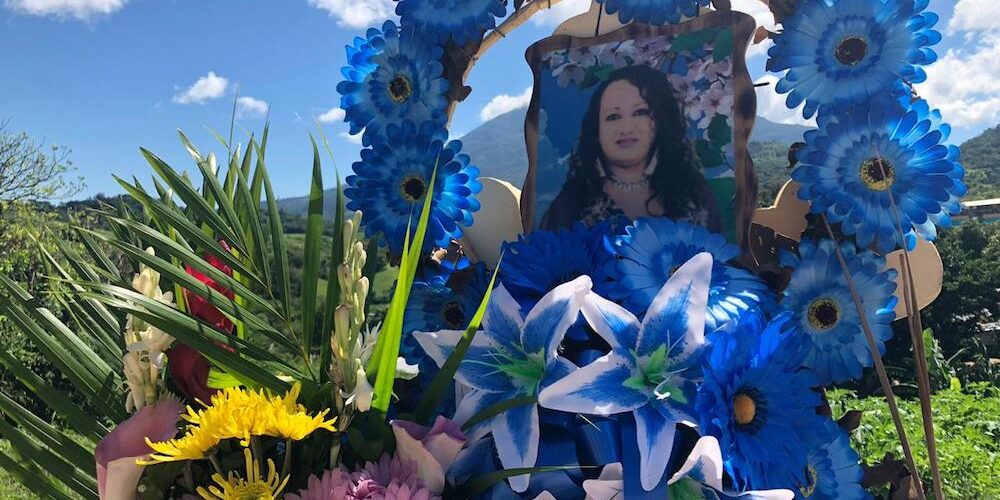
Camila Aurora Díaz Córdova's tomb lies with its back to the viewer, facing a picture-perfect landscape. The Chinchontepec volcano looms majestically, surrounded by sugarcane fields. The small cemetery in the municipality of Santa María Ostuma is always closed; to enter, one must request the key from an attendant, and it is currently unavailable. But that wasn't enough to stop Edith Córdova and Virginia Flores from slipping through a hole in the fence on November 9, 2019, and entering the cemetery. With tears in their eyes, they placed a floral offering on her mausoleum. That day, Camila would have turned 30.

READ MORE: Another hate crime in El Salvador: four transfemicides in 40 days
We are present
We are committed to journalism that delves into the territories and conducts thorough investigations, combined with new technologies and narrative formats. We want the protagonists, their stories, and their struggles to be present.
SUPPORT US

FOLLOW US
Related notes
We are present
This and other stories are not usually on the media agenda. Together we can bring them to light.