

Young man run over by police car in Santiago: “It was a homophobic act”
Nicolás and his boyfriend were run over by a police water cannon truck. It was traveling at high speed against the flow of traffic.


Share

By Airam Fernández, from Santiago, Chile
On the night of Wednesday, November 19, Nicolás Méndez and his boyfriend were returning home after running some errands at a store in their neighborhood. They were walking hand in hand, as they usually did, and upon reaching the pedestrian crossing that connects Santa Lucía and Agustinas streets in downtown Santiago, they were struck by a police water cannon truck. It was traveling at high speed against the flow of traffic.
In a conversation with Presentes, Nicolás recalls that the clock read 9:40 p.m. He remembers that he and his boyfriend took a few steps while the pedestrian light was green. No one was walking near them in that area, which for over a month has become deserted as soon as the sun sets, due to its proximity to Plaza Italia, the so-called "ground zero" since the protests and police repression erupted in Chile. He also remembers seeing only two private vehicles waiting for the light to change. "They were the only witnesses, but they didn't come to help us when the police car drove off and left us both lying on the ground," he says.
[READ ALSO: New allegations of sexual violence against lesbians by state agents ]
“It was an openly homophobic act. There is no other justification for what they did,” says Nicolás, a 26-year-old sociologist. Especially since that night, right where they were, there were no protests or clashes. And also because that day, unlike others, Nicolás didn't join any street demonstrations. “I've been protesting every day since this started because I understand and share the movement's demands. But at that moment, at that time, and in that place, I was just buying groceries to take home. I think that for them, seeing two gay men walking hand in hand during a complicated time for the city was the perfect opportunity to commit an act that would go unnoticed amidst all the turmoil,” he explains.
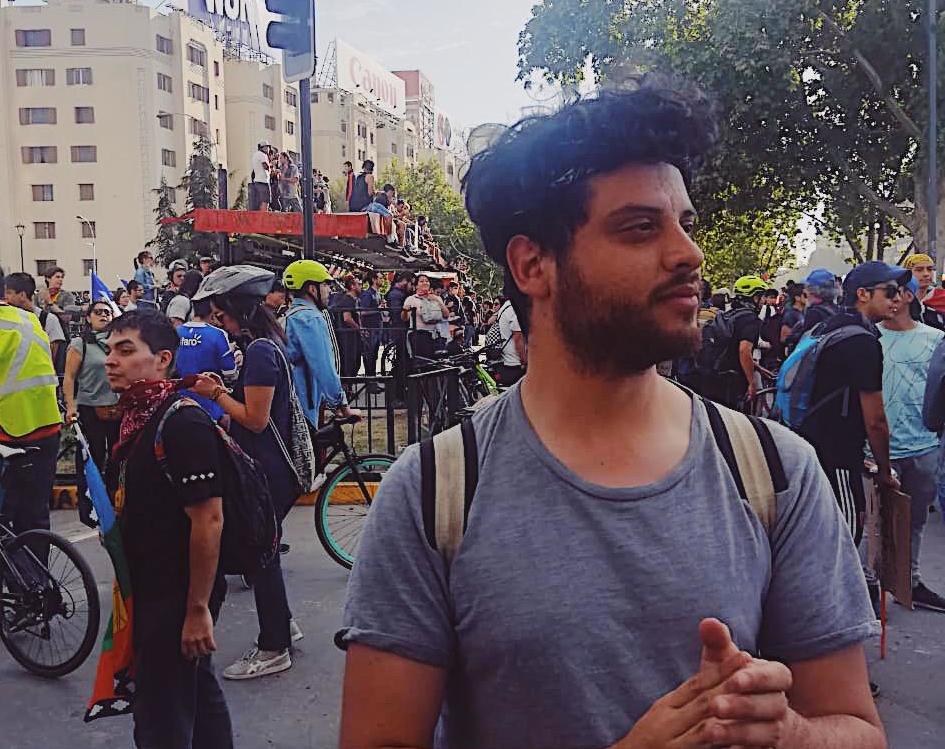
“It wasn’t enough that they ran us over, they threw tear gas at us from two meters away.”
The couple, Nicolás, were left on the hood of the vehicle and then fell to the ground. The car ran over him. In the shock of the moment, Nicolás admits that his response was to yell something at the police. “But their response was much more violent: it wasn't enough to run us over, they fired tear gas canisters from two meters away, directly at our faces. I thought I was going to drown; I felt like my airways were burning, I couldn't see anything, I couldn't breathe, and my skin was on fire. When they saw that they had almost incapacitated us, they left,” Nicolás recalls.
Injured and bruised as they were, they walked a few blocks further up the street shouting for help. Luckily, they came across some people who gave them water and baking soda to counteract the effects of the gas. As soon as they recovered, they ran home. The next day, Nicolás went to a clinic because he was in a lot of pain. He couldn't move his neck or his left shoulder.
He was diagnosed with a contracture in the cervical area and was prescribed a treatment for one week.
Her boyfriend is Venezuelan and decided to treat the wounds and cuts he suffered in the accident himself. The reason he didn't go to a health center is that his Chilean ID card is expired and he can't renew it until the Department of Immigration and Foreigners approves his permanent residency, which has been pending for several months. He also doesn't have a valid passport or the means to renew it, as he's currently unemployed and a new Venezuelan passport costs over $200. “Without an ID, they weren't going to treat him at a hospital. Much less at a clinic; that's how healthcare is in Chile. The only option was to pay for a private consultation, and that's very expensive for a migrant,” Nicolás explains.
[READ ALSO: Young gay man who reported torture and sexual abuse by Carabineros testified in court ]
What they did do was report the case to the Movement for Homosexual Integration and Liberation (Movilh) and to the National Institute for Human Rights (INDH), which from October 18 to November 25 counted at least five people killed by state agents, more than 2,700 injured by pellets, unidentified firearms, bullets and pellets, including 232 people with eye injuries caused by special forces in the context of the demonstrations.
“For our part, we ask the Human Rights Directorate of the Carabineros to investigate and punish those responsible for this unleashed and uncontrolled violence,” said Oscar Rementería, spokesperson for Movilh.
Presentes attempted to contact the Chilean police (Carabineros), but received no response by the time of publication. Nicolás and his boyfriend are physically well and nearing the end of their recovery, but emotionally devastated. They are also afraid to return to the streets to protest: “I believe that the state forces in this country are deeply sexist and homophobic; they don't respect people's freedoms or basic rights, and at least for me, it's very frightening to go out again in that context with my partner,” says Nicolás.
We are present
We are committed to journalism that delves into the territories and conducts thorough investigations, combined with new technologies and narrative formats. We want the protagonists, their stories, and their struggles to be present.
SUPPORT US

FOLLOW US
Related notes

We are present
This and other stories are not usually on the media agenda. Together we can bring them to light.