

Trans workers in Paraná filed a complaint against the municipality for unfair dismissals.
Trans workers who had been hired through public policies to reverse their extreme vulnerability denounced unjustified dismissals to the Justice system.

Share

By Gisela Romero, from Paraná
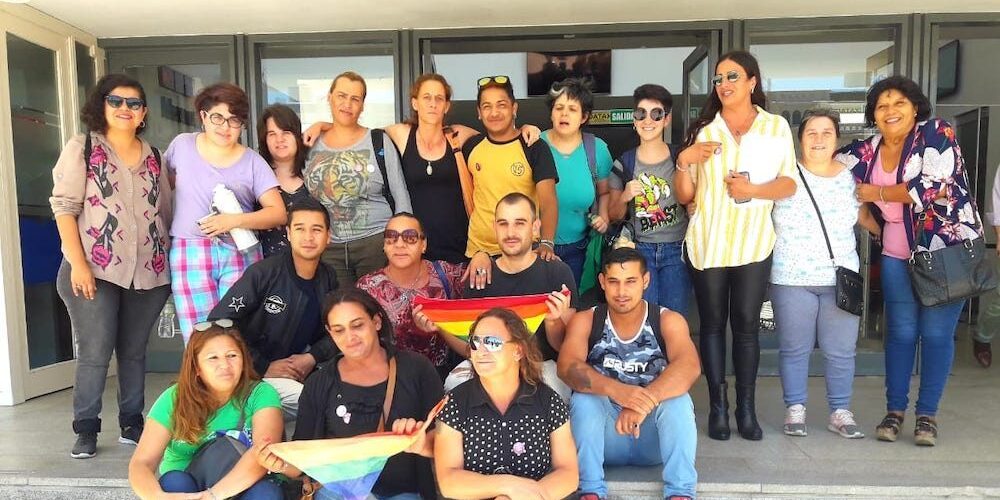
Five transgender women and one transgender man from the city of Paraná, Entre Ríos province, denounced their dismissal by the municipal government. Yesterday, they filed an injunction in the provincial courts seeking recognition of their labor rights and their reinstatement or transfer to permanent positions within the state workforce.
Vanesa Arami Bello, Paola López, Gabriela Abigail Manríquez, Iara Aranzazu Quiroga, Fernanda Ramírez, and Matías Berón had benefited from public policies implemented by the municipality to address their extreme vulnerability. After being hired, they were dismissed from the municipal government on October 31. In response, they decided to seek legal recourse in Entre Ríos province. On Thursday, November 28, under the midday sun, they were not alone at the Palace of Justice to file their injunction. They were accompanied by activists from the city's LGBTQ+ community and social organizations.
“We filed an injunction on behalf of six people employed by the municipality of Paraná. They were hired following a municipal initiative: they participated in a survey of the trans population, which yielded many positive results for the community. They also participated in the municipal Continuing Education Center, where they were able to complete their studies and other activities,” Aranzazu Quiroga, the group .

“After this process, which took some time, they were hired by the municipality on a service contract, which is much more advantageous than a construction contract, for six months. They continued working on the issue of social inclusion and successfully lobbied for the passage of the municipal ordinance on the trans employment quota ,” the lawyer continued. In that regard, she considered the hiring of the five trans women and the trans man “to be clearly within the framework of affirmative action aimed at progressively advancing the rights to which they are entitled.”
“After six months, their contracts were renewed, but they were then subjected to a mass hiring of people for two months, which made it clear that their rights were not fully respected based on their previous employment status,” Quiroga explained. This new hiring process included 400 people, and the contract was set to expire on October 31. “During November, they continued working but received no further information and know that they will not have either continued employment or permanent positions, which is what they should have been entitled to. Therefore, the legal action seeks to compel the municipality to recognize their acquired rights and either rehire them or grant them permanent positions,” she told this publication.
On June 27 of this year, the Paraná City Council approved the Comprehensive Inclusion and Reparation Ordinance, which includes provisions for the inclusion and employment quota of transgender people , among other things. And although this ordinance was implemented—with modifications strongly criticized by the LGBTIQ+ community—the municipality itself proceeded with the dismissal of the workers.
"The interpretation that can be made is that an expectation was created in them. Their hiring was within the framework of the continuity of rights framed in article 75, section 23 of our national Constitution, which speaks of equality of opportunity, and they have a lot of rights from international human rights treaties that protect them against that positive action that the municipality had and that we can now understand as a contradiction and a violation of those rights."
In short, "it is a contradiction of its own actions, well of Administrative Law, where the municipality, violating the principle of good faith, first behaves in one way and then has a totally contradictory behavior."
The lawyer emphasized that, given it's an injunction, the response from the Entre Ríos justice system will be swift. "In the province of Entre Ríos, we are pioneers in this, because we have an injunction that is a fast, unique, and expedited legal avenue, and they will possibly have a ruling within a week," she pointed out.
When asked if the municipal authorities would have to comply with the ruling, Quiroga responded: “It depends on the judge’s decision, because we are subject to a judicial ruling, but with all the legal elements and arguments on which we based the injunction, logically, if the injunction is granted, the Municipality has no option but to comply. A period of time must pass for the ruling to become final, and after that, they have no other option but to comply.”
"This issue is very important and clearly violates constitutional rights. That's why we have high expectations for the results we obtain, because for us there is a very clear violation of the constitutional right to progressivity; that is, progress is made towards the acquisition of rights first, and the non-continuation of the contract demonstrates a regression," the lawyer concluded.
There is no going back
Vanesa Arami Bello, Paola López, Gabriela Abigail Manríquez, Iara Aranzazu Quiroga, Fernanda Ramírez, and Matías Berón released a statement outlining their situation. “The precarious, vulnerable, and unequal access to formal employment opportunities faced by trans and gender-diverse people is well known,” the statement sent to Presentes reads. “For many years, we have been fighting as a collective for job placement and to ensure that prostitution is not the only possible means of survival, and it seemed that in Paraná we were finally making progress, taking concrete steps: first with the survey, then with our hiring, and more recently with the passage of the Comprehensive Inclusion and Reparation Ordinance.”
“But the current situation puts us back in the same place as always, unprotected and without guarantees, since our contracts were terminated just like many other contracts that are considered political, but it is worth fighting to make it understood that our hiring was due to a work process in specific projects and a positive action that sought to reverse the situation of violation of rights in which we live ,” they warn in the statement.
And they reiterate: “We demanded labor inclusion at the time and we continue to do so, the State's response was our hiring and then the quota, we cannot go back on this now.”
The group received support from the Paraná Assembly of Women, Lesbians, Transvestites, and Transgender People, which issued a public statement: “We stand in solidarity with our transvestite and transgender colleagues employed by the municipality who were dismissed. We condemn this action by the Sergio Varisco administration and support the demands of our colleagues. While, as we did in the recent November 25th march, we demand the reinstatement of all women, transvestites, and transgender people dismissed from the municipality, we believe it is important to highlight the extremely vulnerable situation of the transgender community .” The Assembly further demanded: “Reinstatement of our transgender colleagues, effective implementation of the Comprehensive Inclusion Ordinance, and reparations for transvestites and transgender people in Paraná.”
"It's a missed opportunity for trans people."
Fernanda Ramírez, one of the trans women who signed the legal petition, continues to show up for work in the Social Development department every morning. She was hired by the municipality on February 22nd of this year and learned through social media that she had been fired. That's when lists with names and surnames began circulating on Facebook.
"Losing my job means losing a huge opportunity for the trans community to be included in dignified work, access social services, and decent housing. It was a chance for them to know that we are also capable of taking responsibility for our work and learning like any municipal, provincial, or national employee, or even in a private sector job. This municipal decision is a setback in the context of inclusion and integration with equal human rights."
Context
The legal injunction was filed amid a wave of layoffs at the municipal level in the capital of Entre Ríos province. Since last Friday, a group of contract workers, whose contracts were terminated, have set up a camp in front of City Hall to demand their reinstatement.
A court order was issued Wednesday afternoon, and the traffic blockade in the city center was lifted. So far, they have not received any response from the government authorities headed by Sergio Varisco.
Study: Living conditions of the trans population
In October 2016, Ordinance 9478 was passed in Paraná, creating the Municipal Representative Council for Diversity, with the aim of promoting the creation and implementation of public policies. And in February of the following year, the project to survey the city's trans population was presented, prepared by the Autonomous University of Entre Ríos; the National University of Entre Ríos; the National Institute Against Discrimination, Xenophobia and Racism; and the Entre Ríos branch of the National Secretariat for Human Rights.
“We diagnosed that the main situation to be addressed was that of the transvestite and trans population, and the State’s response was that to address it, accurate information was needed to support actions and public policies to reverse it . For this reason, from UADER, UNER, INADI, and the Human Rights Secretariat, we prepared the survey project, put it up for discussion, and presented it to the Representative Council for Diversity, where it was voted on and modified, and then we secured the funding to carry it out,” Gonzalo Molina, a member of the Comprehensive Gender, Rights, and Health Program of the Secretariat for Integration and Cooperation with the Community and Territory at UADER, who also participated in the creation of the Council, where different stakeholders met, told Presentes.
To carry out the project, the Municipality signed an agreement with the National Ministry of Justice and Human Rights, represented by the Secretariat of Human Rights and Cultural Pluralism. The pilot test was conducted in the second half of 2018. Vanesa, Paola, Gabriela, Iara, Fernanda, and Matías were hired for this task and participated in the different stages of the survey, which extended from October 2018 to January 2019.
Molina mentioned, on the one hand, that "the importance of this work is that it was the first official test, the closest precedent of which we found was a 2012 survey conducted in La Matanza, but that one had a more formal component." And, on the other hand, "because it was clear in the project and the arguments that the data should be used to generate actions and public policies within the State, and that is precisely what happened, and we were in the process of implementation until this situation arose."
She also emphasized that the survey data was used to draft the Comprehensive Inclusion and Reparation Ordinance for transvestites and transgender people. "The data was taken into account by public officials because at the time they allowed those of us who were working from the ground up, coordinating in this area and building networks," Molina told this publication.
Molina explained what it means in this context for a trans woman or man to lose their job. “In the current context, job loss for trans people has a dual dimension: at the national level, it's framed within the context of the major crisis and unemployment that Argentina is experiencing as a result of the national government's neoliberal policies. This makes it even more difficult for these individuals to find alternative sources of income,” she explained. “At the local level, there's also the subjective impact on these individuals, who have undergone a personal and collective process of expanding their rights, becoming agents of advocacy for their own rights and those of their peers, and fostering a process of inclusion. It's a negative aspect for their own lives, but also for an entire community that perceives it as a setback in inclusion and the expansion of rights.”
The figures in the report
For this report, 60 trans and transvestite people aged 17 and over were interviewed in Paraná as part of a survey on the living conditions of this population. 80% were between 20 and 49 years old.
The report revealed that 60% of respondents had updated their birth certificate and National Identity Document (DNI) records. It also showed that 60% of those interviewed live with others: family members (30%) and partners (23%), while 37% live alone. Approximately 80% reside in houses, the remainder in apartments, rooms, shacks, etc.; most of these are owned by the respondents (28%), family-owned (28%), or rented (26%). These homes are located in social housing developments (56%) and informal settlements (7%).
Meanwhile, 68% of those surveyed do not have health coverage, prepaid or state plan, and when they seek care for general check-ups (57%) or follow-up for treatment or illness (22%), they do so in public hospitals (63%) and health centers and clinics (37%).
Regarding education, 71% did not complete secondary school, of which 17% did not complete primary school. 23% completed secondary school, and only 3% have completed university studies.
The study also confirmed that discrimination in education is high. 53% of those interviewed reported experiencing discrimination from classmates, teachers, and school administrators, and 33% had to drop out of school due to their gender identity.
Regarding occupation, 73% engage in activities that provide them with income: prostitution, hairdressing, caregiving, selling products, and sewing are the most frequently mentioned. However, when asked not only if they are currently involved in prostitution, but also if they have been in it previously, 73% responded affirmatively. Furthermore, 57% of the women interviewed began working in prostitution between the ages of 16 and 20, and 20% between the ages of 11 and 20.
We are present
We are committed to journalism that delves into the territories and conducts thorough investigations, combined with new technologies and narrative formats. We want the protagonists, their stories, and their struggles to be present.
SUPPORT US

FOLLOW US
Related notes


We are present
This and other stories are not usually on the media agenda. Together we can bring them to light.