

Pride and Uproar: Franco Torchia's book of interviews in You Can't Live on Love
The art of the interview in this conversation with Franco Torchia, about much more than the cuisine of his e-book Pride and Noise.

Share

By Lucas Gutiérrez
Photos: Romina Perkins
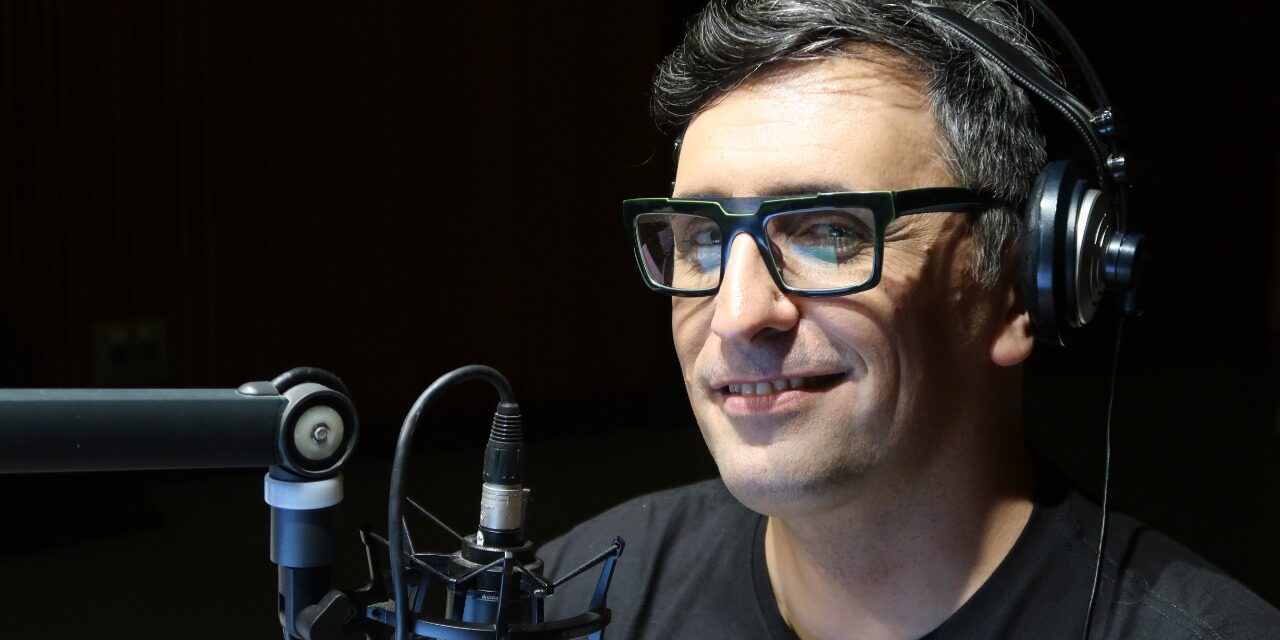
Franco Torchia graduated with a degree in Literature, is a journalist, and for the past seven years, every midnight, has launched his program "You Can't Live on Love" on Buenos Aires' public radio station. With a manifesto and a banner, he has built on the airwaves the only radio program in the world dedicated to sexual diversity that airs daily. Many voices have appeared on this show and been interviewed by the engaging conversationalist that is Torchia. Now, some of these voices are gathered in "Pride and Uproar" (Indie Libros), an e-book that condenses seven crucial interviews that bear witness to our times.
The book is dedicated to Romina Perkins, producer of "You Can't Live on Love." "For the bond and for the advice, this is the certificate of our marriage," Torchia wrote before introducing the seven interviews. They feature the voices of Rita Segato, Daniel Borrillo, Marlene Wayar, Ernesto Meccia, Diana Maffia, Sayak Valencia, and Eva Giberti.

“My intention is to delve deeper and, I would even venture to say, to enrich and refine certain arguments. Those of us who work with this every day run out of arguments. Sometimes we get tired, even we ourselves, of certain terms, of certain pronouncements that are romanticized or emptied of meaning . And which political administrations also take it upon themselves to automatically empty of meaning,” Torchia tells Presentes.
The seven interviewees
Torchia will ask Daniel Borrillo, PhD in Philosophy of Law, author of several books, and LGBT+ activist, about new notions and approaches to the term "pride." Some of these will appear in the words of philosopher Sayak Valencia, when she poses the question, "Who is audible and who is not?" With anthropologist Rita Segato, there is a discussion and critical examination of the role of the State. Reflecting on this part of the book, Torchia says: "The work of political and partisan demands must always be done, but it is not enough. We have no other option than to deploy a myriad of strategies, a creative power, a wealth of resources that activists can use so that all these demands resonate more deeply."

Then the dialogue unfolds with social psychologist and trans activist Marlene Wayar. Torchia explains that for this chapter she decided to merge two conversations she had with her. “I’m incredibly drawn to Marlene’s thinking. She always leaves me perplexed and reminds me that I fall short in the archaeological work that Marlene ends up doing. Marlene is always more of a long-distance runner than those of us who think we’re reaching certain depths .”
A tough book
It's the kind of e-book you can go back and forth with, read and reread later, and depending on the circumstances, it will lead to new reflections. “It's a difficult book. We could have made a book about activists or life stories, and it would have had different reading conditions. It would have been more mainstream , but I chose to make a tough book. I feel obligated to try to make it tough on purpose. I feel that this hardening of the discourse, however harsh it may seem, will ultimately open up possibilities for thought ,” says Torchia.
The book is also an excerpt from the radio program, in which the host shares a way of being, existing, and listening. “The family today is just as criminal as a state institution as the Ministry of Health or an anti-rights senator.” He asserts this based on his years of experience hosting the radio program, where he witnessed how some members of the LGBT+ community had to leave their homes due to family rejection.
“I didn’t see it directly, but I witnessed the suicides of people who listened to us, at least five, due to homophobia. Where there is a suicide due to homophobia within the family context, there is a problem with the State. You asked me about the dynamics of the State, and of course there is work to be done, but we also need to innovate in our requests, we need to innovate in our demands,” he says. And each of the seven interviews he shares in the book presents itself as a new coordinate for rethinking .
The nighttime atmosphere of "You Can't Live on Love" is full of pride and a lot of noise; it's what defines it. The LGBT+ acronym is viewed from as many perspectives as there are voices on the airwaves of Radio La Once Diez. And the book is no exception. In the conversation with sociologist Ernesto Meccia, his central theme is older gay adults, the "old faggots." "Self-reflection is fundamental. The LGBTQ+ population itself is a population completely characterized by micro-expulsions and self-marginalization; it's not exempt from that. I think it's from our self-destruction that we'll be able to rebuild ourselves time and time again," says Franco.
"There is nothing more political than a life"
In the interviews for this e-book—a dynamite book, a Phoenix book—Franco explains that he usually adopts the role of the dazzled. “Which is not the same as that of the fan,” he clarifies. But Torchia is another race of mutants that could very well have its own series in the X-Men saga; he is a chameleon-like interviewer.

You can find him on social media with a format he greatly appreciates: “Interviews for five pesos.” Some random person will pay five pesos to be interviewed by Torchia. “In those areas where insignificance reigns, where there is only the narration of a moment, for me there is so much more, because there is nothing more political than a life. Even than a life condensed into five minutes .”
And that feat, which lives outside the book, within the radio, lives on in Torchia. He knows it will always mutate. “Like when I have to do one of those live radio interviews with the tagline 'this is how I became gay/lesbian/+'. For me, that abyss where I don't know the person who's going on air, that exposure, that fall, that mystery that unfolds when I start 'Good evening, how are you?' reconciles me a lot with journalism, much more than interviewing intellectuals. There's nothing more powerful than a life ,” he says.
And when the interviews end, another question remains: who is Franco Torchia?: “I’m a sad guy. I’ve had a very difficult life; I wasn’t programmed to survive anyway. I developed strategies, I over-adapted, and I don’t recommend it. I carry the marks under my skin of having deployed many mechanisms to be able to work at whatever, whenever,” says Franco.
“I am the son of an 80-year-old Italian immigrant who arrived starving with Perón’s last wave of immigration in 1951. I’ve heard firsthand accounts of war and famine my entire life. It’s not easy for me to escape that death drive that so quickly leads you to think about death,” Torchia shares, recalling the phrase uttered by trans activist Lohana Berkins: “I have a cemetery in my head.”
“We do nothing but count the dead until maybe our time comes. I had jobs where I was a funny guy, others where I was a fictional character, like on the TV show Cupid. I worked on gossip shows, I did all that, I learned to do it like someone learning to paint a wall well. But that's not me.”
-And does Franco Torchia from 'Pride and Noise' look like you?
-Yes, a lot. Beyond the morbid aspect, there's ultimately a reconciliation with life, a revaluation of certain meanings. I, who lose my sense of meaning very quickly, need to find it again somehow. Thinking about it in Rita Segato's terms, I don't have blind faith in states; I have blind faith in intellectual production. It makes me very happy to discover that there are people who think and work with thought, and from there they construct new thoughts. From stories they create new stories, from knots they tie and untie. From bonds they build other bonds.
*Orgullo y Barullo can be obtained here .
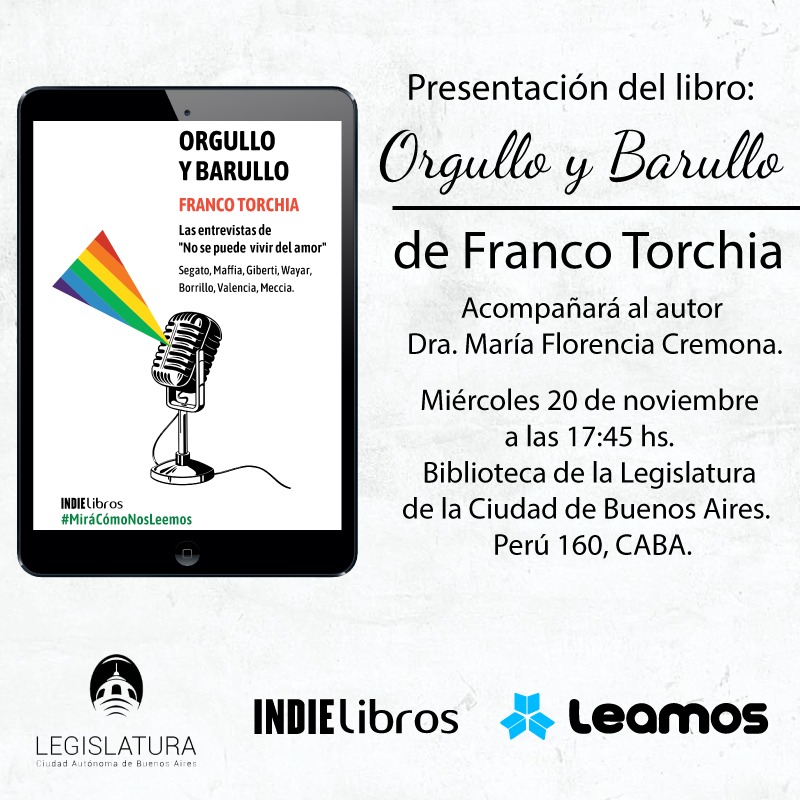
This Wednesday, November 20th, at 5:45 PM, the presentation will take place at the Library of the Legislature of CABA (Peru 160).
We are present
We are committed to journalism that delves into the territories and conducts thorough investigations, combined with new technologies and narrative formats. We want the protagonists, their stories, and their struggles to be present.
SUPPORT US

FOLLOW US
Related notes
We are present
This and other stories are not usually on the media agenda. Together we can bring them to light.