

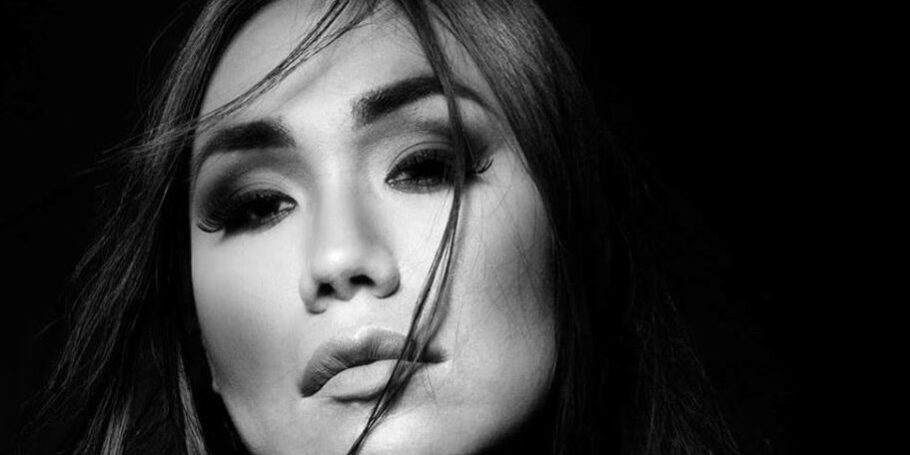
Marina Kapoor, the artist who defies transphobia: "We are demanding rights"
By Vero Ferrari. Marina Kapoor is a renowned artist in Peru for her participation in televised music competitions such as The Voice Peru and The Four Finalists, as well as her foray into film with the first movie starring trans women, Without a Vagina They Marginalize Me, where she plays the character of “The Microbe”.

Share

Marina Kapoor is a renowned artist in Peru, known for her participation in televised music competitions such as The Voice Peru and The Four Finalists , as well as her foray into film with the first movie starring trans women, Without a Vagina, They Marginalize Me , in which she plays the character "The Microbe." Although the film was never released in theaters due to transphobia in Peru, her image was featured at various national and international film festivals. Currently, in addition to releasing her first single, " This Is My Party ," for the film Miss Amazonas , she continues acting and remains active in activism, because, as she says, she would feel she has lived in vain if she doesn't do something for her fellow trans women.
Marina's childhood was that of an ordinary child. She would go for walks with her family: her father, her mother, and her little sister. At age 11, she realized she wasn't attracted to women, and that in games with her classmates at the all-boys school she attended, she always took on the female role. At that time, she could talk to the school psychologist, who supported her, but she didn't allow her to tell her parents. At 15, feeling she could no longer live in that prison, Marina decided to come out: “I sat my mother and father down in my room, talked to them, and said, 'You know what, Mom, I don't like girls, I like boys.' Back then, I thought I was gay.”
"My mom became my enemy"
As she told Presentes, at first they took it well, but her mother started taking her to various psychologists trying to change her. When she saw that wasn't working, she tried to do it herself through insults and reproaches. That period was a real nightmare for Marina: “My mom became my enemy. I would have liked that, even if she wasn't going to support me, at least she wouldn't do things to hurt me, and that's what she did; she insulted me with very ugly, hurtful phrases.”
After much patient effort from Marina, her mother began to change. The turning point came when, after Marina participated in The Voice Peru as Marina Kapoor, very close to Christmas, her mother gave her a women's t-shirt. Little by little, Marina's mother became an accomplice, someone with whom she could finally share what transphobia had previously forbidden: her innermost thoughts, her dreams, her triumphs, and her failures.
Marina began her transition at 19, amidst constant depression due to her mother's abuse and the feeling that her male body disgusted both her and the people who stared at her in the streets. She had been like this since she was 17, times when she could spend months locked in her room, without bathing, barely eating, and just listening to music, until one day she decided to start living again: “I saw the days passing by and I wasn't doing anything, and it was either stay the same or move forward. That's when I said, 'I have to change, I have to take control of my life, because it's my life and doing what I feel is right,' and that's when I started hormone therapy, I started changing, modifying my body.”
Expulsion from the world of work
It was at that moment that she felt the true sting of societal transphobia. She was used to having a job, and if she didn't like it, she would quit and look for another. As a trans woman, she could no longer do that. She had to beg for any position; her English and tourism studies were useless. People didn't understand her and didn't want to work with her: “I remember a candy store in Plaza Lima Sur gave me an opportunity. They had me on a three-day trial. The manager told me, 'The HR representative is coming, and you'll definitely sign the contract.' Then she arrived, they went into the office and called me over. After some tests, the HR representative told me, 'I can't hire you because we don't know how to work with people like you.' I got a lump in my throat. All I could do was grab my things, leave, get in my car, go home, and cry and cry for three hours.”
Marina thought that her only options, seeing all doors closing on her, were what she had always feared: “Do I really have to become a prostitute now? Do I have to go out on the street now? What do I do?” she repeated to herself in her despair, feeling the injustice firsthand: “It was very frustrating for me. That's when I understood a phrase that I'm very aware of: 'As long as they keep denying us the opportunity to develop professionally, prostitution and the street will always be waiting for us with open arms.'” She was depressed for a month until a friend got her out of bed and took her to a call center . There she worked for five years on autopilot, hiding her budding femininity and trying to survive.
Trans women live being pushed by a society that excludes them into very specific activities like hairdressing, into jobs that put their lives at risk like prostitution, and even into crime due to state abandonment that denies them access to education, health, housing, a dignified life, and even love: “It’s not that many of us want to be prostitutes or live that life because we want to, but because it’s something society pushes us into, closing other doors to us. I’m sure that if there were a law to protect us—just like there’s a law requiring a certain percentage of people with disabilities to be on the payroll of all companies—many of us would leave the streets, and others obviously wouldn’t, but at least we would have options.”
The road to success
But Marina also found success, thanks to her daring participation in a popular singing competition show a few years back: The Voice Peru . She was looking to reaffirm herself as a trans woman through what she loved most: singing. She saw the casting call and decided to participate in the first season. She made it through several rounds, but when it came time to sing in front of the judges, she didn't make it; they didn't turn around. She returned for the second season, but they told her it was best not to. The third time would be the charm. She was more prepared and more self-assured. This time the judges did turn around, praised her voice, and she chose the singer Eva Ayllón as her coach. From that moment on, her life changed again. As fame arrived, other trans women began writing to her, sharing their experiences. Marina had some idea of the suffering they endured, but that was about it. It was after reading so many testimonies and so much despair that she began to speak for them as well: “I realized that I had to do something for my community, that I wasn't the only one going through all those things, that it's not fair that other trans people or new trans girls who are going to be born go through the same thing and live through those painful moments that I have also gone through.”
Cinema and activism
Then came *Sin vagina me marginan* (Without a Vagina They Marginalize Me) , Wesley Verástegui's film in which she played "La Microbio" (The Microbe). Excited about the upcoming premiere, she went to theaters to see people's reactions when they showed the trailer, but two days before, transphobia struck again: the film was censored. Some people had complained about the word "vagina," and the distributor, intimidated by the anti-rights campaign of the "Don't Mess With My Children" movement, decided to terminate the distribution contract.
After that, she participated in the singing competition Los Cuatro Finalistas , the documentary Sarita Colonia by Javier Ponce, the films Muerte por muerte and Un romance singular by Wesley Verástegui, which will premiere next year, and her first single “Esta es mi fiesta” for the documentary Miss Amazonas .
Marina's wish is to make a miniseries or a telenovela; she wants to reach mass audiences, to show them that trans people are diverse, that there are also actresses like her, who can do comedy and drama, but above all, that people normalize their presence in society: "We are not begging to be allowed to exist or to be allowed to work, we are demanding rights, that our rights be respected, just as we also respect the rights of others."
“I want people to know that they are killing us, that they don't respect us, that we are treated worse than animals, that no one is doing anything to help us, and that it's not fair. No one is immune to the rainbow coming into their family at some point. I want them to understand that, that we are not an abomination, that they shouldn't label us. Many people need to know that, to understand the diversity that exists within society. And how important family support is. With my mother's love, I felt capable of anything. That's when I decided to study what I wanted, I decided to dedicate myself to what I love, which is acting, singing, and fighting for the rights of all of us. Family support allows a person to develop. Now that I have my mother, I feel invincible.”
]]>We are present
We are committed to journalism that delves into the territories and conducts thorough investigations, combined with new technologies and narrative formats. We want the protagonists, their stories, and their struggles to be present.
SUPPORT US

FOLLOW US
Related notes
We are present
This and other stories are not usually on the media agenda. Together we can bring them to light.