

A feminist cooperative helps trans women obtain decent housing
In Paraná, Entre Ríos province, the first cooperative of women and dissidents dedicated to construction is being formed.

Share

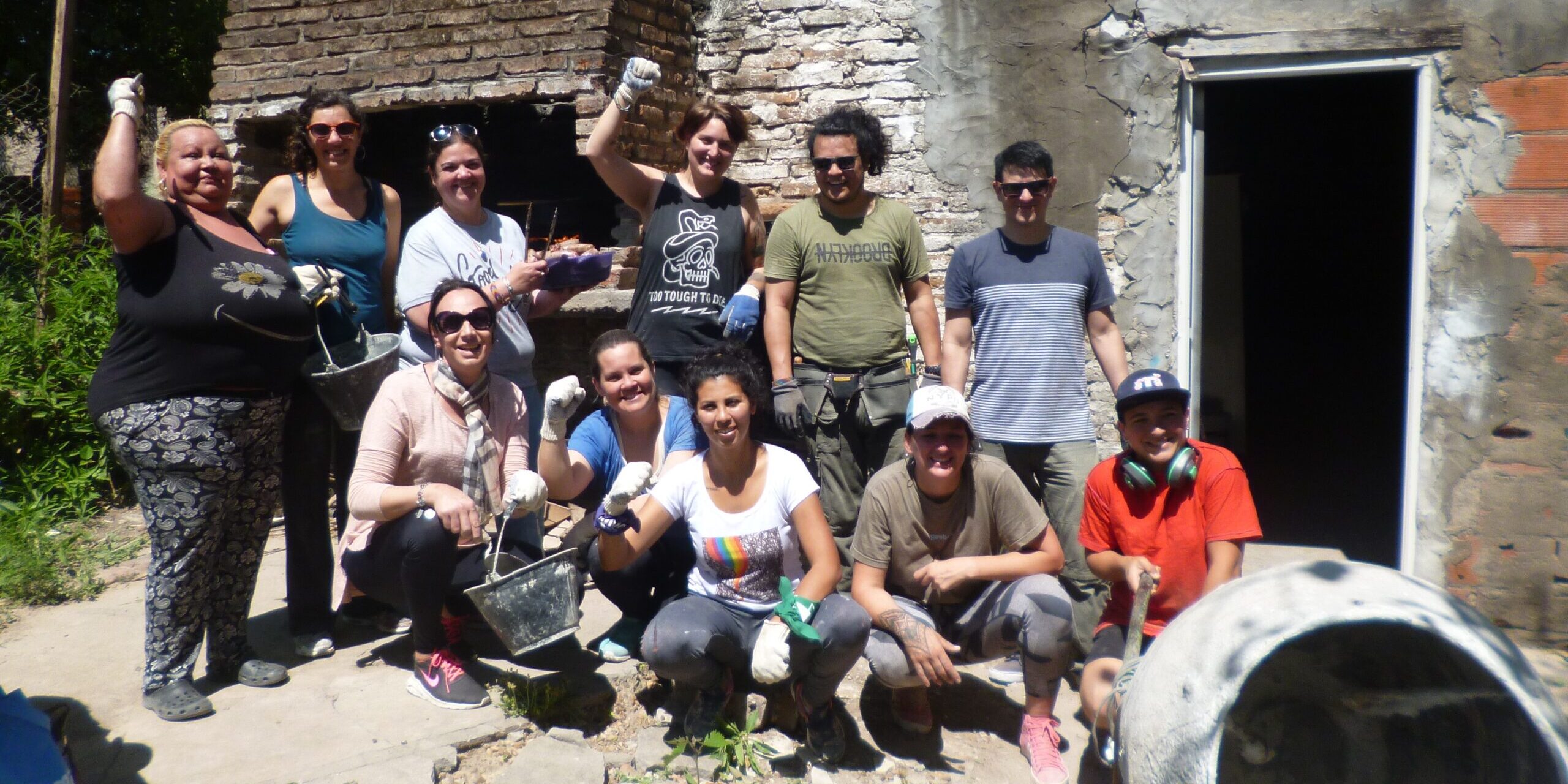
In Paraná, Entre Ríos province, the first women's and gender-diverse cooperative dedicated to construction is being formed. While awaiting national registration, the group continues its work on construction projects. As part of its social outreach, it held community workdays, known as "mingas," at the home of Verónica Siomara Lescano, a trans woman who has suffered violations of her rights to education, health, and housing throughout her life.
By Gisela Romero from Paraná
Photos: Alfredo Hoffman
In the Mosconi Viejo neighborhood, in the western part of Paraná, the loud cumbia music beckoned people into Verónica Siomara Lescano's house one Monday morning. Gloves, buckets, drills, and wood were scattered around the entrance and inside the makeshift dwelling where this trans woman, who turned 42 on September 21, has lived for about six months.

The members of La Pasionaria, the first cooperative being formed by women and gender-diverse individuals, traveled to this populous neighborhood in the capital of Entre Ríos province. Their goal was to carry out their first "minga" – a community work project – to help Vero, who spends her days alone, unemployed, receiving benefits from the Hacemos Futuro Program, and suffering from physical ailments resulting from medical malpractice in her youth.

"Our cooperative was born with the idea of being a source of work for all the women who are part of it, but also with a social perspective. We were already working on the homes of women who needed extensions or renovations. We came to see Vero's house and it's a very complicated situation she's living in," Yudit Baez, president of La Pasionaria, explained to Presentes.
[READ ALSO: Salta: They created a trans services cooperative to live off their work ]
“As we all know, trans women suffer the most in every aspect: in health, work, education, and access to housing. So we feel a great responsibility, from our position, to improve their quality of life and help them have their own space,” she added. “This is our first community work day as a cooperative, but the idea is to hold one of these activities once a month and help women and LGBTQ+ people who need to fix up their homes,” she explained.
Throughout the day, the members of La Pasionaria worked on the house, which has a low ceiling and a yard with grass and leafy trees. "It's a house with a lot of dampness problems because it doesn't have plaster on the exterior walls, it doesn't have waterproofing, and it doesn't have plaster inside. Since Vero suffers from asthma, we thought it was very necessary to make a window so the house would be better ventilated and let in the sun, to do the plastering, and to fix pipes that were leaking," Yudit explained about the work.
The Passionflower
“My sister and I started building our own house two years ago, or a little more, always with the idea that if we could learn the trade, we couldn't pass it on to other women. That's how we met, because there were a lot of women working as helpers, and we started to organize and give it a legal structure. We decided on a cooperative because the social and solidarity economy is what will get us out of this crisis we're in,” Yudit Baez told Presentes. That's how La Pasionaria began, as a dream that is now becoming a reality.

“We put out a call and saw that there were many women who were working independently, but they didn’t identify as construction workers. For those of us who practice the trade and have been doing it for many years as helpers to colleagues, parents, or friends, it’s very difficult for us to recognize ourselves in that way. So when the La Pasionaria proposal came up, it was like saying: I recognize myself as a worker and I can make a living from this,” explained Yudit, who also highlighted La Pasionaria’s social profile, which is related to providing support to transgender people.
[READ ALSO: The Justice system calls on transvestites and trans people to demand decent housing ]
Today, La Pasionaria is made up of 13 people, including a trans woman and a trans man, who are awaiting national registration with the cooperative and training from the UOCRA (Construction Workers' Union). Some members previously worked in construction, while most come from other backgrounds. There are students of folk singing, art and dance, and social communication. "I only need a few more courses to graduate with a degree in political science. The courses of study within the cooperative are varied, but we all love doing this: laying bricks," said Yudit.
"Some looked for work and couldn't find it, but most of them like construction and had done this type of work before, but never recognizing that they could do it alone. Then they joined: it was the enjoyment, finding a united group, a bond, showing that when women get together we're not all crazy, but that we can create other things," she also reflected to this media outlet.

Learning the trade and breaking down prejudices
When Yudit started laying bricks and building walls, she had no experience. But with the help of one of her peers, Lulu, and her father, a master builder, she learned the trade.
"At first it was a little difficult because of all the social stereotypes we have, that as women we don't know how to work in construction. It's socially constructed that way: if you're a woman you don't know how, it's not that you can't, but it's a trade that has historically been dominated by men. So we started with few clients, a small group, those who trusted us and those who called with skepticism, but today we have many clients who call us, because word has spread that we do good work. It's a matter of time, of people seeing us work, to put an end to all the prejudices," she told Presentes.
Yudit admits she never considered the possibility of making a living from construction. "I had thought about starting a group where women could learn, so we wouldn't have to depend on anyone else to do it at home. But making a living from it? Honestly, no," she admitted. However, little by little, she began to see it as a way to support herself. "Even though I have a university degree, I love what I do. I love laying bricks; I say it all the time."
In the cooperative that Yudit Baez leads, everyone is paid the same. Neither the architect nor the foreman receives a higher salary. And 10 percent of the work's value is set aside and saved for times of hardship. "We are women, we are workers, we are Black, and we are four or three times poorer than other people. So we save that percentage in a shoebox, and whenever someone runs out of gas, their bus pass, or can't afford snacks for the children, we take it out and distribute it among the other women," she explained.
The story with Veronica
During the minga, a form of collective work, a communal lunch was a must. And there were also plenty of expressions of affection for the hostess, whom the members of La Pasionaria met through students from the Autonomous University of Entre Ríos and the Provincial Area of Gender Identity and Sexual Diversity Policies. "The fact that my comrades came gives me hope and fills me with joy. They are taking care of me, and I feel loved," Verónica Siomara Lescano told Presentes.

Throughout her life, she experienced many moments of abandonment by her family and profound loneliness. "I don't think there's anything beautiful in my story. I was kicked out of my house when I was nine, I started working at twelve, and I've rented my whole life. For a while, I worked for my mother because she made me work, and I fell into drugs. I did a lot of drugs because my mother didn't love me and I had to bring her money to see her," she recalled, hurt. "I was young, I didn't know anything about life. But as I got older, I changed, and I told myself I didn't want a mother I had to pay to see for a little while. I tried a thousand ways to make her love me for who I am, not for money, and it didn't work. So, it's been many years since I've seen anyone in my family," she revealed.
Throughout her difficult journey, Verónica has endured countless hospitalizations in the provinces of Santa Fe and Entre Ríos. Each of her relapses stems from an injection of airplane oil she received at age 18. "I wanted to change a little, so I got the injection. I went to Buenos Aires and they did it," Verónica recounted, now aware that she was deceived about the product she was given. It wasn't liquid silicone, as she had been told.
The airplane oil spilled on her body caused, over time, severe pain in her legs and lower back, which now prevents her from moving with ease. She finds it difficult not only to walk but also to dance, something she once loved. She relies on eight medications to alleviate the physical pain. In addition, she suffers from asthma.
Reflecting on her experience, Verónica offered a message to young trans people: "Don't get anything done. It completely ruined my life. Save up and get prosthetics. I loved to dance, but I can't, and I can't walk either. It ruined me. I wish I could work. But because of everything that happened to me, I'm seeing a psychologist and a psychiatrist, and I'm fighting."
Verónica didn't finish elementary school and learned to fend for herself on the streets. She rarely leaves the house she rents, almost never, but the neighbors know and respect her. When she was 14, she knew how to run and play in the muddy streets, among the houses with their low, corrugated iron roofs. "I've always lived alone and managed on my own, and I've worked as a prostitute my whole life because there was no other way out. I never liked it, but these days I don't want to be with anyone. I have the Hacemos Futuro program, and with that I pay for my room and board," she explained, her eyes sad, occasionally lighting up with small smiles.
To coordinate in order to achieve public policies
The community work project was made possible through the collaborative efforts of social organizations, the Provincial Area of Gender Identity and Sexual Diversity Policies of the Undersecretariat of Human Rights of Entre Ríos, and the La Pasionaria cooperative. The goal is to repair the homes of LGBTQ+ individuals in the city.
Within this framework, the solidarity campaigns will continue, adding hands and labor, with the support of the provincial government guaranteeing the provision of supplies and tools. The goal is for these actions to become a public policy capable of changing the quality of life for transvestites and transgender people in the city.
More information
Those interested in contacting the cooperative can do so by calling (0343) 155024359.
We are present
We are committed to journalism that delves into the territories and conducts thorough investigations, combined with new technologies and narrative formats. We want the protagonists, their stories, and their struggles to be present.
SUPPORT US

FOLLOW US
Related notes

We are present
This and other stories are not usually on the media agenda. Together we can bring them to light.