

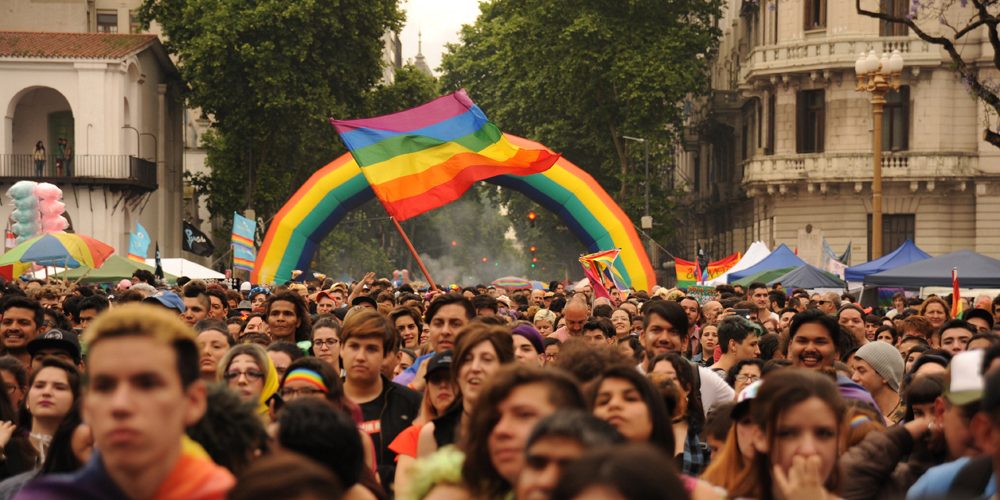
This Saturday, the LGBTI Pride March will be held in Buenos Aires.
This year's slogan is: "For a country without institutional or religious violence. Stop hate crimes" and it is accompanied by 21 other slogans.

Share

Photo: Ariel Gutraich
The 23rd LGBTI Pride March will be held in Buenos Aires on Saturday, November 2nd. November— unlike June in the rest of the world, which commemorates the Stonewall riots —is LGBTI Pride Month in Argentina.
Starting at 11 a.m., there will be a Pride Fair in Plaza de Mayo with stalls selling t-shirts, pins, and other items. Between noon and 4 p.m., La Queen, Mala Fama, and Marilina Bertoldi will perform.
The march begins at 4 PM in Plaza de Mayo and proceeds to the Congress building. This year's slogan is: “For a country without institutional or religious violence. Stop hate crimes,” accompanied by 21 other slogans.
The Organizing Committee denounced today that the National Government will not provide the usual setting for Congress.
Parallel events
Last year, CHA, 100% Diversity and Rights, Argentine Trans Women, and the La Rosa Naranja Association—among other organizations—withdrew from the Pride march's organizing committee and held their own event in Plaza de Mayo, which was ultimately canceled due to rain. At the time, they questioned "the loss of the historical spirit of Pride and the lack of representation regarding the substantive demands of our community."

This year they will participate in the march – although not as part of the organizing committee – and are holding a festival this Thursday the 31st at 7 PM at CAFF – Sánchez de Bustamante 772 – with the following slogans: “Everyone for the Diana Sacayán National Transgender Employment Quota Law. Stop the murders of transvestites and transfemicides! Stop institutional violence. Legal, safe, and free abortion for pregnant people. Free childhoods. Recognition is reparation. Medication now! And an update to the HIV, Hepatitis, and STI Law. A new Anti-Discrimination Law to eradicate sexism, xenophobia, and racism through education and public policies. Implementation of Comprehensive Sex Education.”
Slum Pride March

The sub-slogans of the March
This year's March has the following sub-slogans: "Leave Comprehensive Sexuality Education (CSE) alone"; "Legal, safe, and free abortion"; "Healthcare cuts kill"; "Political, economic, and symbolic separation of Church and State"; "Stop trans/travesti genocide"; and "Comprehensive trans law." Other slogans include: "Our kisses are not a crime"; "Respect for body diversity"; "For a diverse sports environment that respects identities"; "Non-binary people exist"; "Visibility and depathologization of asexual and non-binary identities"; "Proudly bisexual and pansexual"; "For the depathologization of trans children"; and "Repeal of the municipal codes."
"Out with the IMF"; "Work for all"; "Legalization of the self-cultivation and consumption of marijuana"; "No to political persecution: freedom for Milagro Sala, Daniel Ruiz and all political prisoners"; and "BDSM and alternative sexual practices are not violence."
"Reform of the trafficking law that criminalizes sex work" and "For the social and labor rights of sex workers" are added to the slogans in the debate between abolitionism versus legalization of prostitution.
History
The first Pride march in the city took place on July 2, 1992. It was organized by Carlos Jáuregui and César Cigliutti, two leading figures in the Argentine Homosexual Community (CHA). Three hundred people participated, most of them with their faces covered by masks to avoid being recognized. They chanted for "Freedom, Equality, Diversity."
The marches were moved to November for several reasons: to have a local date, but also due to weather conditions. The temperatures in June and July were dangerous for people living with HIV, many of whom belong to the LGBTQ+ community.
We are present
We are committed to journalism that delves into the territories and conducts thorough investigations, combined with new technologies and narrative formats. We want the protagonists, their stories, and their struggles to be present.
SUPPORT US

FOLLOW US
Related notes

We are present
This and other stories are not usually on the media agenda. Together we can bring them to light.