

"Chile needs a new social and sexual pact"
"Today, the only way to look ahead and build a country with historical memory is through a social pact where everyone is included."


Share

By Constanza Valdés *, from Valparaíso. Photos: Josean Rivera
October 2019 will be remembered for decades as one of the most powerful months in terms of national protests in Chilean history. Due to the massive scale of these protests, and in an irresponsible and negligent manner, President Sebastián Piñera declared a State of Emergency in the Metropolitan Region, and later in other regions, through their respective regional governors. The Armed Forces were placed in charge of security, and Chile witnessed one of the worst human rights violations committed by state agents since the dictatorship. This generated concern from international organizations such as the Inter-American Commission on Human Rights and the United Nations.
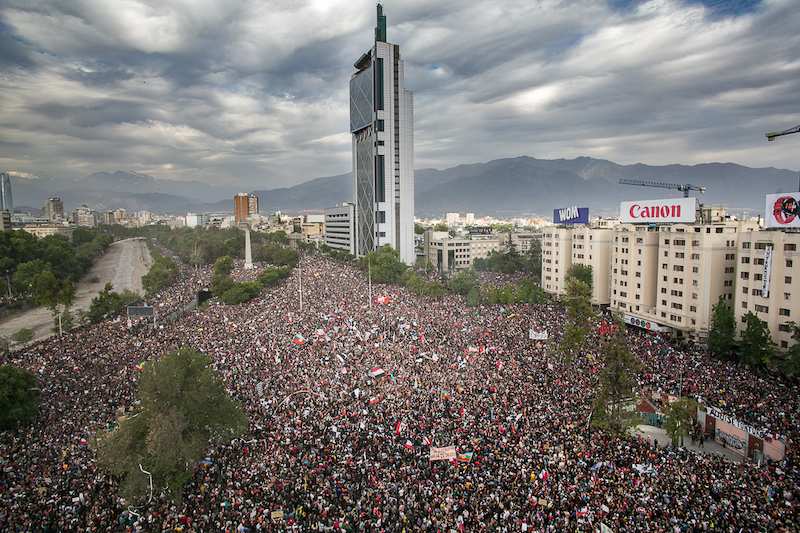
Within this historical context, a consensus has emerged among citizens and even some political sectors. Our country needs a new social pact, that is, a new constitution to replace the current one, which dates back to the dictatorship, despite successive reforms. The national mobilization has created a climate in which the political interpretation suggests we are at a constituent moment, understanding that constituent power resides essentially in the people.
READ MORE: Sexual violence and torture of women and LGBT+ people by Carabineros denounced
In recent days, various town hall meetings have been held nationwide to discuss the essential points that need to be modified in our political system and that should be included in a new social pact. There is a general consensus that it is necessary to robustly incorporate economic, social, and cultural rights, which are poorly regulated in the current Constitution.

The importance of regulating these rights is evident in some of the slogans of these mobilizations. They primarily denounce a deficient pension system, low wages and long working hours, a poor quality of life, inadequate housing policies, and a healthcare system in crisis due to national hospital debt and waiting lists, among many other issues.
READ MORE: The biggest march in Chilean history in photos
However, slogans related to children, human rights, and the eradication of inequality and gender-based violence . This has been particularly evident when LGBTQ+, human rights, and feminist organizations march together . Far from "dividing the struggles," as some might think, they are forging an indissoluble unity necessary for this new social and sexual pact.
READ MORE: [In Photos] This is how feminism and diversity resist in the streets of Chile

Although they have been absent from the public debate, they must be taken into account when discussing a new social contract. Their invisibility is explained by the fact that, in general, public debate is dominated by men, relegating women to a secondary role.
READ MORE: Chilean resistance is also sexual: post-porn has taken to the streets of Santiago
The eradication of gender-based violence, as well as the need to advance the recognition of women's rights, particularly in the area of reproductive and sexual rights, are slogans that the feminist movement has placed at the forefront of public debate for years regarding the need for a new social and sexual pact . This is necessary to eliminate what Carole Pateman has called the sexual contract, which lays the foundation for the patriarchal structure that governs our society and state apparatus.
Similarly, a different paradigm is required in this area regarding the rights of children and adolescents, who are mentioned in the Constitution mainly in the debate on the preferential right and duty of parents to educate their children.
The human rights of historically discriminated and excluded groups cannot be relegated in this discussion about a paradigm shift in our society. Unfortunately, under the current paradigm, there is still a tendency to relegate issues of childhood, gender, and the human rights of historically discriminated groups to isolated discussions, which has led to the invisibility of these topics when developing comprehensive public policies and laws .
If we truly want to change the paradigm and create a new, different social contract, we need to incorporate these approaches comprehensively into all the topics we discuss. It's no coincidence that the feminist movement demands a feminist constitution.
The mere participation of diverse sectors of society in the national mobilizations has demonstrated that the demand for a new social pact is not limited to the traditional demands related to work, education, and health. It extends to various issues that for decades had been relegated to isolated discussions due to the lack of vision of the ruling political class: those related to gender, childhood, human rights, and many others. These demands have become visible in citizen assemblies: the inclusion of people with disabilities, the constitutional recognition of Indigenous peoples, a new immigration policy, the need for dignified mental health care, among many other matters.

This in no way signifies a division of the national mobilizations. On the contrary, it solidifies unity through the diversity of demands and requirements that citizens need for a new social pact . Only in this way can we forge a new agreement with the people, a slogan that has been repeated ad nauseam by our political authorities, who have failed to grasp the true underlying issues of the current situation.
For decades, Chile has been burdened by a flawed constitution and a society where the horrors of the dictatorship still run deep due to the systematic denialism of some sectors of the right. Today, the only way to move forward and build a country with historical memory is by establishing a social pact that includes everyone.

* Constanza Valdés is a lesbian feminist activist, lawyer, legislative advisor, co-director of the Chilean Association of Feminist Lawyers and expert @hay_mujeres on LGBTI rights.
We are present
We are committed to journalism that delves into the territories and conducts thorough investigations, combined with new technologies and narrative formats. We want the protagonists, their stories, and their struggles to be present.
SUPPORT US

FOLLOW US
Related notes

We are present
This and other stories are not usually on the media agenda. Together we can bring them to light.