

Frida Sofía, the trans woman who fought against addiction in the working-class neighborhoods of San Salvador
One month after her death, we remember Frida Sofía, a Salvadoran trans woman, through the stories of those who knew her, reconstructing her life and legacy. By Paula Rosales, from San Salvador (text and photos) Frida Sofía died alone in her room in the popular Saavedra condominiums in El Salvador's capital. Forensic authorities indicated that…

Share

One month after her death, we remember Frida Sofía, a Salvadoran trans woman, through those who knew her, and reconstruct her life and legacy.
By Paula Rosales , from San Salvador (text and photos)
Frida Sofía died alone in her room in the popular Saavedra condominiums in El Salvador's capital. Forensic authorities indicated it was a heart attack. She was found dead on the last Sunday of September. Her lifeless body lay for three days in the apartment where she lived, waiting. The spread of "strange smells" through the building's gray hallways was the signal to call the police.
Frida Sofía died surrounded by sewing machines, fabrics, and lace, which she used to make aprons, smocks, dresses, and blouses. Her family never came forward to claim her body, and her remains were at risk of ending up in a mass grave, where unidentified bodies are kept, at the Institute of Legal Medicine in El Salvador.
Frida Sofía's story is collectively constructed and reconstructed, as if made from fragments of scattered memories, each person having their own version. They say she was born in the municipality of Izalco, 63 kilometers west of the capital. They recall that she had a foster mother and a sister who still wanders the streets.

His family, gathered at the funeral home to pay tribute to him, are LGBTQ+ individuals and former alcohol and drug addicts from various groups, including members of Alcoholics Anonymous (AA) in El Salvador. One of their tenets states that anonymity is the spiritual foundation of their traditions.
José Manuel, 57, remembers very well the day he met Frida. Although he admits his memory is failing him, he can't forget the first impression he felt when she arrived at the "La Cachada" shelter. That place has become a kind of redemption for people suffering from alcoholism and drug addiction.

Even though that meeting happened 17 years ago, her voice breaks when she remembers it.
"That night, she raised her hand and we welcomed her. She arrived very thin and signaled for help. I don't know how to come to these wakes, but remembering the state she was in when she arrived and how she left afterwards, she never drank again."
Frida Sofía hit rock bottom in life. She slept on the streets, for a time she worked as a sex worker, she was an alcoholic and addicted to crack cocaine.

"I remember Frida as someone who came from hell, from spiritual dungeons where no human power can rescue us. And she always said that AA had rescued her," Jaime A. told Presentes, sitting in one of the armchairs in the funeral home.
With effort and the help of her colleagues, she managed to overcome all her addictions for 17 years. She then became a therapist to help others fight them. According to witnesses, she was one of the best. Dozens of men and women followed her advice and, above all, her story.
"She had such an engaging therapy, a shock therapy, powerful, touching people's minds, touching their egos, lowering their pride. She spoke of the wall created by the ego of a proud, stubborn individual, one who doesn't want to accept his illness and suffering from alcoholism," Jaime A. recalled.
READ MORE: The trans odyssey of intervening in trans bodies with home treatments
Promoter of life
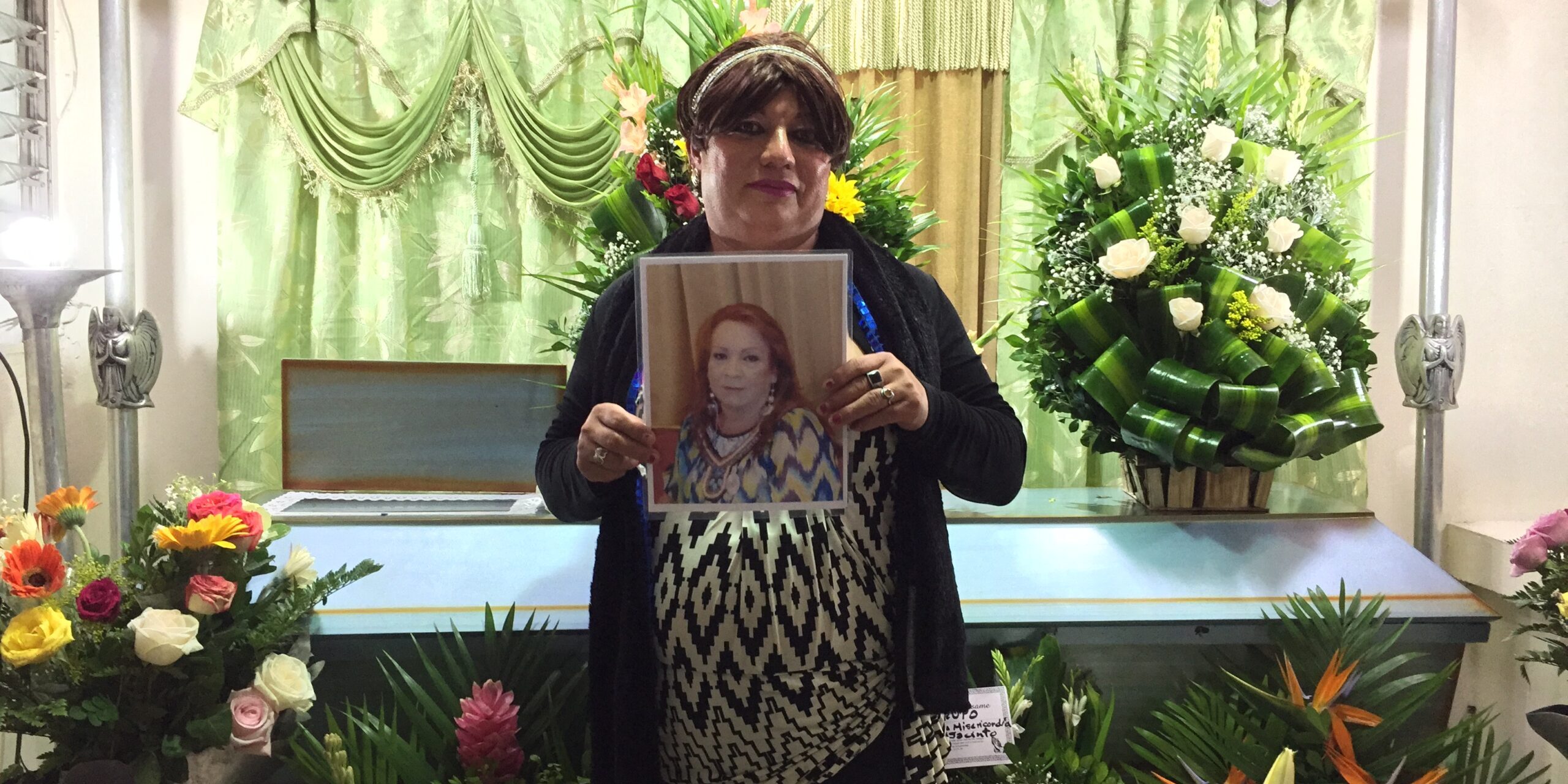
Her light blue coffin is adorned with flowers of all colors: sunflowers, white, yellow, and red roses, as a tribute to her struggle.
Frida Sofía has died, and the only image of her is a photograph on the glass of her coffin. In the snapshot, she looks elegant, with her reddish hair, earrings, a mosaic blouse, and a shy smile.
People have come to pay their respects. They remain silent, bow in reverence, and some even take photos in front of her coffin to commemorate the wake of Frida Sofía, a Salvadoran trans woman who became a kind of heroine in the fight against addiction in the poorest neighborhoods of San Salvador.

The street in front of the Casa Blanca funeral home, in the east of the capital, is packed with people. The mourners form small groups. They talk, drink coffee, smoke cigarettes, and laugh. It looks like a gathering or a celebration, not a wake, but they are paying tribute to a champion of life.
In the tiny funeral parlor, bathed in a pale, whitish light, some dare to sing with a guitar or improvise the recitation of the rosary. In that minuscule space, market vendors, still wearing their aprons tucked into their waistbands, mingle with men whose faces bear the marks of the harshness of the streets.
On the night of the wake, 39-year-old Joselyn Paola entered the funeral chapel alone and approached the coffin to see her friend one last time. She stood there silently for a few seconds, then left, her face contorted with grief.
"Thanks to Frida I managed to get out"
She met Frida in her teens. She says that meeting her 20 years ago, when they were both sex workers, changed her life. Frida loved the music of Laura León, Ana Gabriel, and Paulina Rubio. Together they overcame alcoholism and maintained their friendship for two decades.
"On the street, they look down on us, they don't value us. When I joined the group, I felt that they truly loved me. 'They're my family,' I said. Here, they accept me just as I am: made up, painted, vain. Before, nobody gave a damn about me; I'd end up abandoned in ditches, but thanks to Frida, I managed to get out. She told me I had value; through her, I learned to be honest with the work of my hands."
Her friends fought for a dignified farewell. She wasn't just an unidentified person; she was Frida Sofía. Friends and siblings searched through their purses and wallets for money to help pay for the coffin and the burial plot at La Bermeja Cemetery, where her remains now rest. Frida Sofía has died; her remains rest in peace.
This work was carried out with the support of the International Women's Media Foundation as part of ¡Exprésate!, its initiative in El Salvador and Guatemala.
Share
We are present
We are committed to journalism that delves into the territories and conducts thorough investigations, combined with new technologies and narrative formats. We want the protagonists, their stories, and their struggles to be present.
SUPPORT US

FOLLOW US
Related notes



We are present
This and other stories are not usually on the media agenda. Together we can bring them to light.