

“Stop the murders of trans women” is a cry against all forms of violence.
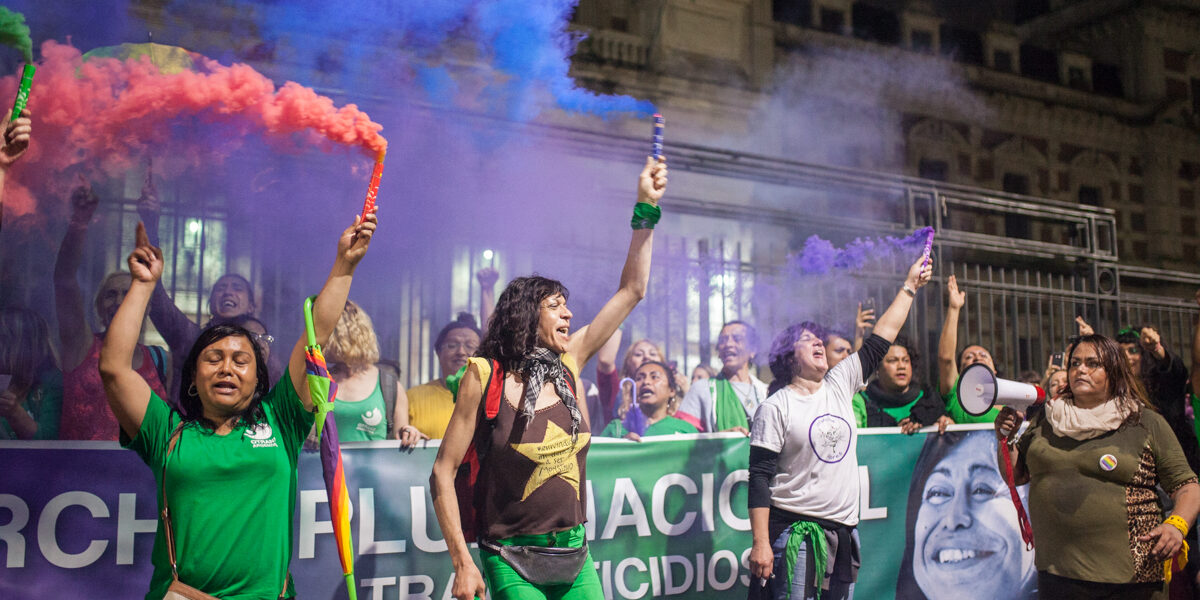
The March against transvesticide and transfemicide was held at the 34th National Women's Meeting and by dissidents.

Share

By Alma Fernández
Photos: Luli Leiras
Once again, the March Against Transvesticide and Transfemicide took place at the 34th Plurinational Meeting of Women, Lesbians, Bisexuals, Transvestites, Transgender, and Non-Binary People. The meeting in La Plata is the largest in history—the organizing committee estimates over 200,000 people—and this afternoon's march was historic. We marched for about 15 blocks for three hours. The Plurinational banner, along with various prominent figures such as Marlene Wayar, Claudia Vasquez Haro, Florencia Guimaraes, Casandra Sandoval, Say Sacayán, and Violeta Alegre, led our movement, followed by groups like Infancias Libres and other organizations that fight for our identities and bodies.

For four years we've dreamed of being heard and supported. And today this march fills me with pride: the first time there were ten of us, and today there were thousands.


I think the personal is political and the plurinational is trans, Black, poor, illegal, dirty, ignorant, attention-seeker, Mapuche, Trotskyist, Kirchnerist, Peronist, Diaguita, from Matanzas, from the Greater Buenos Aires area, child, drug dealer, illiterate, decadent, multicolored, and brown. Some of my sisters say that prostitution is a job, to which I would say that it is precisely in the practice of prostitution that most trans murders occur. It is a system that oppresses us and our histories and ways of loving. It kills in cold blood the desire to feel pleasure, consummated, erotically agreed upon between two.

Social transvesticide
Similarly, when we speak of social transvesticide, the oppressor is the State, which has historically abandoned, penetrated, and harmed the trans body without question, with or without protection, time and time again. We call any hate crime aggravated by gender identity transvesticide. Prostitution is the heart (read: root problem) of this trans body that is transvesticide. I dare to say this trying to generate the awareness that many of us lacked when we got silicone implants or had clandestine abortions. I say this embracing the streets and the struggles of many of the sisters who follow and love us. I say this because I can't bring myself to cry when I look at this trans genocide.

“Stop the murders of trans women and trans people” is a cry against all forms of violence. It is a humble, South American action against the violence suffered by all people in the world and in society. Trans people's ingenuity channeled this slogan to embrace all struggles, to the point of making them a single cause. Thinking about the journey of the “National March Stop the Murders of Trans Women” and the journey that the “Plurinational March Stop the Murders of Trans Women and Trans People” will now take fills me with pride. Many times I was the voice of those demands, wanting them to be heard and for people to fight.

The march at the Encounters
Since that National Women's Meeting in Rosario in 2016, we decided to get together after the trans workshop. Having held our first march that same year on June 28th in Buenos Aires, we needed to keep mourning, demanding justice, carrying the banners of Lohana Berkins and Diana Sacayán. We were captivated by this beautiful feminism that helped us reclaim the streets of Rosario, which we love so much. And we did it orphaned and in pain, with the Paraná River as our witness and the flag as a reinterpreted symbol of the long-awaited trans and travesti citizenship. Chaco arrived in 2017, and we did it as we always had, without asking permission. Knowing that you, our sisters, would be with us. Thank you for that.

The marches continued and grew massively in Buenos Aires. The fact that the justice system in this country, for the first time, recognized the murder of a trans leader like Diana Sacayán as a "transvesticide" gave us strength, desire, and drive. I was proud to know that the history of the trans community in our country was still being written. And I was one of its protagonists. Could it be that we, the poor, the nobodies, those of us who don't fit into the photos of diversity, those of us who aren't invited to sit at that rather small political table with a lot of money in our name, with a megaphone and the pain of losing one of our own, came to make a difference? I'll never know.

The cry of the Plurinational
Trelew arrived in 2018. The south wind welcomed and embraced the trans women with force. The slogan was part of the official schedule for the first time in the history of the gatherings. More than 20 blocks of empowered women marched for trans women, demanding an end to their murders. The echo reverberated throughout the afternoon, saying, "Sir, Madam, don't be indifferent, trans women are being killed right in front of everyone." With the wind and Higui embracing us amidst the crowd. Memories that will never fade from my trans heart. Suddenly, a cry of protest and indignation rang out, directed at that year's organizing committee. The cry was: "We want to be plurinational." They tried to silence that cry during that year's gathering, but in the end, the indignation was heard. We all declared on Facebook that we wanted to be plurinational.

It was on that stage, at the closing ceremony, that I was struck by the newen (the Mapuche force). As a trans woman, I often felt the pain of exclusion. That's why, together with Claudia Vásquez Haro, we brought our Indigenous comrades onto the stage where they weren't allowed to speak. We, the empowered trans women, were the ones who understood that pain and indignation. Tears well up in my eyes as I write this and remember those comrades who ran alongside the bus as I turned back, greeting me, waving their handkerchiefs, blowing kisses, thanking me, with the mountains behind us as witnesses.
36 indigenous nations
The days passed, and the initial excitement of the national gathering in Trelew began to subside. I started researching what it means to be plurinational. I eventually discovered that this country has 36 Indigenous nations that don't fit into what we call the nation-state. Like transvestism, which doesn't fit into the binary. Like my grandfather's surname, which, because he was illiterate and had to work in rural areas as the only option for someone who can't read or write, was erased by the person who employed him so he could be registered legally. They replaced his surname with his own, Fernández, and sent him to pick lemons in the hills of the farms he owned in Amaicha del Valle. When I discovered that this had happened to my surname—which is surely of Indigenous origin—I felt the same indignation I had felt behind the scenes at the closing ceremony in Trelew.

This year's march against transvesticide and transfemicide in Buenos Aires arrived, and I didn't hesitate. I went to the Organizing Committee with a firm proposal: we have to change the name. By collective consensus, the name was changed from National to Plurinational. I felt we had to rise to the occasion and respond clearly, as trans people, to a system that, just like with Indigenous peoples, Afro-descendants, and migrants, constantly expels us. The march was a success in Buenos Aires this year. Thanks to the trans spirit and fury of comrades like Ivana Gutiérrez, Violeta Alegre, Lara Bertolini, Alba Rueda, Marcela Mainero, Luli Fernández, Sabrina Segovia, Jem Rodríguez, Daniela Ruiz, Zoe Rodríguez, Mahia Moyano, Lucía Fuster, Yessi León, Jennifer Gabriela Aranda, Gaby Puga, Say Sacayán, and a whole bunch of trans and non-trans comrades who joined in. I understand that from now on we want to be plurinational.

From a hotel room
The memories are fresh as I write. I live in a hotel room that I sometimes can't afford because I can't make ends meet and I have to run away. That's when social transphobia tears me in two. That's when transphobia makes me illegal and a criminal. And I'm not writing about chance and good luck.
I want to end this by writing about and naming those who are always there, like my friend Florencia Guimaraes, Marlene Wayar, and Aunt Susy Shock. I want to end this writing by saying that this Saturday the Plurinational March "Enough of Transvesticide and Transfemicide" arrived in La Plata. I remember from here the sixty transvestite and trans sisters who have died so far in 2019. And the more than 80 who died due to the historical abandonment by Mauricio Macri's government in 2018. I completely condemn the hunger policies of Horacio Rodríguez Larreta in the City of Buenos Aires, which condemn and further aggravate the historical impoverishment of all of us. I write so that justice hears the cry that all those in Tucumán have been making known, demanding justice for Cyntia Moreira. May we one day have real work in both the public and private sectors. May abortion be legal, just as the National Women's Meeting is Plurinational. Plurinationally trans. Trans fury.
We are present
We are committed to journalism that delves into the territories and conducts thorough investigations, combined with new technologies and narrative formats. We want the protagonists, their stories, and their struggles to be present.
SUPPORT US

FOLLOW US
Related notes
We are present
This and other stories are not usually on the media agenda. Together we can bring them to light.