

Paraguay celebrated 60 years of its first LGBT struggles at the 16th March
"Let's build freedom for everyone," the motto of the 16th LGBT March in Asunción.


Share

By Juliana Quintana
Photos: Jess Insfrán and Calu Giardina
“Ñamopu'â sâso oñondivepa” (Let's build freedom for everyone) was the slogan of the 16th March for LGBTI Rights on Saturday in Asunción. It was held to commemorate the 60th anniversary of the “Letter to an Immoral Man,” published in the newspaper El País on September 30th, a manifesto that launched the public struggle for sexual diversity. This occurred during the dictatorship and 10 years before Stonewall.
More than a thousand people took to the streets of downtown Asunción on Saturday to celebrate sexual diversity. They called for an end to hate crimes against lesbian, gay, non-binary, transvestite, and transgender people.


The march set off at 1 p.m. from the Antequera Steps, a time chosen precisely to highlight love and families in all their diversity in broad daylight. Trans organizations like Panambi and Escalando led the demonstration. Also present were Aireana's "tattooed" group, Diversxs, Amnesty International, and political organizations such as Fuerza Común, Convergencia, the Workers' Party, and the peasant movement.

“I believe there is a lack of freedom to exercise critical thinking without repression. The march's slogan resonates with me because it includes all of society and expresses that it's not only LGBT people who have problems with freedom in this country. And if we in the LGBT movement can cultivate this awareness, I have a feeling that we will encourage people who are in the closet to come out, to join us, and to adopt a political stance,” Brune Comas, a performer and member of the LGBT Coalition Paraguay, told Presentes.

Escalando prepared a life-size Paraguayan identity card so that various activists could write their names and take photos in support of a gender identity law. Trans artist Yousi dressed in mourning and sewed the names of the 61 trans people murdered during the democratic transition onto her dress.


“Today we want to remember our murdered trans sisters because we still haven't solved a single case. Our sisters who work the streets are primarily the ones who end up being victims of transfemicide. We want the opportunity to have dignified work, because society thinks we're only good for sex work. We demand a trans employment quota and a law against all forms of discrimination,” stated Yahaira López, president of Escalando Paraguay.
On the way to Plaza O'Leary (located on Palma Street between Independencia Nacional and Nuestra Sra. de la Asunción), the voices sang in unison "sir, madam, don't be indifferent, transvestites are being killed in front of people" and the neighbors, curious, looked out from the balconies to see what was happening.

David Amado directed an artistic intervention titled "Deeply," starring performers Alejandra Martínez, Yams Morel, Rose Colman, and Rocío Delgado. "Many of our childhoods were marked by fear and confusion about who we are. Today, we can be free and without fear. Jumping on the trampoline, belly flopping, shouting a lover's name while soaring through the air. I wanted us to have fun from what moves us most deeply," Amado explained.

“For some time now, we at Aireana have been fighting for a diverse lesbian feminist space, and for me, as a young lesbian, I feel comfortable here. There is so much sisterhood among my comrades, and fighting alongside them from this space, this place, and this body, for me, is the right and necessary thing to do,” said Lía Benítez Flecha, from Aireana, and expressed her concern for incarcerated lesbians who cannot access conjugal visits.
“We marched 16 years ago to stop being second-class citizens, to demand that this fascist state recognize us as subjects of rights. Hate crimes against the LGBTI community must stop,” said Edu Barreto, author of the poetry collection Primera piedra (gay poetry underwater) .

The festival in Plaza O'Leary was organized by drag artists Envidia Metenés, Lalita, and Héctor Ariel. It kicked off with a "trans cabaret" show, followed by TrepaTrape. The event also featured renowned actor Silvio Rodas, a stand-up comedy show by Sonia Moura, and concluded with a set by DJ Lilo. Aerial silks, music, and physical expression were all part of the celebration and advocacy for LGBTQ+ rights.

Prohibition and violence in Hernandarias
The mayor of Hernandarias, Rubén Rojas, through a resolution he made public on Friday, prohibited the march of LGBT activists in the town. He argued that the municipality is a “protector of the rights to life and family,” and that it “would not allow the mobilization” of the LGBTI community.
He commented that in his municipality it is not permitted to preach “disobedience against the pro-life and pro-family city,” and argued that no one can go against what the law establishes. “I cannot allow them to come around the streets acting immorally,” he told the local press.
However, police and prosecutors did not prevent the LGBT march scheduled for Sunday in the Niño Jesús neighborhood square. The event began at 3:00 p.m. and ended with violent attacks by anti-rights groups.
60 years of “Letter to an Immoral Man”
On September 1, 1959, Bernardo Aranda, a well-known radio announcer for Radio Comuneros, was found burned to death in his room in the Barrio Obrero neighborhood of Asunción. The press labeled the case a "crime of passion between homosexuals." The search for the alleged killers unleashed a witch hunt against any man accused of being gay.
For 10 years, the police carried out raids on opponents and entertainment venues linked to the gay community. They made arrests in the street, tortured people in police stations, and the press reported on the discrimination.
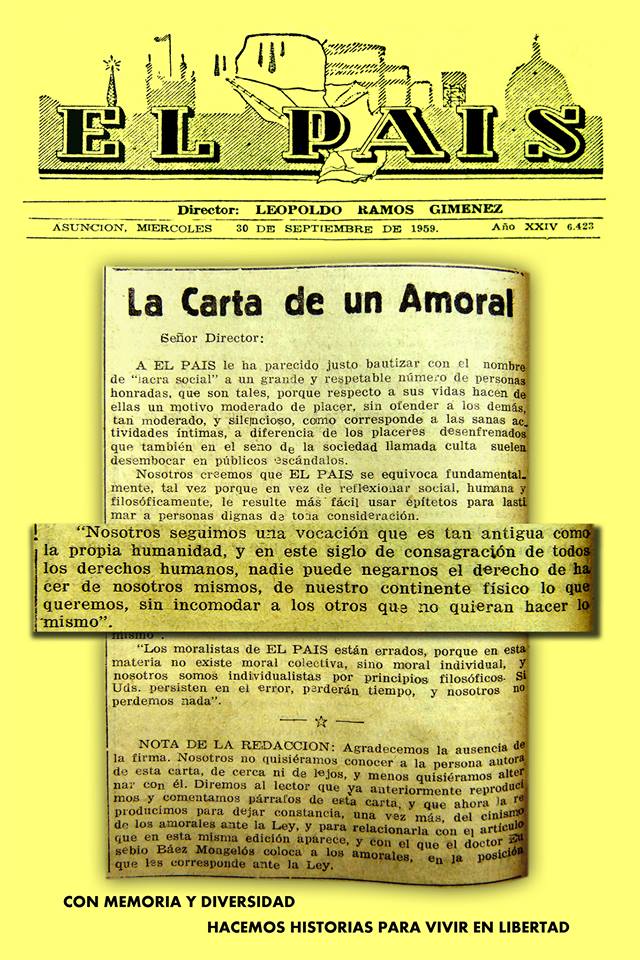
On September 12, the Paraguayan newspaper El País, which was aligned with the dictatorship, opened its edition with the following headline: “108 People of Dubious Moral Conduct Are Being Interrogated. Intense Police Action. Results Expected.” This was the first time the number 108 appeared in connection with homosexuality, according to the archives, newspaper clippings, and documents that make up the investigation conducted by Paraguayan lawyer Erwing Augsten.
Days later, the newspaper published the complete list of those arrested, whom it accused of "immoral conduct." From then on, 108 disappeared from the room numbers of some Paraguayan hotels and houses, from car license plates, and even from student rosters in schools.
On September 30, 1959, the editor of El País allowed the publication of a text entitled Letter from an Amoral Man. "We follow a vocation that is as old as humanity itself, and in this century of the consecration of all human rights, no one can deny us the right to do with ourselves, with our physical body, what we want, without bothering others who do not want to do the same," the anonymous letter states.
That is why, every year, continuing the history of struggles and memories of resistance in the country, September 30th is commemorated as LGBTI rights day in Paraguay. This charter is claimed by LGBTI organizations in Paraguay as the first known public demonstration for sexual freedom in the country, even 10 years before the Stonewall riots (New York, USA, 1969).
We are present
We are committed to journalism that delves into the territories and conducts thorough investigations, combined with new technologies and narrative formats. We want the protagonists, their stories, and their struggles to be present.
SUPPORT US

FOLLOW US
Related notes
We are present
This and other stories are not usually on the media agenda. Together we can bring them to light.