

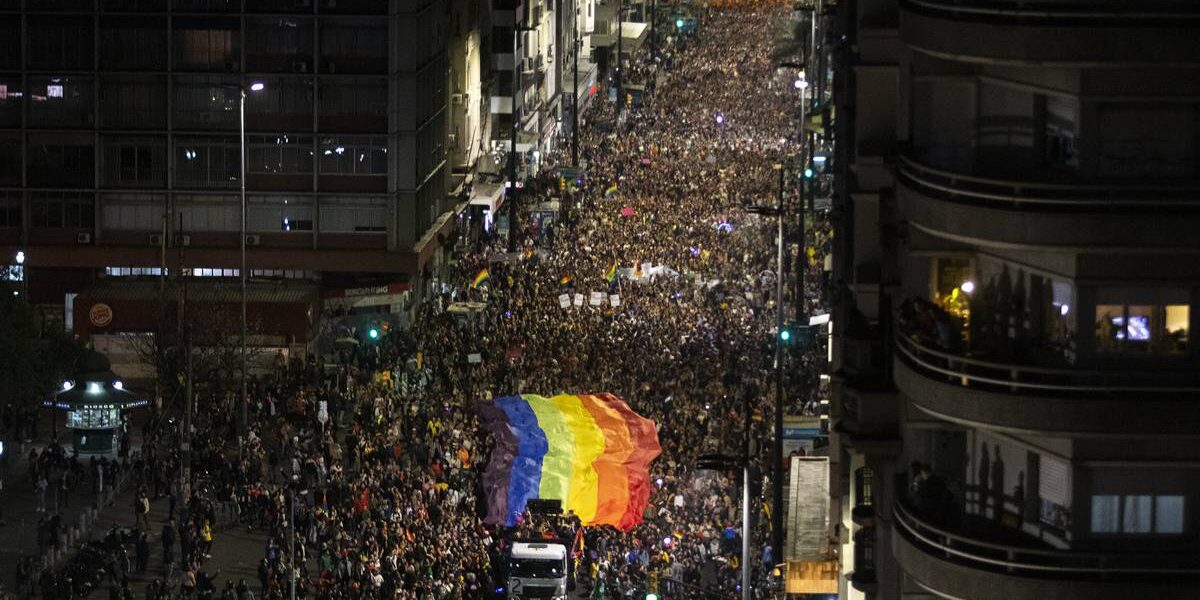
The March for Diversity in Montevideo was the youngest and most attended
By Denisse Legrand Photo: Ernesto Ryan On a spring afternoon, downtown Montevideo, and particularly Plaza Independencia, was filled with color from very early on. Celebrating diversity draws thousands upon thousands of people. It's a political phenomenon unthinkable not so many years ago, when marches only gathered 50 people who tried to hide…

Share

By Denisse Legrand
Photo: Ernesto Ryan
On a spring afternoon, downtown Montevideo, and particularly Plaza Independencia, was filled with color from early morning. Celebrating diversity draws thousands upon thousands of people. It's a political phenomenon unthinkable not so many years ago, when marches only attracted 50 people who tried to hide their identities.
Today, diversity is rights, it's life, it's pride, it's glitter, and it's color. This year's slogan, "Never again in the closet," was accompanied by "Fear is not the way," the slogan of the massive mobilization against the reform promoted by National Party politician Jorge Larrañaga, which aims to establish life imprisonment, mandatory sentence enforcement, nighttime raids, and military patrols of the streets.
In their proclamation, they defined the march as a political act, “because all participating groups understand politics as collective action to transform everyday reality.” They emphasized that the thousands upon thousands of people taking to the streets dream of “a more just world, in which love and kindness are the true pillars of our existence.”
The intention is always to “dismantle the closets that society has built around dissident identities.” To this end, a central task has been to gain visibility, space, freedoms, and rights. Regarding the Latin American context, they warned about the attack on hard-won rights: “Neoliberal, coup-plotting, and corrupt governments were quick to erase years of struggle,” they noted. Brazil was in the spotlight, particularly due to institutional violence.
Three murdered people were remembered who have emerged as symbols for the struggle: Marielle Franco, a black, lesbian, feminist and favela activist who was murdered; Yuri Piettro, organizer of the diversity march in Rio de Janeiro, recently murdered; and Agatha, an eight-year-old Afro girl murdered by the Military Police from behind in the favela where she lived.
[READ ALSO: Uruguay considers allowing same-sex marriage for non-residents ]
“These are not isolated cases: Bolsonaro’s fascist government, led by a defender of torturers, is promoting the genocide of young people, political and cultural leaders of the Brazilian community,” the proclamation stated. The Macri administration was also criticized for “bringing hunger to the Argentine people” and for the government’s systematic repression of social movements, including “trigger-happy” policing, as well as for forcing women into clandestine abortions. For the march organizers, this year is crucial “for our democracy”: “Our slogan stands as a clear warning: under no circumstances will we surrender the dignity we have won. We will not accept any sign of backsliding”; Uruguay is “the hope for Latin America,” they added.
In that regard, they highlighted the human rights agenda and, in particular, the passage of the comprehensive law for transgender people, which aims to ensure that the most vulnerable population in our country can live with dignity. Memory was also a central theme. They remembered the murders committed during the last civic-military dictatorship and those who remain disappeared to this day. Another person who is no longer with us and was also remembered is Plef (Felipe Cabral), the urban artist whose murder remains unpunished. “Plef was killed by fascism and its fear-mongering campaigns.”
[READ ALSO: Campaign to repeal trans law in Uruguay fails: there will be no referendum ]
Feminism as a transformative force permeated the discourse. The violence women experience daily and the need to eradicate the machismo that pervades our society were highlighted. There was a diverse welcome and a commitment to migrants: “Uruguay has become the destination of a wave of Latin American migration.
In recent years, we have seen how migrants from different parts of our continent have come to enrich our daily lives, but above all, in search of opportunities for their happiness. From this perspective, we want to welcome all our migrant brothers and sisters with open arms and tell them that we will not rest until the State and society as a whole are able to receive them without discriminatory practices of any kind. This includes eliminating phenomena such as precarious employment and housing, which we are currently seeing grow at an alarming rate.
The diversity movement also included demands regarding the UPM pulp mill, education, legal recognition of children born to same-sex couples, a guaranteed healthcare system, and comprehensive legislation for people living with HIV, among other issues. The march proceeded along 18 de Julio Avenue, bringing joy to the city. The social movement seems to be responding to reactionary impulses with love and collective effort, with reasoned arguments and mobilization. “When fear was the norm that governed our existence, pride was our response. And this time will be no different,” emerged as the rallying cry. The emphasis is on not backing down, on not returning to a society that curtails rights, because “we're not going back into the closet” and “because fear is not the way.”
We are present
We are committed to journalism that delves into the territories and conducts thorough investigations, combined with new technologies and narrative formats. We want the protagonists, their stories, and their struggles to be present.
SUPPORT US

FOLLOW US
Related notes
We are present
This and other stories are not usually on the media agenda. Together we can bring them to light.