

Trans youth: advocating for gender in schools
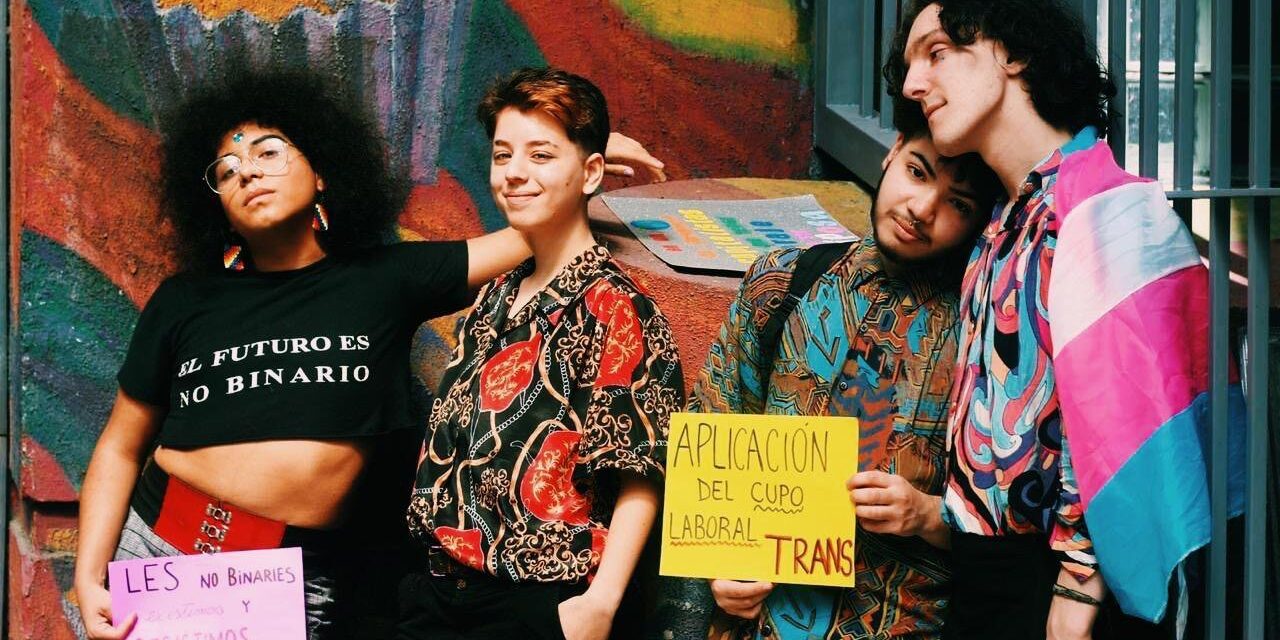
Three teenagers aged 16 and 17 met with a common goal: to create the Trans Youth Movement (MJT) to offer support and advice to transgender youth and teenagers.

Share

In September 2018, three teenagers, aged 16 and 17, met with a common goal: to create the Trans Youth Movement (MJT) to offer support and guidance to transgender youth and teenagers. A year after that first meeting, on Saturday, September 28, they will give an open talk at the Conti Cultural Center about Trans Identities: New Perspectives and Concepts, as part of the Futuros Festival. We spoke with its members about their lives and daily activism.
By Alejandra Zani
The Trans Youth Movement of Argentina challenges adult-centrism and poses new questions: those of its own generation. Its members share one certainty: the answers can only be collective. “We want to make visible the fact that trans children and adolescents exist and that trauma is not an exclusionary requirement for being trans,” Feliciano (17 years old), one of the Movement's founding members, explains to Presentes. “Our goal is for trans youth to experience schooling, family relationships, and interaction with society in the best possible way.”
The initiative arose among three friends, Feliciano, Félix, and Giovanni, due to the lack of spaces geared toward young people and teenagers within the trans community, and today it has eleven members. “The best-known organizations were always made up of people over 25. We were never really given a space in them. We were kind of like a 'youth annex,' and we wanted to create a place that felt like our own,” says Gio (17 years old). In the end, he continues, “the differences between a trans adult and a trans teenager are similar to those that differentiate a cis adult from a cis teenager.”
Diversities in plural
This is why, when it came to naming themselves, they decided to use the plural. “We speak of youth because our experiences are diverse. We are not a homogeneous movement, and to belittle what we have to say simply because we are youth is not only disrespectful, but it also perpetuates a stereotype of trans people perpetuated by adults,” explains Nehuén (17 years old). “The media always reproduces certain stereotypes of the trans adolescent community, portraying them as young people who hate their bodies and want to change them, who want to be 'something else,' and only show happiness when they achieve 'cispassing,' that is, when they can finally pass as a cis person. The entire transition before that is sadness and pain. Speaking of youth in the plural means acknowledging that not all experiences are the same.”
Nehuén was invited to join the MJT because they didn't see non-binary trans identities represented in schools. “Or anywhere else. I reaffirm myself not only as a non-binary person, but also as an Afro-descendant and a descendant of the Mapuche people. That cultural identity is inseparable from my gender identity. If people from the non-binary community invite me to read Judith Butler, I read her, but from the perspective of a Black, non-binary teenager. At the MJT, we understand this heterogeneity, and despite that, we share a core set of principles.”
In the middle of this year, the MJT's growth on social media and its increased visibility in the media led to a surge in requests for advice and invitations to give workshops, talks, and training sessions in schools. Because of this, they decided it was time to expand and recruited Agustina (18 years old). “When they asked me to get involved in trans activism, I was incredibly excited because from the very beginning, the emergence of youth groups seemed like something absolutely necessary in the trans community. At that time, I had already started the process of getting my ID and was on hormones, so I didn't need legal advice, but rather a space where there were other people like me, 17-year-old trans people.”

“It’s important to remember that trans youth have historically been silenced. There are still many people who have to live their transition in silence, facing discrimination and suffering from their own families or schools,” Agustina continues. “If we were to speak of a single trans youth, we would be excluding the vast number of exceptions who have a dignified life as young people, just like everyone else.”
For her, it's also impossible to speak of trans adulthood as something rigid. “Let's keep in mind that the life expectancy of a trans person is cut short at 35, and in 80% of cases, trans women are forced into prostitution. We aren't even sure if we'll fully experience adulthood; we don't yet have that certainty that we'll be able to access and finish a degree, or even get a job with a degree, because being trans still 'damages the image' of companies, and they prefer not to hire us regardless of our qualifications.”
Gender in the classroom
For Gio, asserting her gender identity as a teenager requires considerable courage. “When I started feeling the way I did, identifying as I do, nothing was clear and everything embarrassed me. I felt undeserving of anything. And beyond the emotional aspect, which is significant, there's also the bureaucratic courage. You need a lot of strength to confront the system and how it's regulated, to change your ID, to 'come out' at school, to wait in line for hours for an appointment three months later to see an endocrinologist or surgeon.”
When she was 15, Gio had Comprehensive Sexuality Education (CSE) in a subject called Health and Adolescence, but it didn't meet her expectations. “The explanation was super basic and biological. Penis, vagina, condom, birth control pills. Luckily, the teacher was flexible, and we presented a project on sexual and gender diversity, but that initiative came from us. Unfortunately, many professionals have no idea how a trans body works, about our experiences, or how contraceptive methods affect us during hormone therapy. It's as if at that moment they tell you, 'You should know you're part of an experiment,' because there's no data on 80-year-olds who have been on hormones their whole lives.”

"I have to constantly reaffirm my pronouns."
In Nehuén's case, navigating youth activism spaces as a non-binary person is "extremely stressful." "There's no way to identify that a person is non-binary, and I have to constantly reaffirm my pronouns, my identity, in any kind of space," they explain. "Furthermore, my identity is one that's been affirmed within the Argentine and Latin American context; it's not the same non-binary identity as that of someone from the United States or Europe. We have to understand our perspective because our needs are different, and that's what I'd like the Argentine non-binary community to understand."
“I had to arrange a meeting with an INADI employee to find out things like the fact that the school had to register me and respect my name even though I hadn't changed my ID,” Agustina explains. That's why she considers finding the Movement fundamental for spreading awareness and providing other teenagers with the tools to have a normal school experience. “Contrary to popular belief, advocating for gender identity within youth and high school is quite rewarding because, slowly but surely, we're seeing a change in society's response to the presence or potential presence of trans people in high school, and we're already seeing a much greater willingness among both teachers and students to learn more.”
“That’s quite encouraging, although we’re still aware of situations where people act not just out of misinformation, but against what the Gender Identity Law establishes. And it seems to me that while there’s been progress toward greater openness regarding the rights of trans people, some people are beginning to resist respecting this law,” Agustina comments. She adds, “It shocks me, in 2019, to see people willing to face a lawsuit just to have a student’s name revoked.”
A date at the Conti
On Saturday, September 28, as part of the Futuros Festival, which takes place throughout the month at the Haroldo Conti Cultural Center for Memory, the Trans Youth Movement will open a space for meeting and dialogue to address various issues surrounding their experiences. “We are going to review basic concepts, discuss problems, and above all, generate a debate where we can reach a conclusion on the matter,” explains Feliciano.
The meeting will be a continuation of the series on feminisms and cissexism, which began on September 6 during the opening of the collective exhibition Re-Existence, and will take place at 5 p.m. “The idea is to have a completely open discussion for anyone who wants to come and address these issues in order to pave the way for future trans generations,” says Agustina.
“We are going to talk about new masculinities and how to address this issue that is so difficult within the LGBT+ community and feminisms, which we believe are not separate, they have always been very close struggles, but suddenly, now, with new generations of the community and young feminists, a rather problematic discussion about separatism is being generated,” Gio explains.
“The idea is to ask ourselves how this affects trans people, how we automatically judge what we see based on an assigned role, an assigned gender, how to build a transmasculinity that is truly friendly, that isn't demonized, not characterized as the enemy, and what to do about all of this,” he continues. “Nothing that happens in the workshop is going to be about providing an answer, but rather a discussion, because we don't have an answer. The proposal is to think about it together.”
We are present
We are committed to journalism that delves into the territories and conducts thorough investigations, combined with new technologies and narrative formats. We want the protagonists, their stories, and their struggles to be present.
SUPPORT US

FOLLOW US
Related notes


We are present
This and other stories are not usually on the media agenda. Together we can bring them to light.