

A trans activist arrived at the Paraguayan Supreme Court to change her name
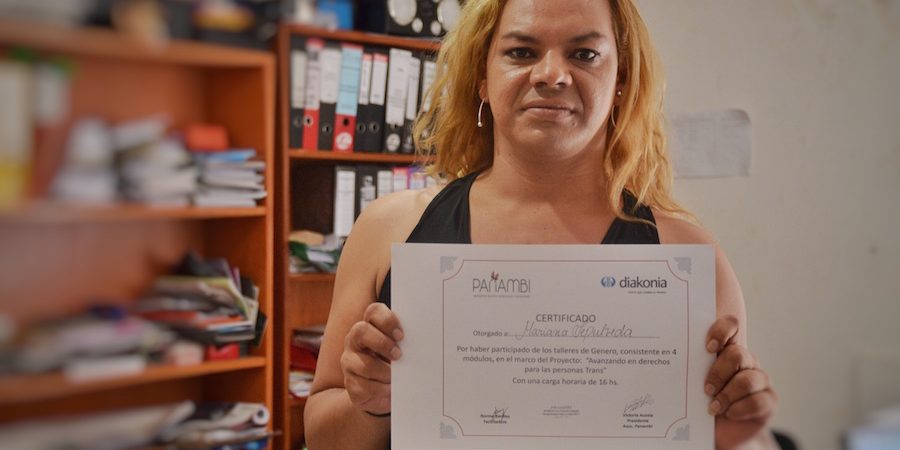
Paraguayan trans activist Mariana Sepúlveda began a legal battle years ago to change her name on her official documents. A positive outcome would set a historic precedent.

Share

By Juliana Quintana
Photo: Jess Insfrán
Although Paraguay is one of the countries subject to the jurisdiction of the Inter-American Court of Human Rights, transgender people still face a series of legal obstacles to change their birth name due to the lack of a gender identity law. Transgender activist Mariana Sepúlveda, after winning the first instance in the legal process to change her name on her Paraguayan identity card, appealed to the Supreme Court.
Following Judge Karen Leticia González's ruling, which was favorable to the Constitution and in accordance with international law, the Court of Appeals submitted the case to the Supreme Court for an advisory opinion. The ruling was appealed by prosecutor Sara González Valdez, who argued that the judge's decision violates Article 56 of Law 1266/1987 of the Civil Registry, which states: “The Civil Registry Official shall not register ridiculous names or names that may mislead regarding sex, nor more than three names.”
Without a law prohibiting it, but with an international framework that supports it
In Paraguay today, there is no law prohibiting a transgender person from changing their name. Furthermore, the arguments of the Public Prosecutor's Office conflict with the criteria upheld by the Inter-American Court of Human Rights, to which the country subscribes. In the context of the advisory opinion requested by the Republic of Costa Rica, the Inter-American Court stated that individuals have the right to autonomously define their sexual and gender identity, both in official records and in identity documents.
“The prosecution is using completely archaic, transphobic arguments that are outside the bounds of constitutional and international law. But the Public Prosecutor's Office is the only state body, so far, that has promoted blatant and open discrimination, not the Judiciary. On the contrary, the judge's initial ruling is noteworthy; it's historic. The problem is that this ruling may now be overturned because the prosecution has appealed,” Maximiliano Mendieta, a human rights lawyer, told Presentes.
“The law is there as a protection for minors.”
“This law is inapplicable to Yren and Mariana’s case because the civil registry only intervenes when the father, mother, one or both, are going to register their son or daughter. The law is intended to protect minors. In this case, we are talking about two adults who are requesting a name change through a judge. Therefore, the civil registry official is no longer involved because the change is made by the judge,” said Diego Molina, Mariana’s lawyer, in an interview with Presentes .
Mariana's case is paradigmatic because, unlike Yren Rotela's case, the trial was treated as a transfer from a "male" to a "female" name. Yren's name does not appear on any definitive list of names. "The prosecution treated the two cases differently. Yren's wasn't treated so much as a male name becoming female, but Mariana's was. What Yren did was reverse her name," Molina explained.
“Who defines what is male or female? What’s happening here is that religion and machismo prevail. Carlos Benítez sent a letter to the judges asking them to delay the name change because it disrupts public order and good morals, as well as the rights of others. Which is completely absurd. The problem is that we are used to the use of masculine or feminine names, but that is a binary and sexist concept,” Mariana stated.
A case that would set a historical precedent
“The Supreme Court of Justice is currently under fire,” says Mendieta. The person in charge of the annual reports on discrimination and violence against transgender people at the Panambi Association believes that we are facing a “historic trial” that will mark a paradigm shift in Paraguay, whether through a positive or negative ruling.
“At this moment, in the 21st century, in 2019, the most important issue for setting a precedent by the Inter-American human rights system is, without a doubt, the violation of the rights of LGBTI people, just as it was in the 1990s with Indigenous peoples or in the 1980s with the disappeared. In each decade there were very important rulings from the Court. I believe that at this moment, the Court is facing the most important issue of its time,” Mendieta stated.
Victory in the first instance
Last year, Civil and Commercial Court Judge Karen González ruled in favor of Mariana's civil suit. In final judgment No. 22, dated February 20, she ordered the rectification of the birth certificate and the change of name. She cited Article 25 of the Constitution, which guarantees ideological pluralism and establishes that "every person has the right to the free expression of their personality, to creativity, and to the formation of their own identity and image."
The judge emphasized that the case file demonstrated the harm done to Mariana's dignity and personality, to the detriment of her psychological and emotional well-being, the protection of which, according to Article 4 of the Constitution, is a responsibility entrusted to the State. Furthermore, Article 46 mandates the removal of obstacles that foster unequal or discriminatory treatment.
“People make fun of our names in healthcare, education, and work. When they realize that we are biologically male and reject power based on the subjugation of our sex, they discipline us. For anyone else, changing one's name is an administrative procedure. But we have to go to the highest levels of the justice system,” Mariana emphasized.
We are present
We are committed to journalism that delves into the territories and conducts thorough investigations, combined with new technologies and narrative formats. We want the protagonists, their stories, and their struggles to be present.
SUPPORT US

FOLLOW US
Related notes
We are present
This and other stories are not usually on the media agenda. Together we can bring them to light.