

What happens to lesbians and bisexuals in gynecological clinics?
For over 10 years, I'd been hearing anecdotes about ignorance, prejudice, and even some horror stories involving gynecologists. I wasn't the only one. Half of the women surveyed reported having heard similar experiences from the group, and most of those who responded were lesbians.

Share

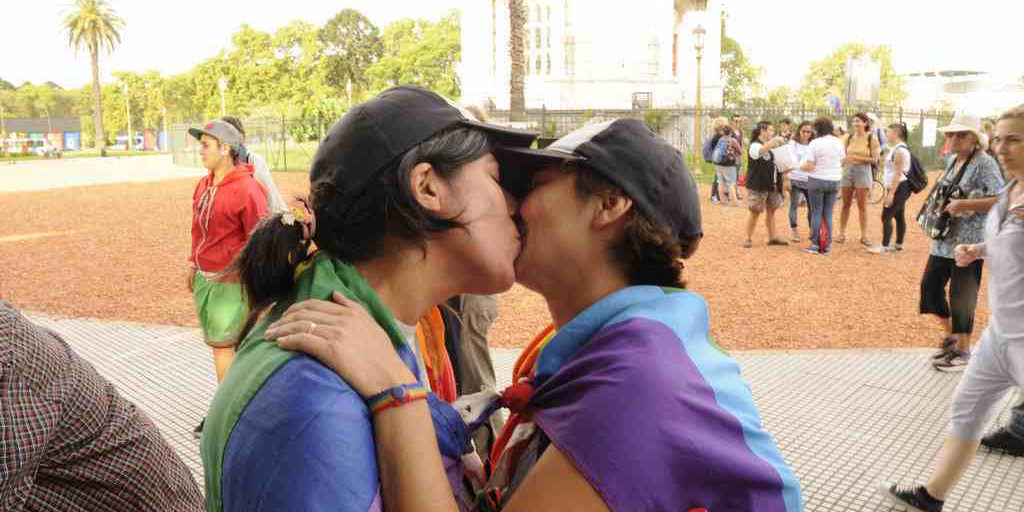
Photo: Ariel Gutraich
I spend almost an hour flipping through the directory. I skip over the male doctors' names and try to find the gynecologists who live near my house. I don't know all the streets in Almagro, and there's no division by neighborhoods, so the task requires me to look up many of the addresses on an online map. I end up noting down two or three that are close by. The first one has an appointment for more than a month from now. The other one is available in a couple of weeks; I go with that one.
I was 29 at the time and had never been to the gynecologist for routine checkups, but I was seeing someone who wasn't using protection with me, and I reckoned she wasn't using it with the other women she was sleeping with either. The time I told her, half-jokingly, half-seriously, that I wanted latex gloves for safer sex, she said, half-jokingly, half-seriously, that she wouldn't touch me with the gloves on. But she was getting regular checkups. I decided to start there.
What happens to lesbians and bisexuals in and around gynecological clinics? What happens to our sexual health? I took advantage of a university course and undertook a small research project on the topic. I conducted the survey using a web form, which I distributed to former activist comrades and on my social media networks, in the City of Buenos Aires and Greater Buenos Aires. Twenty-seven people responded; 14 identified as lesbians and 13 as bisexual. The options "trans" and "non-binary" were also available, but no one responded identifying with those terms.
The preview
For over 10 years, I'd been hearing anecdotes about ignorance, prejudice, and even some horror stories involving gynecologists. I wasn't the only one. Half of the women surveyed reported having heard similar experiences from the community, and most of those who responded this way were lesbians. They still decide to go, but with concerns or fear of discrimination. Some seek out recommended gynecologists.
Do we go regularly? Only half go for routine checkups. The rest went a few times, or when they had symptoms or concerns. 11% indicated they used to go regularly but stopped.
So, a good portion of us go with fear.
In the doctor's office
I arrive at the doctor's office. I learn in the waiting room, from the pictures and posters, that she's also an obstetrician. Nothing about prenatal care, just a lot about motherhood. I go into the examination room and let her ask me the routine questions.
-How do you take care of yourself?
-I don't take care of myself.
I let a brief silence fall. He looks up from the card. I explain:
-I only have relationships with women.
Silence again. I wait to see if she says anything. I jot something down in the margin. Shouldn't she say something about taking precautions? Being a lesbian shouldn't exempt me from taking care of myself, even if I do. It seems that, even though I don't use them, I know more about protection than she does. At least she doesn't discriminate against me or say anything about it.
In the survey, half revealed that they directly avoid this situation: They don't tell their gynecologist about their sexual identity. Many also said that the professional simply "assumes" they are heterosexual, without asking them.
Perhaps they're right to keep it hidden. More than half of the lesbians (and only 2% of bisexuals) revealed that their healthcare provider held some kind of prejudice regarding their sexual practices. They also dismissed routine checkups and the possibility of motherhood. And forget about them advising on contraception.
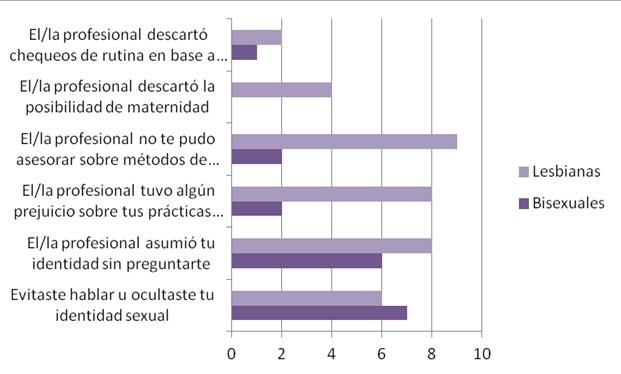
My gynecologist doesn't talk much. She tells me she's going to order some tests and that when I come back with them, she'll do a Pap smear. I think, "Well, at least she didn't refuse me like she did with other lesbians," but I wonder why she doesn't do it that same day. I don't know if it's common practice. What surprises me is what she says next: she also asks me to buy a "small speculum" at a pharmacy. She says she only has medium and large ones. She writes it down on a Post-it note, instead of using the prescription pad she used for the previous tests. It dawns on me moments later that she assumed I have non-penetrative sex because I'm a lesbian. She didn't even look at my vagina.
Violence
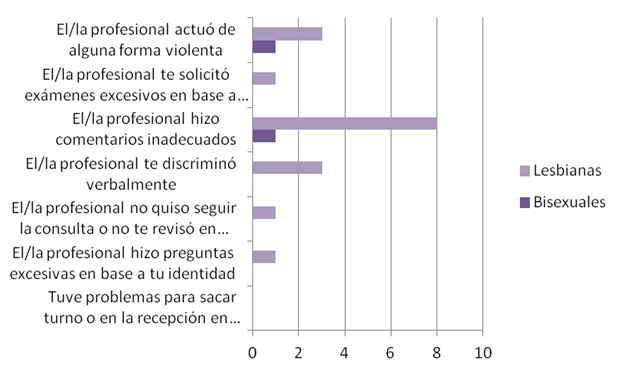
More than half of the lesbians reported some form of violence. This was mostly verbal, in the form of inappropriate comments, but also included explicit verbal discrimination. Others said the healthcare professional acted violently, requested excessive tests based on their identity, or refused to continue or review the consultation.
Sexual health
Returning to the topic of safe sex practices, I wondered what the situation was for other people. The results showed a significant difference between lesbians and bisexuals in this regard. While methods are known, most bisexual people only listed those used for prophylaxis with cisgender men, even confusing prophylaxis with contraception in some cases. In this group, few people listed methods like dental dams, and none indicated knowing about gloves. All of the lesbians reported knowing about dental dams (some specifying that they knew how to modify condoms or gloves to make dams, or use plastic wrap instead), and a good number were familiar with gloves. A few people reported knowing about using condoms with dildos.
How did they learn about the methods? Most of those who listed methods for use with other lesbians and bisexuals said they learned about them online, and in some cases through LGBT+ organizations or activism. Only in one case was the information provided by a gynecologist. This differs from the methods listed by bisexual people for use with cisgender men, who mostly said they learned about them in educational settings.
What do they know about sexually transmitted infections (STIs) that can be acquired among lesbians, bisexuals, and other gender identities (excluding cisgender men)? Here, too, there is a difference between lesbians and bisexuals. Most lesbians are familiar with HPV and HIV. Some were able to list other STIs such as syphilis, gonorrhea, herpes, yeast infections, etc. Others, although they didn't list them, knew that all of these STIs are transmissible among these gender identities, depending on the practices. A third of the respondents said they didn't know of any, and note: all of them are bisexual. In this group, few people were able to list any STIs: two listed HIV, one listed HPV, and another listed a few more.
Whether or not people are aware of the methods or STIs doesn't seem to be a determining factor in whether they use prophylaxis: almost no one uses it . Those who are aware of them say it's because they find it uncomfortable or because they think it's useless. There's also a perception of being a "low-risk group." They prefer to rely on the confidence of having stable partners or getting routine checkups.
Are we really at low risk? Slightly less than half reported having acquired HPV, yeast infections, and herpes at some point, but they don't know when or how they acquired them. Does this perception come from us or from the medical field? Let's remember that many conceal their identity during consultations and are listed as heterosexual.
Outside the office, I think I was lucky, all things considered. But then it starts to sink in: why do I have to buy her equipment? Maybe she needs the small speculum, maybe not, but shouldn't she be prepared for all body types? What if, during the examination, she sees I bought it for nothing? I'm also worried that one of the tests is intravaginal. I spent hours looking through a chart to choose this doctor who didn't even examine me, only for her to order a test that I'm not even sure is necessary before the Pap smear, and which involves someone I didn't choose inserting something into my vagina.
I keep going over the issue, I look into centers, but my order expires. I'm not going back.
We are present
We are committed to journalism that delves into the territories and conducts thorough investigations, combined with new technologies and narrative formats. We want the protagonists, their stories, and their struggles to be present.
SUPPORT US

FOLLOW US
Related notes
We are present
This and other stories are not usually on the media agenda. Together we can bring them to light.