

The "feminism" that excludes trans people has arrived in Guatemala
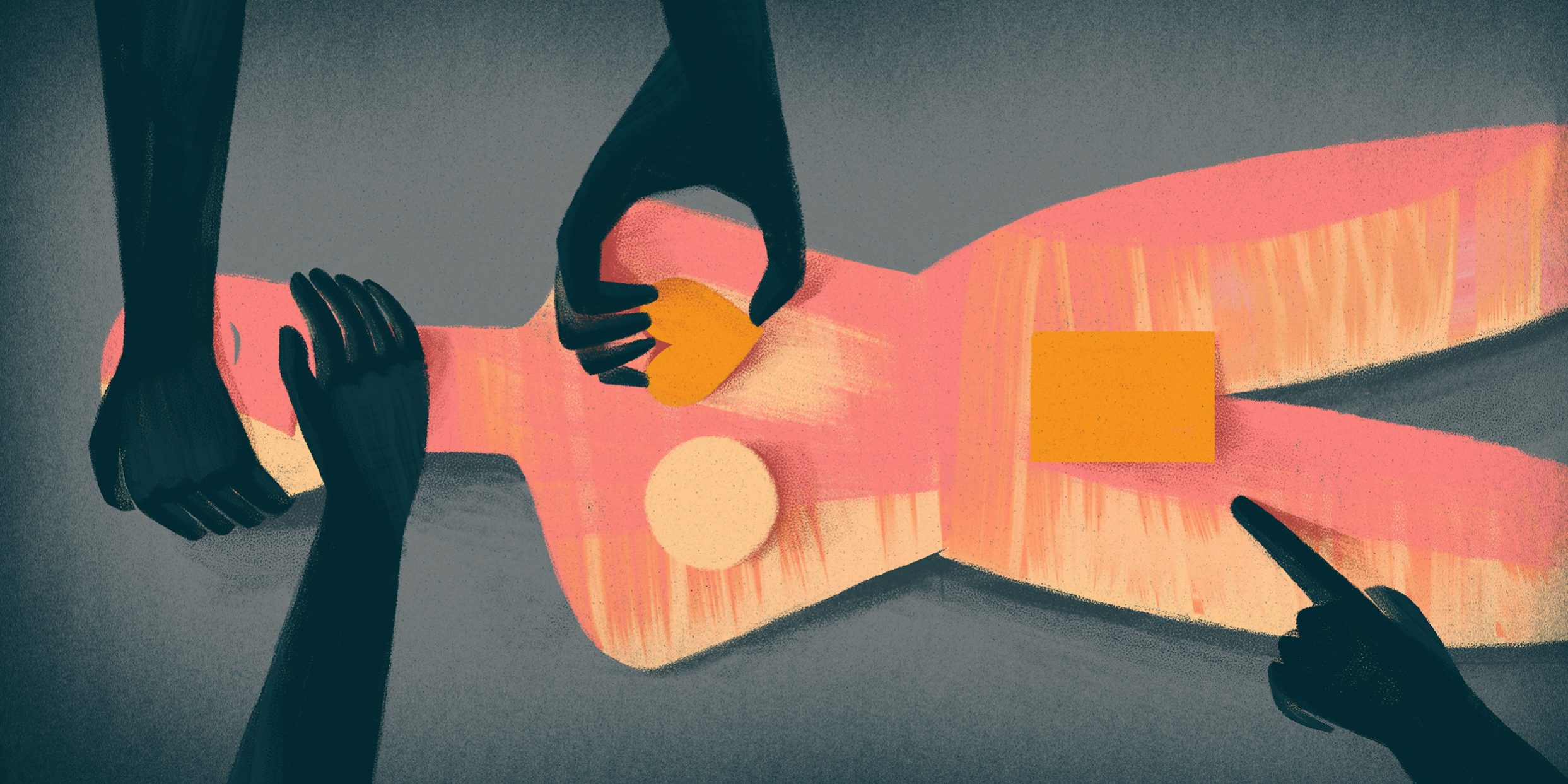
The axiom that a vulva equals a woman and a penis equals a man is shattered by transsexuality or transgender identity. And the disciplinary power of Western medicine brings death to one fiction and birth to another.

Share

By Pilar Salazar Illustration: Florencia Capella A few days ago, a well-known digital media outlet in Guatemala published an article advocating for “antifeminism.” It’s a rather misguided piece, portraying feminism (which is not a monolith either) as a dogma, as violent as Islam or Judeo-Christianity. Meanwhile, a secret “sorority” group of women, to which I was invited by a friend, was establishing membership rules, and during that process, they put to a vote and opinion among the members (including myself, a trans woman) whether it was appropriate to include trans women. What they were questioning was whether or not we were women. I felt upset because there was a prevailing mindset that perceived trans women as a threat. My intention in writing this is not to divide or attack the feminist movement, but to highlight how we are responding to these attacks alongside our daily actions. We will also coordinate collectively so as not to overlook other women whose struggles we are (by choice) unaware of, and who, instead of contributing to the movement, could detract from or divide it. It's hard to understand that trans women are also involved in feminist struggles; we are interested in many of the same struggles that intersect with those of cisgender women.
Trans-exclusionary radicals are not feminists
Viv Smyth called them TERFs, referring to “trans-exclusionary radical feminism,” which describes cisgender “feminist” women who believe that trans women are not women and that the feminist struggle doesn't belong to them. But I'm going to be rebellious and contradict this conceptualization, because in my opinion, and in the opinion of many feminists, being “trans-exclusionary radical” is not a characteristic of feminism but rather a stance that implicitly carries the biological framework (relying on genitalia to categorize gender identity). It has a baggage of cisgender logic that keeps us blind to the privileges that allow cis-normative women to violently “decide” whether trans women can be women and be in the same spaces or not. It's a paternalistic folly and, at the same time, an exclusionary one because there's neither the space nor the capacity to understand that women are diverse and that, in general, this part of trans women are killed before the age of 35 in Latin America. I believe that cisgender "feminist" movements' ignorance of the struggles faced by trans women is no longer a valid argument for inaction and violence. Many trans women and men support these same struggles because we too are affected by issues like abortion, street harassment, and more.Who are the political subjects of feminism?
Opening ourselves to dialogue and accepting that we haven't cared or that we have points to discuss is the first step to avoid confrontation and division, which, as I've said, is a possibility in some circles and is now reaching Central America. It's the reluctance to ask, for example, a question as basic as the one proposed by Paul Preciado: Who are the political subjects of feminism? It's no longer enough to say that to join the fight against the patriarchal system and the dismantling of oppression, one must have a vulva. I propose that we talk about intersectionality and ask ourselves: Who does the patriarchal system attack? Here I'm talking about oppressed feminized bodies. The axiom that a vulva equals a woman and a penis equals a man is shattered by transsexuality or transgenderism, but also by intersexuality, for example. And the disciplinary power of Western medicine brings about the death of one fiction and the birth of another. Teresa de Lauretis said that, like sexuality, gender is not a property of bodies or something originally existing in human beings, but rather the set of effects produced on bodies, behaviors, and social relations. In the words of Michel Foucault, it is the deployment of a complex political technology.Does it make sense to continue talking about feminism or feminisms?
To paraphrase Preciado: yes, as long as it's a way of combating the specific mechanisms of control and production of sexual, racial, aesthetic, etc., subjectivities. The heterosexual matrix[1] It attempts to reduce the multiplicity of bodies to masculinity and femininity from the perspective of genital politics, without taking into account that systems of oppression reach even the peripheries of subaltern bodies[2]At this point I must say, I find it unethical and completely unacceptable sisterhood To rail against trans women while defending feminism against violent men, arguing from a biological perspective, is unacceptable. It is important, and counter-current to these arguments, to open a dialogue and address doubts in order to strengthen, rather than divide, what has been so hard-won by feminists. [1] Judith Butler, Gender in Dipusta, 1990. United States [2] Saurabh Dube, Subaltern Subjects, 2001 ]]>We are present
We are committed to journalism that delves into the territories and conducts thorough investigations, combined with new technologies and narrative formats. We want the protagonists, their stories, and their struggles to be present.
SUPPORT US

FOLLOW US
Related notes
We are present
This and other stories are not usually on the media agenda. Together we can bring them to light.