

Azul Montoro Trial: Unprecedented conviction for femicide of young trans woman
It was the first time that the murder of a trans woman went to trial in Córdoba.


Share

By Alexis Oliva – from Córdoba [News updated at 5:50 PM] Fabián Alejandro Casiva, accused of the murder of Azul Montoro, a young trans woman, was sentenced to life imprisonment for femicide in the trial that concluded today at noon in the 9th Criminal Court of the city of Córdoba. The jury rejected the defense's argument of diminished responsibility due to mental disorders. They agreed with the charges proposed by the investigating prosecutor and requested by the prosecution and the plaintiff in yesterday's closing arguments. The aggravating circumstance of "gender-based violence" is unprecedented in the Córdoba justice system, which had never before tried the murder of a trans victim.
READ MORE: Córdoba: The trial for Azul Montoro is nearing sentencing
Azul was 23 years old when she was murdered on October 18, 2017. She was stabbed 17 times and struck on the head in an apartment near the red-light district of the Mercado Norte in Córdoba, where she survived by working as a sex worker due to a lack of other employment options. Before fleeing, the perpetrator also stabbed and mutilated a poodle. He was immediately identified and captured because he answered a video call on the cell phone he had stolen from the victim. Casiva was the same age as Azul at the time and will begin serving his sentence today in Bouwer prison.A multicolored outpouring of emotion in front of a gray building
“Azul Montoro, present! Now and forever!” chanted about thirty young trans people, transvestites, and LGBTQ+ activists in the plaza outside the courthouse. “Justice has been served, now she can finally rest in peace,” a girl told Lara Godoy before embracing her tightly. She was Azul’s best friend, and together they survived in the red-light district of Córdoba’s Mercado Norte, ever since Lara arrived from San Juan and Azul from San Luis.🇦🇷[Now] #Argentina Activists and organizations are accompanying the trial for the transfemicide of Azul Montoro outside the 9th Criminal Court of Córdoba. The verdict will be announced after midday. https://t.co/2GZ8zXI91H pic.twitter.com/3S4UpsPk6R
— Presentes Agency (@PresentesLGBT) August 22, 2019
READ MORE: Trial begins for Azul's murder: "Trans people are in a vulnerable situation"
Throughout the trial, she remained with her friend's family the entire time. "Thank you all, I'm very moved," she managed to say as she left the building. Azul's parents and younger sister wore the same expression, a mixture of emotion and relief, their eyes filled with tears. As lawyers and court officials came and went, a collective outcry erupted: "Sir, Madam, don't be indifferent! Trans women are being killed right in front of everyone!" “She felt like a woman from a young age and we supported her.”
The final day of the trial began at 9:40 a.m., when the judges gave the victim's mother the opportunity to testify before the jury. Alejandrina Torres said, “Azul felt like a woman from a very young age. We have always been there for her. I wouldn't want any family to go through what we are going through. No one will bring Azul back to us, but we want justice. I'm not seeking revenge, but whoever killed her has to go to jail.”
 “She felt like a woman from a young age and we supported her.”

“I love women, not homosexuality.”
“I don’t know those people in the back. I never hung around, like they say. I love women, I don’t like homosexuality,” Casiva said, raising his voice slightly, while some in the audience murmured indignantly and Azul’s friends wept with anger. Finally, he addressed the judges and, almost shouting, reproached them for his imprisonment: “I’m in the back wing, where the really bad people are. I’m getting worse there. I don’t have 10 or 8 stitches and they won’t take me to the front wing, or let me see the psychologist, because of everything the press says. I’m not here to say I got into a fight with so-and-so or that someone tried to stab me, I’m just here to ask for forgiveness.”When Casiva finished speaking, the judges announced a recess until noon. Everyone stood up, except for Mónica Galindez and Vanesa Casiva, who remained seated in the front row, staring straight ahead. It was as if their son and brother's words had paralyzed them, as if they sensed the impending outcome. Both had been present since the first hearing, testified as witnesses, and supported the accused throughout.🇦🇷As he testified, the accused Casiva's voice grew increasingly loud. The public murmured with indignation, and some of Azul's friends wept. “When I was in prison as a minor, the things I went through in there made me a bad person. I have nothing against them (the trans women). I ask for your compassion.” pic.twitter.com/EBxRhVrZ7p
— Presentes Agency (@PresentesLGBT) August 22, 2019
“Today we overturned the chessboard of a conservative power”
The news of the verdict spread from the third floor to the ground floor, generating an initial wave of applause and cheers, which would be repeated several times. Upon leaving the courtroom were Azul and Lara's family, their lawyer Tomás Aramayo, the plaintiffs' psychologist Fabiana Boerr, Victoria Romero, a representative of Casa Trans, and Guillermo González, the investigating prosecutor who championed the "femicide" charge and brought the case to trial. Each person was greeted with kisses, hugs, and thanks—thousands of thanks. With a trembling voice and accompanied by chants of “Not one less, we want to live!”, González told Presentes: “It was as we asked from day one, and I’m truly proud. When we considered the choice between transvesticide and femicide, we saw the person. And Azul wasn’t a trans woman, she was a woman.” He added, “Azul made herself visible, and today her light will be a beacon in the struggle of this community and all the people the State must protect. We must demand policies for labor inclusion so that they aren’t forced to work on the streets. And the Justice system, which is a conservative power, must adapt to the changing reality. Today we did it by overturning the status quo, and it was a victory for vulnerable communities.”
“It was a hate crime against our identities”
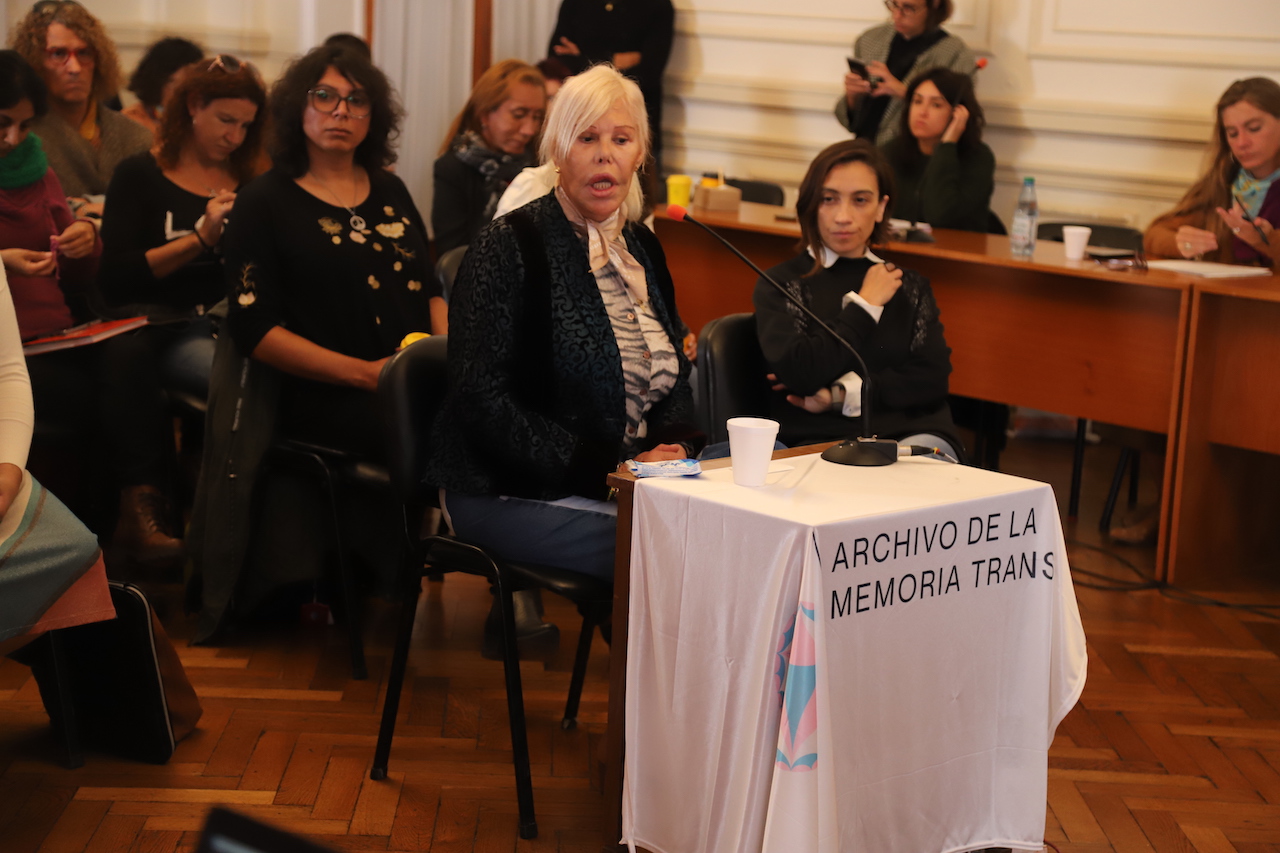
“This is a great day of justice for us, because we are human beings,” said Julia Palomeque, a member of the trans collective. “The case has been classified as femicide, and this is a very important precedent in the province and at the national level. The fight has only just begun, and we are going for more. Enough with hate crimes against us.” Victoria Romero also pointed out that the definition of femicide should not overlook the fact that “They killed a trans woman and that is a hate crime against our identities.“No one can bring our friend back to life, but we are at peace because it was a fair ruling and a well-deserved sentence.” Alejandro Escudero Salama, Deputy Director of Human Rights for Minorities and the Fight Against Discrimination for the Province, who was present at the trial from the beginning, commented:This ruling must represent a milestone and an opportunity to send a message to society regarding understanding the situation of trans people, with a life expectancy of 35 to 40 years.which reveals a systematic pattern of discrimination, vulnerability, and violence. And to become aware that there is a normative violence against them that can end in murder.” “We, as public officials, have a greater responsibility to work more deeply in what we do, which is to make trans children and adolescents visible, so that as adults they do not have to go through that ordeal,” she added.
“The ruling will open the minds of many people.”
Tomás Aramayo, the lawyer for Azul's family, celebrated the outcome of a trial that “was very difficult from the beginning, but we defended her and justice has been served. The sentence recognized the femicide, and that is historic. That means a lot, because it is recognition for a person who felt like a woman since childhood.”
-What do you think the sentence means for the trans community?
-Wow… so much. A part of society, so marginalized, has finally received a real response today, for all their struggle. They deserve it.
 “The ruling will open the minds of many people.”
 Azul's lifelong friend, Micaela Videla, is a key member of the group, always present in the courtroom. Now basking in the midday sun, she believes the verdict "will open many people's minds. What happened is unbelievable. We were never alone here; we always had the support of the press, the team of psychologists, the law firm, and Casa Trans. Azul's family has also been a pillar of strength for us, as has Lara, who from day one made it her goal to achieve justice, and she did. As for Casiva… may God forgive him."
The prosecutor was Gustavo Arocena. According to the prosecution's case, in the early hours of October 18, 2017, and “after speaking with other women” in the “red-light district” of the Mercado Norte in Córdoba, Casiva convinced Azul and took her by motorcycle to the apartment at 141 Rincón Street. “There, an argument ensued, the man pulled out a knife “with the intention of killing” Azul and “stabbed her with the knife and then hit her on the head with a blunt object.”
READ MORE: Transfemicide of Azul Montoro: allegations
]]>We are present
We are committed to journalism that delves into the territories and conducts thorough investigations, combined with new technologies and narrative formats. We want the protagonists, their stories, and their struggles to be present.
SUPPORT US

FOLLOW US
Related notes
We are present
This and other stories are not usually on the media agenda. Together we can bring them to light.