

Cordoba: The trial for Azul Montoro is nearing sentencing
On Wednesday the 21st, the arguments will focus on the main controversy: whether or not the accused understood the criminality of his actions.

Share

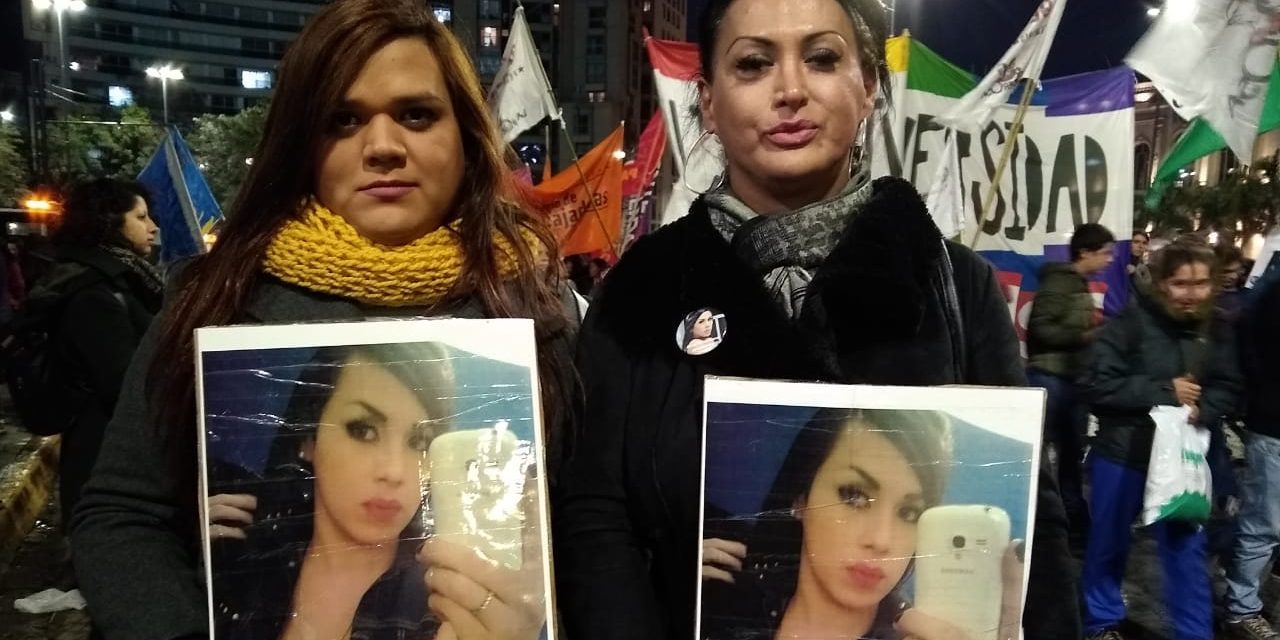
By Alexis Oliva – from Córdoba. On Wednesday, October 21, closing arguments begin in the trial for the murder of Azul Montoro, the 23-year-old trans woman stabbed to death in the early hours of October 18, 2017, in what is known as the "red-light district" of the Mercado Norte in Córdoba. First, the plaintiffs will present their arguments, followed by the prosecution, and finally the defense of the accused, 26-year-old Fabián Alejandro Casiva. The twelve members of the jury will then have the responsibility of delivering the verdict, which will be announced by the judges of the 9th Criminal Court. The verdict is expected to be announced on Thursday. As during the five days of hearings held since July 31, the courtroom will be filled with family and friends of the victim, representatives of LGBTQ+ groups, and human rights activists. This will bring to a close this case, which went to trial as a femicide with the aggravating circumstance of gender-based violence—a first in the legal investigation of crimes against trans people in the province of Córdoba.
 During the now-concluded testimonial phase, friends and colleagues of Azul, family members and neighbors of the perpetrator, eyewitnesses, and several mental health professionals who acted as expert witnesses during the investigation and in a previous case stemming from a domestic violence complaint, and who treated Casiva at the Neuropsychiatric Hospital at different times in his life, all testified. There is now almost no doubt that Casiva was the perpetrator of the crime. That night, he arranged, or pretended to arrange, sex in exchange for money with the young trans woman and took her on his motorcycle to the apartment that his friend Lara Godoy rented at 141 Rincón Street. There, he stabbed her 17 times after an argument that may have been over a financial dispute. What was once again under debate was whether or not he was aware of the criminality of his actions, depending on the state of his mental health.
Recognized, before and after the crime
Azul's trans friends testified that Casiva frequented the North Market area and described him as "annoying," "bothersome," and "difficult to get rid of." On the night of the crime, he spoke with some of the women. They recounted that he "always had little money" and sometimes "scrounged," while Azul "paid well and worked well" and tried to "work with good clients." However, the unanimous conclusion was: “The place is very dangerous and we are exposed to everything.” Among those friends, now witnesses, Maina Carrizo was the one who found Azul's body. At the trial, she recounted that Azul was lying on the floor, covered in blood, "with her shorts half-pulled down." Maina ran terrified into the street and yelled to a friend on the corner. Only when she went back inside did she see the poodle: "I thought she was covered in Azul's blood, but no. She had been stabbed too." Another of the women who testified was Agustina Cáceres, who at 10:30 that morning received a video call from Azul's cell phone. When she answered, Casiva's face appeared. She recognized him immediately because she had spoken with him the night before at the Mercado Norte (North Market). Another friend photographed the video call with her cell phone, and the recording was presented as evidence by the prosecution. A short time later, on the photo that Agustina posted on Facebook to denounce Azul's murder, someone commented from the same account: "She deserves it" and clicked the "laughing" emoji.
“I screwed up”
A witness for the prosecution, Andrea Romero, a neighbor of the Casiva family in Villa El Libertador, recounted: “In 2014, I was coming home from work with my husband, and out of nowhere, Fabián appeared and pulled out a revolver. He pointed it at my husband and said, 'When I call you, you come here.'” She knew he had mental health issues and had been hospitalized in a psychiatric ward. When the young man returned to the neighborhood, he had “a look of resentment and hatred; he changed a lot and was frightening.” On another occasion, Casiva threatened her: “Andrea, I’m going to get you.” Some time later, he promised her: “I won’t bother you anymore.” “And he kept his word; he never bothered me again,” Romero said. One night, she and her husband saw their neighbor on his motorcycle “talking and laughing with a trans woman” in the area of the market. At the Casiva home, “shouting was always heard,” but the family, according to this testimony, remained silent before Fabián was arrested, when they were all victims of violence. Criminal law allows for abstaining from testifying in a trial against a family member. However, siblings Vanesa and Leonardo Casiva testified at the trial and generally agreed with what their mother said on the first day. The young woman recounted that Fabián was diagnosed with schizophrenia in his teens. He had violent tendencies toward her, her mother, father, and other siblings—"He even hit all of us," she said—; she also said that he used drugs, had frequent headaches, and once "tried to burn the house down." "I really screwed up," her brother told her that afternoon after Azul's murder, she recounted in her testimony. She noticed he was "very down, he was high, and you couldn't understand what he was saying." She also noted that he had a cell phone. Then he showed her his clothes and some sneakers stained with blood in the closet, and insisted several times: "I didn't mean to do it," the witness recalled.“He paid me with blood money”
In turn, Leonardo Casiva stated that his younger brother has suffered from schizophrenia “since childhood.” He himself took him to the Neuropsychiatric Hospital several times, and “once he tried to commit suicide” by cutting his wrists with a piece of glass. “Outside the family, he was violent, he fought a lot, he was an aggressive person,” he admitted. “Do you know if he ever fought with any of your relatives?” asked defense attorney Javier Rojo. “There was an argument… I don’t know if he meant to or threatened to, what he did, but he threw a stick at my wife. I don’t know because I work from seven to six in the evening. My wife said she had had an argument with Fabián. That day, he had a headache, my son was playing, he got up agitated, and that’s why the argument started.” The defense attorney brought up the fact that the witness’s wife’s sister is a trans woman and asked if Fabián had any problems with her. “No, never,” the witness replied. “Do you think he could have killed someone because they are transgender?” Rojo inquired. In response to the objection from the plaintiff, Tomás Aramayo, the legal advisor rephrased: “Did you see any displays of hatred toward this girl because she is transgender?” “No,” replied the defendant's brother. Another important testimony came from Diego Carlos Luna, the taxi driver who, on the day of the crime, took Casiva from his home in Villa El Libertador to the Mitre Railway station. When he went to pick him up, he noticed that there were “a lot of people in the street.” During the ride, the passenger “spoke well, but he seemed agitated and nervous.” “He told me he was going to check himself into the psychiatric hospital because he had relapsed into drug use,” he recalled. When it came time to pay, Casiva gave him some bills stained with blood. “Then he showed me his bloody hand and told me he had cut himself because he had overdosed on drugs the night before. He was supposed to give me 120 pesos, but he said he was going to give me 140, because I was being nice,” Luna stated.“There is no connection between what he does, feels, and thinks.”
In December 2017, official experts Sebastián Nigro, a psychiatrist, and Marcela Scarafía, a psychologist, conducted a mental health assessment of Casiva after three interviews and various tests, aimed at establishing his level of understanding of his actions. Called as witnesses, they recalled that he suffered from “schizophrenia, affective disorders, possible auditory hallucinations, and a psychotic process that affected his ability to act in accordance with reality,” Nigro explained. Upon reviewing his medical history, they found “extensive evidence of persecutory delusions.” “Mr. Casiva has a history of a life marked by violence, characterized by the constant abandonment of treatment, a lack of awareness of his illness, and the use of psychoactive substances,” the psychiatrist added. Although he accepted the theoretical possibility of “lapses of consciousness,” he asserted, “There are no aspects of life that remain outside the scope of this disorder, which generates severe cognitive impairment.” Scarafía explained that drug use “is a contributing factor that produces activation: things we wouldn't do when we're sober, we do when we're intoxicated.” “Imagine that in a person with a pathological basis like his,” the psychologist stated. She also noted that during the interviews, Casiva displayed an attitude of “hypervigilance and aggression” stemming from his “lack of awareness and distorted perception of reality,” since “there's no connection between what he does, feels, and thinks.”“He understands, but he doesn’t care about the punishment.”
The results of that expert evaluation were shared by the defense's expert witness, psychiatrist Antonio Ábalos, and disputed by the prosecution's experts, psychiatrist Raúl Quiroga and psychologist Fabiana Boerr. “(Casiva) is not out of touch with reality, but rather fully immersed in it,” Quiroga stated at the trial. “He feels no guilt; he acts and then tries to cover it up; he doesn't cooperate, he chooses which questions to answer and which not to. He told us that between 2013 and 2016 he was able to study and work, and during those years he was fine.” In that regard, he rejected the diagnosis of schizophrenia because “the symptoms don't fit” and considered that he suffers from psychopathy. “There is no indication that a psychopath cannot be held accountable. He understands what he is doing, but he doesn't care about the punishment,” he maintained. Meanwhile, Casiva remained with his chin resting on his left hand, indifferent. Even when questioned about his possible feigning of a mental illness, which psychologist Scarafía dismissed because, on the contrary, he "claimed to have nothing wrong with him, concealed his condition, and denied the auditory hallucinations." The jurors seemed more concerned, some hurriedly taking notes, others with blank expressions. Only when the prosecuting attorney pointed out the contradiction between his supposed remorse and posting "it fits him" under the victim's photo did the accused speak: "They want to ruin me at all costs," he said in a neutral voice, and the guards didn't even react.“Casiva’s actions were impulsive.”
Next, the professionals who conducted a second official evaluation after objections to the initial assessment testified: psychologist Pablo Duje and psychiatrist Diego Cardo. Through four spaced interviews and projective tests, they observed that the accused exhibited “pre-arranged, self-care behaviors; he was in denial, withholding information; he was well-groomed, neat, and meticulous, with a fashionable haircut, and perfectly oriented in time and space,” Duje explained. Given this “coherent discourse,” which persisted even after an agreement with the treating medical team to reduce his medication, they concluded: “No signs or symptoms compatible with psychotic episodes, or schizophrenia, were observed.” “There was never,” Cardo emphasized, “a break with reality characteristic of a schizophrenic. In other words, there was no breakdown of any kind.” “What happened with Casiva (at the time of the crime) was an act of impulsiveness, and that doesn't mean he is not criminally responsible,” the psychiatrist said.We are present
We are committed to journalism that delves into the territories and conducts thorough investigations, combined with new technologies and narrative formats. We want the protagonists, their stories, and their struggles to be present.
SUPPORT US

FOLLOW US
Related notes
We are present
This and other stories are not usually on the media agenda. Together we can bring them to light.