

Report: At least 4 LGBTI people are murdered every day in Latin America
The report includes statistical data on murders committed in nine countries: Colombia, Mexico, Honduras, Peru, El Salvador, Dominican Republic, Guatemala, Paraguay, Bolivia during January 2019 and June 2019.

Share

By Paula Rosales
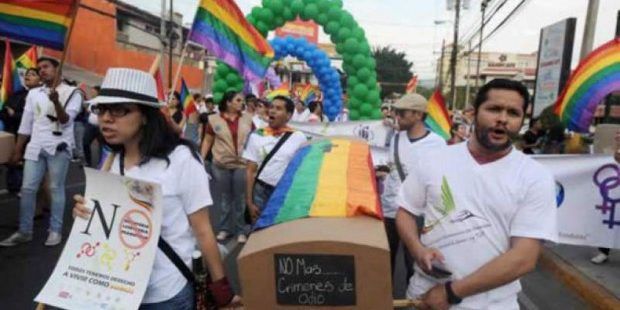
SAN SALVADOR – At least 1,300 murders of LGBTI people have been committed in the last five years in Latin America, averaging four homicides per day, according to a report that is alarming human rights organizations. The study, “Prejudice Knows No Borders,” presented by the LGBTI Violence-Free Observatory, compiles statistical data on murders committed in nine countries: Colombia, Mexico, Honduras, Peru, El Salvador, the Dominican Republic, Guatemala, Paraguay, and Bolivia.
“We face issues of the normalization of violence throughout the region, and this is an undeniable fact. Many people justify the conditions in which LGBTI people die by saying that we bring them on ourselves and, in particular, that we deserve them. No one deserves to die that way, no one deserves to live with violence, and no one deserves to live with their rights violated,” said Carlos Romero, secretary of the Guatemalan National Network for Sexual Diversity.
[READ ALSO: Trans activist Bessy Ferrera murdered: fifth hate crime this week]
The regional observatory indicates that the country with the highest number of murders of LGBTI people over a five-year period was Colombia, with 542 homicides; followed by Mexico with 402 cases and Honduras with 164.
The list also includes data from Peru with 57 murders; El Salvador with 53; the Dominican Republic with 28; Guatemala with 26; Paraguay with 12; and Bolivia with 8.
“We found a downward trend in the region (…) Most of the cases involve people between 18 and 25 years old, which we find alarming,” said David Alonzo of the Colombia Diversa team.
The organizations indicated that they have preliminary projections from the Brazilian Association ANTRA, which suggest that 1,650 people from the LGBTI community were murdered during the same period, an average of one homicide per day.
The majority of the victims were gay men and transgender women, and it was determined that 30 percent of the crimes were motivated by prejudice. According to the study, the murders were motivated by the victims' sexual orientation and gender identity.
The use of firearms predominates in these crimes; however, murders of gay and bisexual men are committed with bladed weapons and by hanging. Meanwhile, transgender, bisexual, and lesbian women are mostly murdered with firearms.
“LGBTI people continue to face stigma. Many families almost celebrate our disappearance from this world to avoid continuing to face the stigma they have lived with their entire lives. We die in silence, in denial, we die in invisibility,” Romero pointed out.
The most dangerous places for LGBTI people are the street and their homes. The data collected indicates that 80 percent of the victims' bodies were found in open public spaces and in their private residences. It is noteworthy that trans women and lesbians were attacked in open spaces, while attacks on gay men were committed in their homes.
Activists maintain that the radicalization of religious and ultra-conservative discourses, as well as the militarization of state security, as in the cases of Brazil, Colombia, and El Salvador, is promoting these acts.
Northern Triangle of Central America
The so-called Northern Triangle of Central America, made up of Guatemala, Honduras, and El Salvador, is one of the most difficult territories for diverse populations because in this conservative region alone, 243 crimes were committed.
The study indicates that 63 LGBTI people murdered in this region were between 13 and 15 years old; 95 were between 18 and 25 years old; and 164 were between 26 and 30 years old.
Organizations that make up the observatory believe that the number of crimes committed against the LGBTI population continues to rise, and governments still have not defined effective protection policies to prevent, investigate, and punish the murders.
“It is time to leave this impunity behind and for LGBTI people to begin accessing justice. We know that in many countries of the region, especially Guatemala, El Salvador, and Honduras, which are the three most violent countries in the Northern Triangle for LGBTI people,” Bianka Rodríguez, director of COMCAVIS TRANS, told Presentes.
Share
We are present
We are committed to journalism that delves into the territories and conducts thorough investigations, combined with new technologies and narrative formats. We want the protagonists, their stories, and their struggles to be present.
SUPPORT US

FOLLOW US
Related notes

We are present
This and other stories are not usually on the media agenda. Together we can bring them to light.