

Presidential candidates speak out against LGBT+ and women's rights
At the request of the National Evangelical Movement of Pastoral Action (Menap), candidates Sandra Torres (UNE) and Alejandro Giamattei (VAMOS) expressed their support for initiative 5272.

Share

By Pilar Salazar, from Guatemala City.
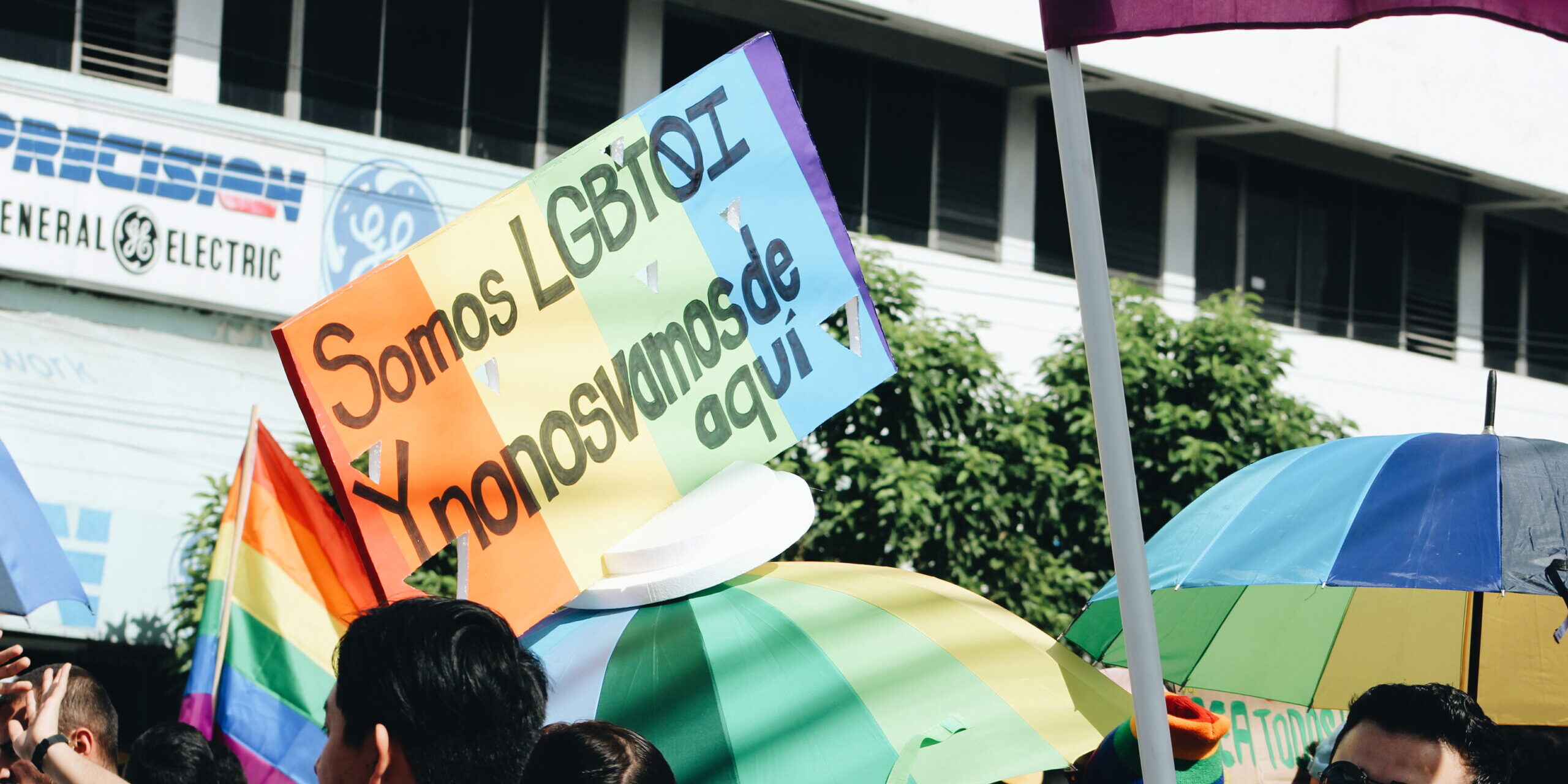
Photo: Celeste Mayorga/archive. Presentes. Days before the runoff election on August 11 to choose the next president of Guatemala, candidates Sandra Torres (of the UNE political party) and Alejandro Giamattei (VAMOS) openly expressed their support for an anti-rights bill: Initiative 5272. This has put LGBT+ people on alert and concerned, as their vulnerability to violence has already been denounced at the regional level. Torres and Giamattei received the most votes in the first round on June 16, but did not reach the majority (more than half) needed to win the presidency. The National Evangelical Movement for Pastoral Action (MENAP)—which unites and provides fiscal, legal, political, and social advice to evangelical churches and pastors—called on candidates on July 30 to openly express their opposition to gender ideology . This was done through a statement in which they requested " that presidential candidates openly express their opposition to gender ideology and any legislative initiative that seeks to introduce ideas harmful to family stability in our beautiful country, and that they support the approval, in its third reading, of Bill No. 5272, the Law for the Protection of Life and Family."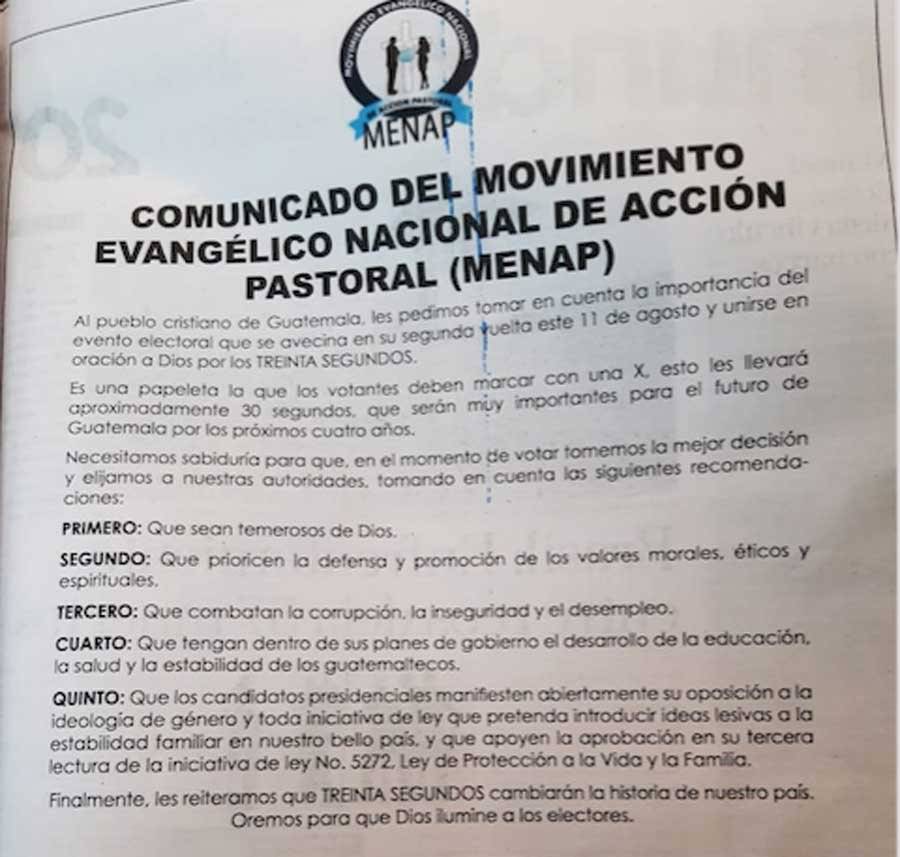 The organization ILGALAC and the Guatemalan National Network for Sexual Diversity and HIV analyzed the candidates' proposals regarding the human rights of sexual diversity in the Report of the Electoral Observatory for #LGBTI Rights and reached the following conclusions: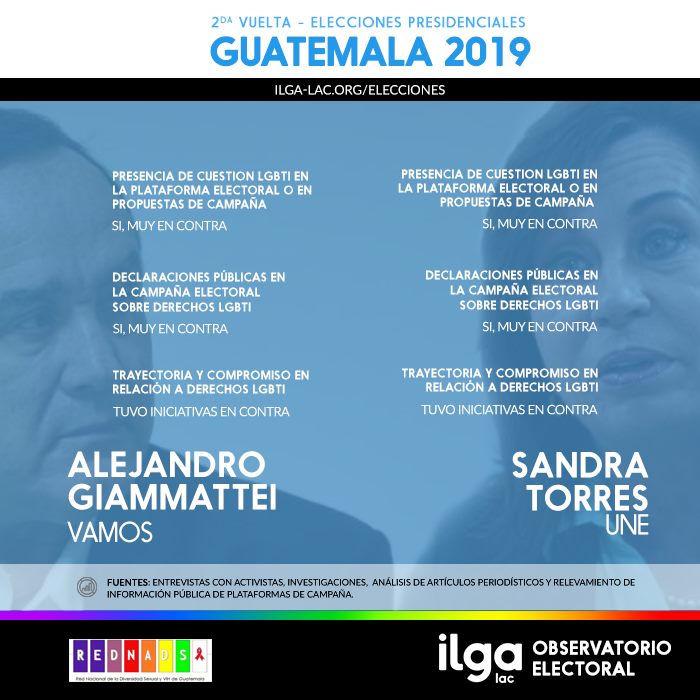
Why Initiative 5272 is unconstitutional
Bill 5272, "Protection of Life and Family," was drafted by the National Committee for the Defense of Human Rights (MENAP) in coordination with a group of members of Congress. It was received by the full Congress for a favorable opinion on February 26, 2018. In May of this year, it was returned to Congress after undergoing minor modifications. Bill 5272 directly threatens the already violated rights of LGBTI people and women. Among other things, it prohibits any public or private educational institution from promoting sex education programs; condemns any content related to sexual diversity and what they call "gender ideology"; reaffirms the prohibition of same-sex marriage; and penalizes women who have abortions and prohibits the "teaching as normal" any behavior other than heterosexuality.READ MORE: #Guatemala Alert over a law against the rights of women and LGBTI people
The candidates' responses
Torres and Giammattei responded quickly. The presidential candidate posted a statement on her social media accounts expressing her support for the demands of the National Menap (MENAP). She stated that she would do everything possible to ensure the passage of Bill 5272, "Protection of Life and Family." For his part, candidate Giammattei expressed his rejection of "any initiative that threatens the family." Edgar López, press spokesperson for the UNE party, told this publication that he could not comment because he is neither an authority figure nor a member of parliament. López stated that the statement was issued in a personal capacity by presidential candidate Sandra Torres and that its content aligns with the party's position. The press spokesperson provided contact information for the party's congressional leader, Orlando Blanco, with whom attempts to contact him were unsuccessful. When asked by Presentes about the position of candidate Giamattei, the press spokesperson for VAMOS, Víctor Valenzuela, stated that only the presidential candidate could comment on the statement. This publication did not receive a response after attempting to contact him by phone.
“It violates sexual diversity and women”
Aldo Dávila, an openly gay congressman-elect and member of the Winaq party, believes that the Menap statement was sent in some way to coerce and pressure the two presidential candidates. He added that this action “not only harms sexual diversity, but also women, children, and youth, because these are issues covered by proposed law 5272.”READ MORE: Guatemala's Congress will have its first openly gay representative
Luis Hernández, another openly gay congressman elected to the Central American Parliament by the Semilla party, declared his complete rejection of candidates using the LGBTIQ+ community as “electoral currency.” He invited other elected representatives to join the protests. Hernández took the opportunity to express his position within the context of negotiations for Guatemala to become a “safe third country,” arguing that negotiations cannot be conducted behind the backs of the public regarding asylum applications. “The struggle in the streets brings us closer to our brothers and sisters,” he said.READ MORE: Guatemala adds two gay congressmen: progress and impacts
Misogynistic and LGBT-hating election campaign
Ana Silvia Monzón, sociologist, analyst and feminist, analyzed: “Throughout the election campaign, an openly misogynistic and homophobic discourse has prevailed. The candidates, whether out of conviction or convenience, have yielded to the demands of fundamentalist groups to publicly declare themselves 'defenders of family values,' which in practice means being intolerant of the diversity of existing families, defending an extreme patriarchal order, and limiting the rights already won by women and the LGBTQ+ community.”. Monzón reiterated that Bill 5272 is unconstitutional. If passed, it would violate existing rights and further criminalize abortion and prohibit sex education. “The State has the obligation to ensure that all citizens enjoy their rights, protecting their lives and safety. When candidates for election support initiatives like Bill 5272, they not only ignore their obligations but also endanger the entire community,” stated the organization Visibles. The ten representatives sponsoring this initiative are Fernando Linares Beltranena (PAN), Adim Maldonado (FCN), María Stella Alonzo (Independent), Sandra Patricia Sandoval (FCN), Javier Hernández (FCN), Juan Ramón Lau Quan (TODOS), Carlos Enrique López Maldonado (UNE), Juan Manuel Díaz-Durán Méndez (VIVA), and Estuardo Gáldamez (FCN), led by Aníbal Rojas (VIVA), who chairs the Women's Commission in the Chamber of Deputies. The members of parliament who introduced the initiative are trying to win the votes of Catholic and Evangelical parishioners by sacrificing education on sexual and reproductive rights for women and young people, and by prohibiting open discussion of sexual diversity in educational centers.We are present
We are committed to journalism that delves into the territories and conducts thorough investigations, combined with new technologies and narrative formats. We want the protagonists, their stories, and their struggles to be present.
SUPPORT US

FOLLOW US
Related notes


We are present
This and other stories are not usually on the media agenda. Together we can bring them to light.