

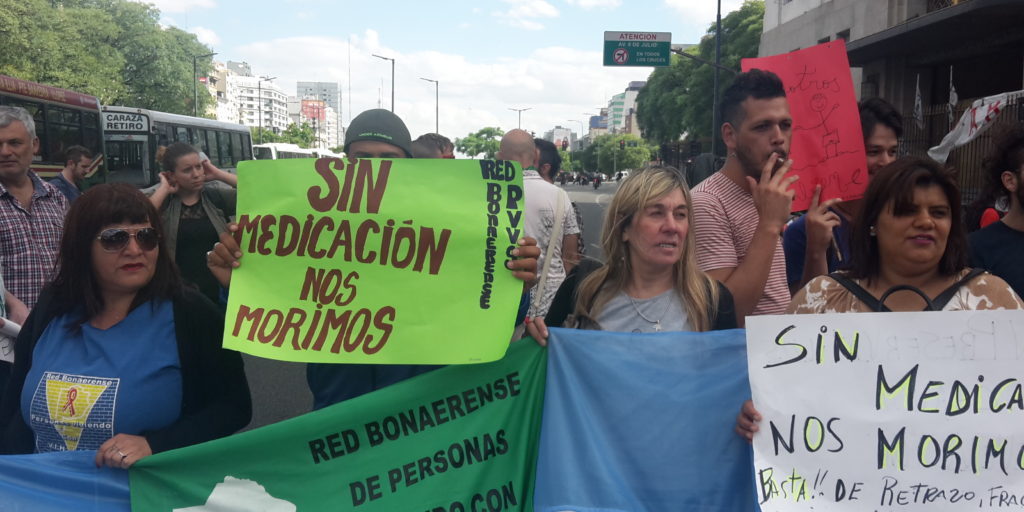
They denounce shortages of HIV medication: “It’s a critical situation”
People living with HIV report that some antiretroviral medications are not being dispensed in public hospitals in Argentina.

Share

By Alejandra Zani.
People living with HIV are reporting that some antiretroviral (ARV) medications are not being dispensed in public hospitals. In response, the Fundación Grupo Efecto Positivo (GEP) released a document detailing the situation and highlighting the lack of planning in medication purchases, which will lead to further shortages.
Following a formal request from the GEP Foundation, the National AIDS Directorate released data on medication purchases for people living with HIV over the past year. The analysis reveals that efavirenz and the darunavir/ritonavir and tenofovir/emtricitabine/efavirenz combinations, used by the 86,338 people with HIV currently undergoing antiretroviral treatment in Argentina, have been out of stock since June.
“We are facing a critical and extremely serious situation of medication shortages that could escalate to the unavailability of another 15 antiretroviral drugs starting in August. The AIDS Directorate will have to find a solution to address the urgent needs of the 15,000 people who will be affected,” announced José María Di Bello, president of the GEP Foundation, to Presentes. “Opening a purchase order for the 15 missing drugs can take between six and seven months if it's a direct purchase, much longer if a public tender is required, and then you have to add the time it takes to distribute the medications throughout the country.”
According to Di Bello, the situation has reached a new level of severity because not only is there a shortage of medications, but to this day, no purchase orders have even been initiated. “This situation has been going on for the last 4 years. In 2018 they tried to transfer the purchase of medicines to the provinces, which do not have sufficient budgetary resources to take charge of the purchase of antiretrovirals and with the inequality of access to medicines between provinces that this would mean, but we stopped it by taking to the streets.”

Chart published by the GEP Foundation
No response from the AIDS Directorate
So far, the National AIDS Directorate has yet to respond. “This must be understood within the context of cuts to public health as a political decision. Viral load and CD4 tests, which we need to have done every four months to check our viral load, have been discontinued for two years,” says the foundation's president. “If shortages continue in four years, if three National AIDS Directors resign, if vaccines are lacking and community health programs are being gutted, it's clear what kind of public health system they're choosing for the country. We're heading toward the privatization of public health, and the consequence is that the health of a large number of people will be affected.” Thanks to the work of Observatory of Access and Public Procurement It was discovered that medications continue to be purchased from multinational companies at dollar-denominated prices. “When the Ministry of Health was dissolved and the Secretariat was created within the Ministry of Development, the budget for the AIDS Directorate was adjusted by 40%, taking into account the dollar exchange rate at the time the project was debated, which was $19,” explains Lorena Di Giano, Executive Director of the GEP Foundation.Considering a dollar above $40, the AIDS Directorate needs 5.2 billion pesos and the budget contemplates 3.1 billion, 2 billion pesos less.”[READ ALSO: March against cuts in Public Health: there are already shortages of HIV medication]
Last October, during the debate on the 2019 budget for the AIDS Directorate, the Foundation denounced that, if approved, more than 15,000 people would be left without treatment. As Di Giano explains, the consequences of these policies are already being felt. “People are going to hospitals and health centers where they are being treated and are being given their medication in installments.” Of the 120,000 people living with HIV in Argentina, the 2018 epidemiological bulletin from the former Ministry of Health reported that 7 out of 10 receive care through the public health system. “Furthermore,” Di Giano continues, “doctors are being forced to change the drugs in patients' treatments for others that are available, but changes from one cocktail to another should only be made based on purely clinical criteria, because the doctor believes the patient needs to change due to adverse effects, or because it could have serious consequences. There are also complaints about shortages in private health insurance plans.”
Poster posted in the pharmacy of the Muñiz Hospital
"If we don't have access to medication, the virus replicates."
“The treatments available for people with HIV are limited, and if a treatment is stopped, it may no longer be effective for that person,” says Matías Muñoz, a member of the Ciclo Positivo Association. “People with HIV need access to medication because otherwise the virus replicates and can develop resistance to that treatment and to the entire family of medications. That's why it's so serious when someone doesn't have access to their medication or has it switched to another one.” Today, Argentina operates under an AIDS law dating back to 1990 that obligates the State to ensure that all healthcare systems can provide HIV-positive individuals with the necessary medications free of charge. “Since 2016, we have been proposing an amendment to this law to also guarantee that the State promotes the public production of medication so that it cannot use budget constraints or a lack of foresight in procurement as an excuse. Currently, as data published by the GEP Foundation shows, there is no transparency in these figures. Had the HIV bill been approved, it would have benefited countless people.”[READ ALSO: A new comprehensive HIV project was presented in the City of Buenos Aires]
For Camila Arce, a member of the Positive Roundtable of Rosario, the 1990 law was very progressive for its time, but it didn't address the quality of life of people living with HIV. “The law only addressed access to medication, even though there weren't enough medications available at the time. But there are certain gaps and shortcomings regarding rights. The new bill was written, designed, and amended by people living with HIV from all over the country and is framed within a human rights approach with a focus on quality of life.” “When a person with HIV runs out of medication, which is what’s happening now, they’re afraid. And that’s perfectly understandable. There’s price gouging in the market when it comes to medications, and when you go to the pharmacy, they give you half of half of the medication, or they change your regimen because they don’t know if there will be medication available in two weeks, and that puts our health at risk,” she adds. “We lose a quality of life that took us a long time to achieve.” ]]>We are present
We are committed to journalism that delves into the territories and conducts thorough investigations, combined with new technologies and narrative formats. We want the protagonists, their stories, and their struggles to be present.
SUPPORT US

FOLLOW US
Related notes

We are present
This and other stories are not usually on the media agenda. Together we can bring them to light.