

#Pride2019 Massive march in Santiago and repression in Quillota
More than 100,000 people took to the streets of Santiago. There was repression and arrests in Quillota.

Share

By Airam Fernández, from Santiago
Photos: Josean Rivera
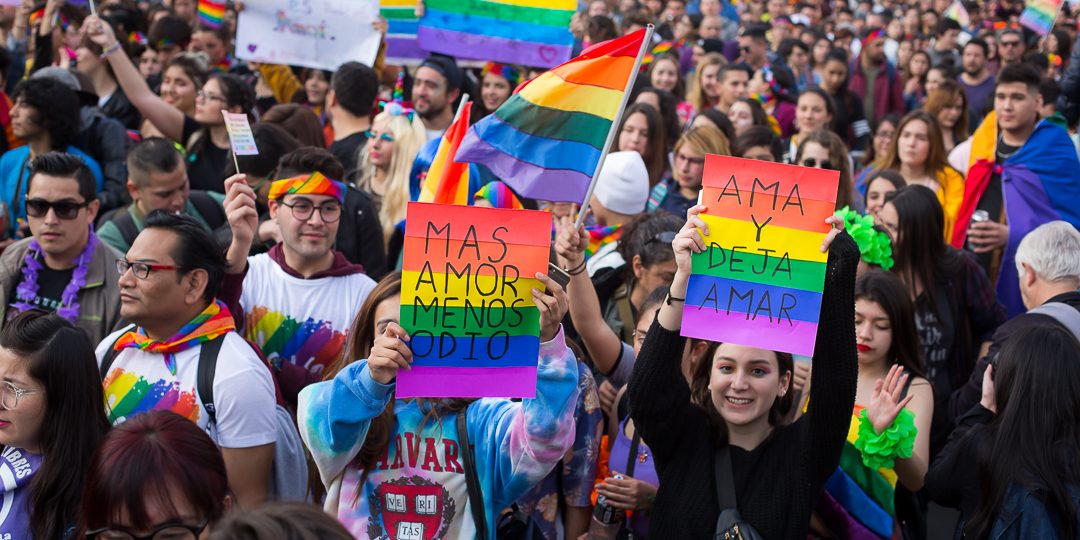
More than 100,000 people took to the streets of Santiago this Saturday to commemorate the 50th anniversary of Pride Day and demand a more just and equal Chile for all its inhabitants. In Quillota, where protesters were demanding progress in the case of the hate crime against Nicole Saavedra Bahamondes, who was murdered at age 23, the day ended with police repression and the arrest of 15 women, including the victim's cousin.

The cry to end violence against lesbians, gays, bisexuals, trans and intersex people was echoed by most of the attendees, in a context where attacks on the community increased by 44% in the last year, according to the XVII Annual Report on Human Rights of Sexual and Gender Diversity by Movilh.
“Beatings and attacks have increased by an alarming 1500%, and murders by 50%. The abuses are extreme. We know of 44 fatalities since 2002, the year we began preparing our human rights report,” said Rolando Jiménez, leader of the organization that celebrated its 28th anniversary yesterday and convened the demonstration for the 19th consecutive time, in conjunction with the Iguales Foundation.


Diverse families
Equal marriage, the reconsideration of including children in the recently approved Gender Identity Law, and the prompt approval of same-sex adoption, currently under legislative review, were the themes of signs and slogans used during the nearly four-hour demonstration, led by the Selenna Foundation. Selenna is the first transgender child in Chilean history, and this organization is a pioneer in the fight for the rights of transgender children.


 LGBTI brothers and sisters from indigenous communities, discriminated against
 LGBTI brothers and sisters from indigenous communities, discriminated against
 In the midst of the march, Claudia Ancapán, a trans and Mapuche activist, told Presentes that these demands are part of a necessary cultural shift for Chile. But in her view, it won't be possible without a “deeper” effort to open minds. “ This change has to go hand in hand with all sectors of society, without neglecting our LGBTI brothers and sisters from Indigenous communities who face discrimination .”
Justice for Nicole Saavedra
 Justice for Nicole Saavedra
The demand for justice in the face of hate crimes that remain unpunished, such as that of Nicole Saavedra, a young lesbian murdered at age 23 and whose death remains unpunished, was one of the reasons for the intervention of Fundación Iguales, to remember the 43 victims of violence from the LGBTI community that have been registered in the country to date.
Dissent within dissent

Nicole's hate crime also spurred a group of activists to organize the "Dissident March for Memory." The group closed the rally and was joined by some political leaders, such as Representatives Camila Vallejo and Karol Cariola.

Theater students from the Arcos Professional Institute also joined this final column, with a performance about mourning. “For some time now, we've been thinking that marches are just about celebrating and partying, and we didn't agree with that. That's why we decided to come out this way, to say enough to the celebration, to reflect on how necessary it is to return to the struggle, and to be a bit of a dissident among the dissidents,” said Marcelo Gutiérrez, one of the creators of the performance.
Repression and arrests in Quillota
While the demonstration in Santiago proceeded without incident, activists and family members of Nicole Saavedra marched in Quillota to demand justice three years after her murder. The march reached the city's Prosecutor's Office, aiming to draw the attention of prosecutor Ulises Meneses, who has been in charge of the investigation since March. The idea was to exert pressure, through this and other actions, to get him to provide concrete answers and expedite the case, Nicole's cousin, María Bahamondes, told Presentes a few days ago.
As of the time of this report, the prosecutor had not yet made a statement. The march ended with police repression and the arrest of 15 women, including Bahamondes, according to the Chilean Network Against Violence Against Women, an organization that has been providing legal support to the family for the past three years.

Ten of the detained activists were released last night. María Bahamondes and four other women remained in custody Sunday morning at the 4th Police Station in Quillota. They are accused of damaging a door that cracked when police officers forcibly removed them from the Prosecutor's Office, according to Silvana del Valle, the family's lawyer.

The arraignment hearing is expected to take place at 10:30 this Sunday. " The same prosecutor handling Nicole's case will be arraigning these women, while the murderers remain free ," del Valle complained.

We are present
We are committed to journalism that delves into the territories and conducts thorough investigations, combined with new technologies and narrative formats. We want the protagonists, their stories, and their struggles to be present.
SUPPORT US

FOLLOW US
Related notes



We are present
This and other stories are not usually on the media agenda. Together we can bring them to light.